Frequency Electronics (FEIM): Supplier dynamics that drive timing and value
Frequency Electronics (FEIM) designs, manufactures and sells precision frequency and time-control products to defense primes and specialized commercial customers, monetizing through direct product sales and program-level contracts where timing components are integrated into radar, EW and space systems. FEIM’s revenue is driven by long-cycle, high-certification programs where its oscillators and timing standards are embedded into higher-value platforms, making supplier relationships and qualification timelines central to throughput and margins. For an operator or investor assessing supplier exposure and counterparty risk, the intersection of defense prime demand and limited upstream sources defines both opportunity and operational fragility.
Learn more about supplier intelligence at NullExposure: https://nullexposure.com/
Why timing suppliers are strategically important right now
FEIM sits at the confluence of two secular trends: the acceleration of Space 2.0 programs and renewed defense spending on electronic warfare and sensor modernization. Timing and synchronization components are low-volume but high-importance parts — they command premium pricing, long qualification cycles, and tight integration with prime-contractor architectures. FEIM converts engineering differentiation (precision time) into recurring revenue by winning design-ins with primes and delivering certified, space-qualifiable parts.
From a capital markets perspective, FEIM is a small-cap specialist: market capitalization roughly $469M with trailing revenue near $67.8M, healthy gross margins and positive EPS, but valuation multiples indicate premium expectations (Trailing PE ~65.7; Forward PE ~14.2). These numbers support a thesis where revenue growth must sustain premium multiple expansion while operational execution depends on supplier and prime-contractor dynamics.
Who the company is supplying — the relationships that matter
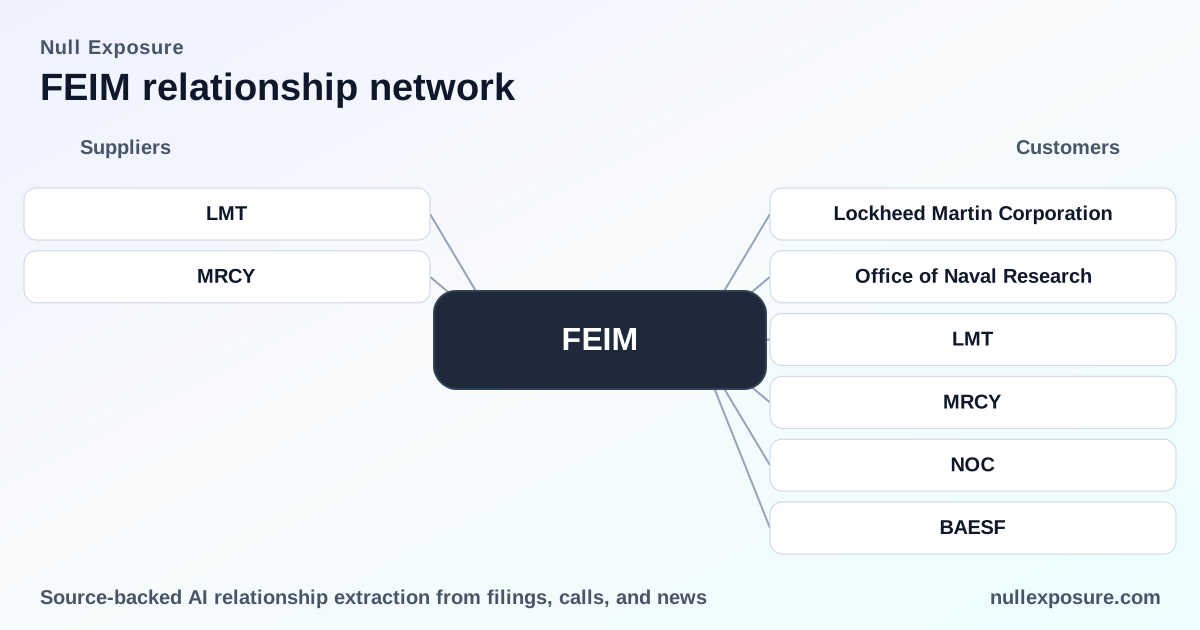
Below are the supplier/customer relationships surfaced in public coverage and their practical implications.
Lockheed Martin — timing supplier to a prime
A FinancialContent MarketMinute article published January 8, 2026 identified FEIM as a primary supplier of timing standards to Lockheed Martin, positioning FEIM as a bellwether for space and defense supply-chain health. This relationship signals direct program-level exposure to a major prime and reinforces FEIM’s role in mission-critical assemblies (FinancialContent, MarketMinute, Jan 8, 2026).
Mercury Systems — enabler for advanced sensor processing
The same MarketMinute piece noted Mercury Systems' renewed adoption of AI-driven sensor processing units that require the exacting timing FEIM supplies, linking FEIM to modern EW and sensor suites through subsystem OEMs such as Mercury Systems. This connection highlights FEIM’s downstream relevance in high-growth RF and sensor markets (FinancialContent, MarketMinute, Jan 8, 2026).
What the constraint signals say about FEIM’s operating model
FEIM’s publicly reported constraints reveal company-level characteristics that shape procurement, contracting posture, and execution risk:
- Supplier concentration and criticality: FEIM is dependent on a limited set of vendors for space-qualified parts, which creates a material constraint on delivery speed and cost. When alternative suppliers are not feasible to qualify quickly, lead times and program delays follow — this elevates operational leverage to supplier performance.
- Buyer posture: FEIM operates as a buyer of specialized electrical components and materials, meaning procurement negotiating leverage is bounded by the availability of certified suppliers and the technical specificity of parts.
- Contracting and qualification maturity: The business operates in a mature, qualification-driven market where switching costs and requalification timelines are lengthy; program revenue is durable once design-in is achieved, but ramping new suppliers or shifting architectures is slow and costly.
- Concentration risk as strategic signal: High dependence on a few primes and few upstream suppliers concentrates revenue and execution risk; however, it also insulates pricing power for truly differentiated, space-rated timing products.
These constraints are company-level signals extracted from regulatory and public disclosures and should shape how investors stress-test scenarios for growth, margin, and working capital.
What this means for investors and operators
- Operational fragility is real but manageable. FEIM’s specialization gives it pricing power in certified markets, yet that same specialization raises the cost of supplier disruption. For operators this prioritizes supplier qualification programs and dual-sourcing where possible; for investors it elevates the importance of order backlog visibility and prime-contractor wins.
- Upstream and downstream concentration drives volatility and optionality. Being a primary supplier to Lockheed Martin and a component supplier feeding Mercury Systems’ subsystems links FEIM to large program tails — both a revenue stabilizer and a single-point-of-failure if program awards change.
- Valuation trades on program wins and execution. The market is pricing growth (high trailing PE, lower forward PE) while expecting successful integration into next-gen space and EW systems; delivery and supplier resilience will determine whether multiples re-rate upward.
For monitoring exact supplier exposure and contract-level information, visit NullExposure for structured supplier intelligence: https://nullexposure.com/
Practical takeaways and portfolio actions
- For active investors: prioritize due diligence on program backlog, supplier qualification timelines, and any public contract awards with primes such as Lockheed Martin. These are the leading indicators of near-term revenue realization.
- For operators: invest in supplier diversity and qualification capacity to reduce the single-supplier risk that regulatory excerpts highlight; that is a direct lever on on-time delivery and margin stability.
- For both audiences: track prime-contractor program schedules and subsystem wins at Mercury Systems and Lockheed Martin as leading demand signals for FEIM’s timing products.
Explore supplier intelligence and monitoring tools that surface this kind of counterparty-level insight at NullExposure: https://nullexposure.com/
Final assessment: concentrated exposure, high strategic value
Frequency Electronics is a specialist supplier whose economics depend on being embedded into mission-critical platforms. The combination of premium pricing for certified timing devices and concentrated supplier and customer relationships creates both upside — in the form of durable program revenue — and downside in execution risk if qualification or upstream supply falters. Investors should weigh program pipeline clarity and supplier qualification progress as primary drivers of valuation, while operators should prioritize supply-chain resilience and dual-sourcing where technically feasible.
If you want ongoing tracking of FEIM’s supplier and prime-contractor footprint, NullExposure provides the counterparty visibility and alerts that investors and procurement teams need: https://nullexposure.com/