Fennec Pharmaceuticals (FENC): supplier posture, partner risk, and commercial implications for investors
Fennec Pharmaceuticals commercializes PEDMARK for oncology indications and monetizes through product sales and licensing while outsourcing critical manufacturing and distribution functions. The company operates a capital-light commercialization model: clinical and commercial manufacturing is handled by third parties, distribution is routed through external partners, and revenues reflect a small but growing commercial footprint (Revenue TTM $38.79M; Gross Profit TTM $36.12M). For investors and operator teams, the economics are straightforward — revenue comes from the drug on the market, while the cost and execution realities are concentrated in outsourced supply and distribution relationships. Learn more about Fennec supplier intelligence at https://nullexposure.com/.
How Fennec runs its business and why suppliers matter
Fennec is a small-cap biotech headquartered in Research Triangle Park that has chosen an outsource-first operating model. The company does not own manufacturing capacity and has contracted both an API supplier and contract manufacturers for vial production of PEDMARK; it also relies on third-party distributors to commercialize and deliver product globally. These choices drive a set of predictable business-model characteristics:
- Contracting posture: Fennec is a buyer of specialist services (manufacturing, API supply, distribution) rather than an operator of production assets. That reduces fixed capital needs but increases dependency on contractual counterparties for quality, supply continuity, and compliance.
- Concentration and criticality: A limited number of manufacturing and distribution relationships create single-point supply risks that would materially affect revenue if disrupted; supply partners are operationally critical to product availability.
- Maturity and scalability: Outsourcing accelerates market entry and scales without heavy capital expenditure, but it also transfers margin control and some regulatory risk to suppliers.
- Commercial signal: Financials through the latest quarter (9/30/2025) show positive gross margins on reported revenue, indicating current commercial sales of approved product; however, EBITDA remains negative, underscoring investment in commercialization and R&D.
These operating constraints are disclosed in company materials describing reliance on third-party distributors and contract manufacturers, and they should be treated as company-level signals when modeling supplier exposure.
Every reported external relationship (full coverage)
Below I cover every supplier/partner mention in the data set provided.
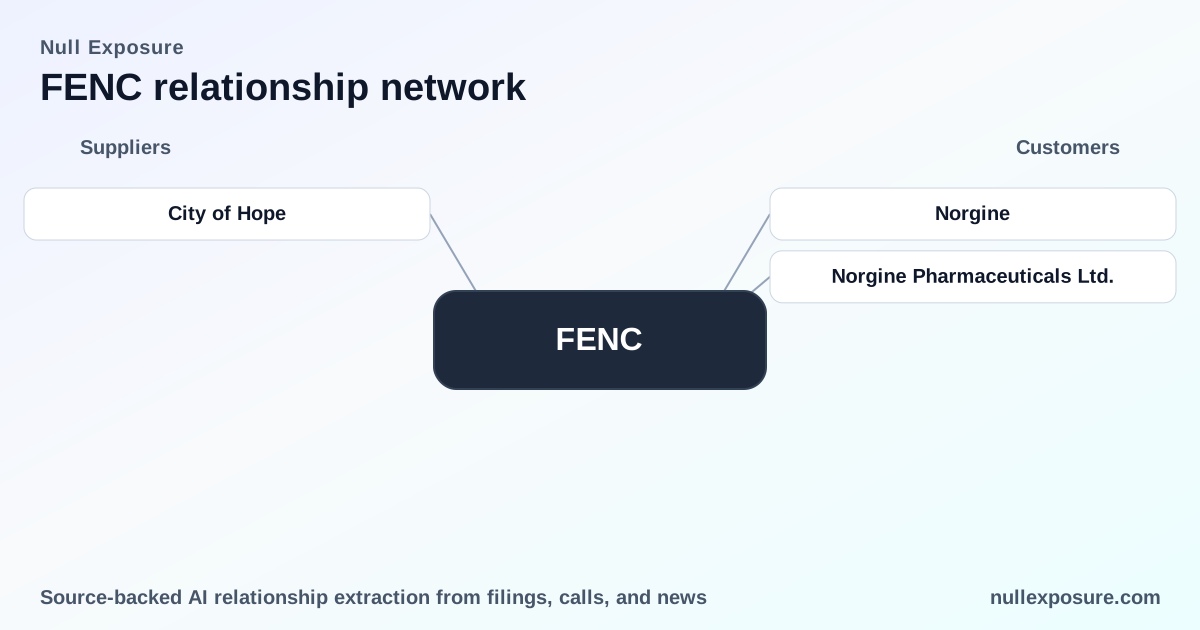
City of Hope — clinical study partner
City of Hope is conducting a clinical study of PEDMARK in California as reported in March 2026, which positions the research center as a clinical investigator rather than a commercial supplier; this engagement extends clinical validation and could support future label expansion. The report was noted on TradingView on March 9, 2026. (Source: TradingView news post, March 9, 2026 — tradingview.com/news/…fennec-pharmaceuticals-inc-initiates-clinical-study-on-pedmark)
What these relationships imply for valuation and operational risk
The City of Hope relationship is a clinical collaborator rather than a manufacturing or distribution counterparty; nonetheless, clinical partnerships matter because trial outcomes drive label expansion and future revenue potential. The more consequential supplier signals are company-level: Fennec explicitly depends on third-party distributors and contract manufacturers for commercial supply.
- Revenue sensitivity: With sales concentrated on a single marketed product, any supply disruption from a contract manufacturer or distributor would cause immediate revenue volatility. Fennec’s gross margin profile suggests product sales are profitable at the unit level, but top-line continuity depends on third parties.
- Counterparty credit and capacity: Suppliers’ financial health and capacity constraints are determinants of Fennec’s ability to meet demand, particularly for scaling beyond current levels. Long-term contracts with favorable terms would mitigate, while short-term spot arrangements elevate risk.
- Regulatory and quality control: Outsourcing manufacturing transfers regulatory exposure to partners; robust quality oversight and redundancy in suppliers reduce the risk of supply-interrupting recalls or refusals to release lots.
Key operational takeaway: The company’s commercial trajectory is limited more by supplier execution and contracting than by internal manufacturing economics.
Learn how supplier relationships change risk-adjusted valuations at https://nullexposure.com/.
Practical guidance for investor diligence and supplier managers
For investors assessing Fennec and for operators managing these relationships, focus on the following action items:
- Request and review contract tenors and termination clauses with major manufacturers and distributors; short notice or limited-term agreements increase business risk.
- Verify multi-sourcing plans for API and vial production and assess the geographic concentration of manufacturing (single-facility exposure is high risk).
- Monitor clinical partnerships (like City of Hope) as leading indicators of label expansion and longer-term revenue upside; trial design and timelines materially affect projection horizons.
- Stress-test cash flow models for supply interruption scenarios given the company’s negative EBITDA and the need to sustain commercialization investments.
Final assessment and investor implications
Fennec’s business model is capital-efficient but supplier-dependent. The company demonstrates commercial traction (Revenue TTM $38.79M; Gross Profit TTM $36.12M) alongside unresolved operating losses (EBITDA negative $4.33M), which is consistent with an emerging commercial-stage biotech that outsources manufacturing and distribution. For investors, upside is linked to successful clinical progress and stable supplier execution; downside is concentrated in contract-counterparty failures or regulatory interruptions.
If you are evaluating supplier counterparty risk or structuring diligence, start with contract terms, supplier capacity, and redundancy planning. For deeper supplier intelligence and comparative analysis across biopharma suppliers, visit https://nullexposure.com/.
Concluding takeaway: Fennec’s outsourced operating model enables lean commercialization but concentrates risk in a handful of supplier and distribution relationships; monitoring those contracts and clinical collaborations like City of Hope is essential to any investment or operational thesis.