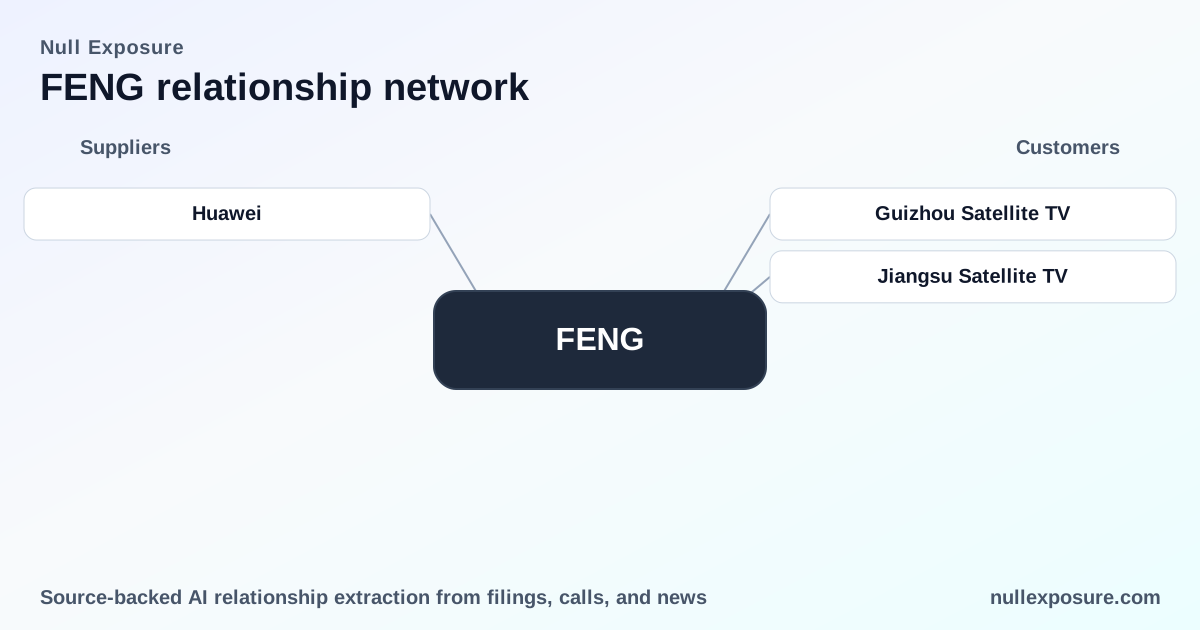
Phoenix New Media (FENG) — Supplier Landscape and the Huawei Connection
Phoenix New Media operates an integrated internet content platform in China, monetizing primarily through advertising, content licensing, and platform distribution partnerships that drive audience scale and ad yield. The company reported roughly $765.6 million in trailing revenue and a $374.1 million gross profit base (latest quarter 2025-12-31), while operating margin stands at 11% even as EBITDA registers a small negative, reflecting reinvestment and product development. For investors and operators, the core commercial dynamic is straightforward: scale of distribution plus differentiated content features equals advertising and platform monetization. Explore full supplier intelligence at https://nullexposure.com/.
How Phoenix makes money and why supplier ties matter
Phoenix New Media is a content-first platform. Its economics depend on three linked factors: audience reach, content exclusivity/depth, and distribution channels that embed Phoenix into device ecosystems and third-party apps. The company’s reported financials show material top-line scale but compressed net profitability, indicating that distribution partnerships and product feature investments are central to revenue growth and margin recovery.
Key business-model characteristics:
- Contracting posture: The combination of co-development with device partners and app placement deals indicates Phoenix negotiates collaborative commercial agreements rather than simple reselling or licensing arrangements.
- Concentration and criticality: Distribution partnerships with OEMs or platform owners are strategically critical because they directly affect user acquisition and ad monetization; a small number of upstream platform deals can therefore move revenue materially.
- Maturity: Financials show an established content business with operating profitability at the margin level but continued investment in product features (e.g., AI) that compress EBITDA in the short term.
These operating dynamics make supplier relationships more than procurement line items — they are revenue levers and product accelerators. If you want deeper, structured supplier intelligence for investment workstreams, visit https://nullexposure.com/ for a full view.
The recorded supplier relationship: Huawei
Phoenix’s public record includes a strategic cooperation with Huawei centered on distribution and product co-development. According to an earnings-call transcript posted on InsiderMonkey in March 2026, Phoenix’s news app was showcased as a premium application at a Huawei product launch, and the companies co-developed an AI news feature with Huawei’s Xiaoyi team, followed by the launch of a Phoenix TV highlights app on Huawei platforms. This is a distribution-and-product partnership that combines placement benefits with joint feature development (InsiderMonkey, March 2026).
Why the Huawei tie matters operationally
The Huawei partnership is both distribution- and product-focused, and that duality drives several concrete operational consequences:
- Distribution uplift: Being showcased on Huawei’s product events and embedded within HarmonyOS positions Phoenix to capture incremental active users without proportional incremental marketing spend, directly supporting ad load growth.
- Product differentiation: Co-development of AI features with Huawei’s Xiaoyi team accelerates Phoenix’s roadmap on personalization and short-form video highlights, which are high-value features for advertiser targeting and session depth.
- Concentration risk: Reliance on any single OEM placement introduces exposure: if the relationship changes, distribution and feature co-marketing could roll back quickly.
- Commercial leverage: Joint development implies revenue-sharing or promotional commitments; these contractual terms typically favor longer-term retention but can compress margins during integration phases.
These effects are material for operators evaluating supply-chain resilience and for investors modeling monetization curves from platform placements.
Constraints and company-level signals
There are no supplier constraint excerpts recorded in the available records, which is itself a signal: the company currently publishes no supplier-side covenant restrictions or disclosed dependency thresholds in the reviewed materials. That absence indicates a flexible contracting posture in supplier relationships and suggests Phoenix relies on commercial partnership terms rather than rigid, contractually constrained supply chains. For due diligence, that means examine the economic terms of distribution deals (placement length, exclusivity, revenue share) rather than expect protective supplier-side covenants.
What to monitor next — tactical checklist for investors and operators
- Track ongoing HarmonyOS placement: confirm whether Phoenix remains a featured app across Huawei device rollouts and firmware updates, since placement directly affects monthly active users and ad impressions.
- Measure AI feature adoption: assess engagement metrics (time-on-content, click-through, video completion) for the Xiaoyi co-developed features to estimate CPM uplift.
- Watch for broader OEM deals: a single OEM relationship is valuable but not sufficient; additional platform relationships reduce concentration risk and increase addressable distribution.
- Review filings for contractual disclosure: any future filings that disclose revenue from platform partnerships or minimum-guarantee clauses will materially inform financial modeling.
If you want supplier-specific tracking and alerting tied to revenue and product milestones, sign up at https://nullexposure.com/.
Relationship inventory — concise entries
Huawei — Phoenix’s app was showcased as a premium application at a Huawei product launch and the companies co-developed an AI news feature with Huawei’s Xiaoyi team, followed by the launch of the Phoenix TV highlights app on Huawei platforms; this was disclosed in an earnings-call transcript reported in March 2026 (InsiderMonkey, March 2026).
Bottom line: what investors should price in
Phoenix New Media’s relationship with Huawei is a high-leverage, distribution-plus-product partnership that accelerates user acquisition and product capability simultaneously. For investors, the calculus is straightforward: projected revenue upside from elevated distribution and better engagement must be balanced against concentration risk and short-term margin compression tied to co-development activity. Operational teams should prioritize measuring engagement trends from Huawei channels and negotiating deployment terms that preserve margin as feature costs normalize.
For a detailed supplier intelligence package and ongoing monitoring into how these partner dynamics convert into ad revenue and product metrics, visit https://nullexposure.com/.