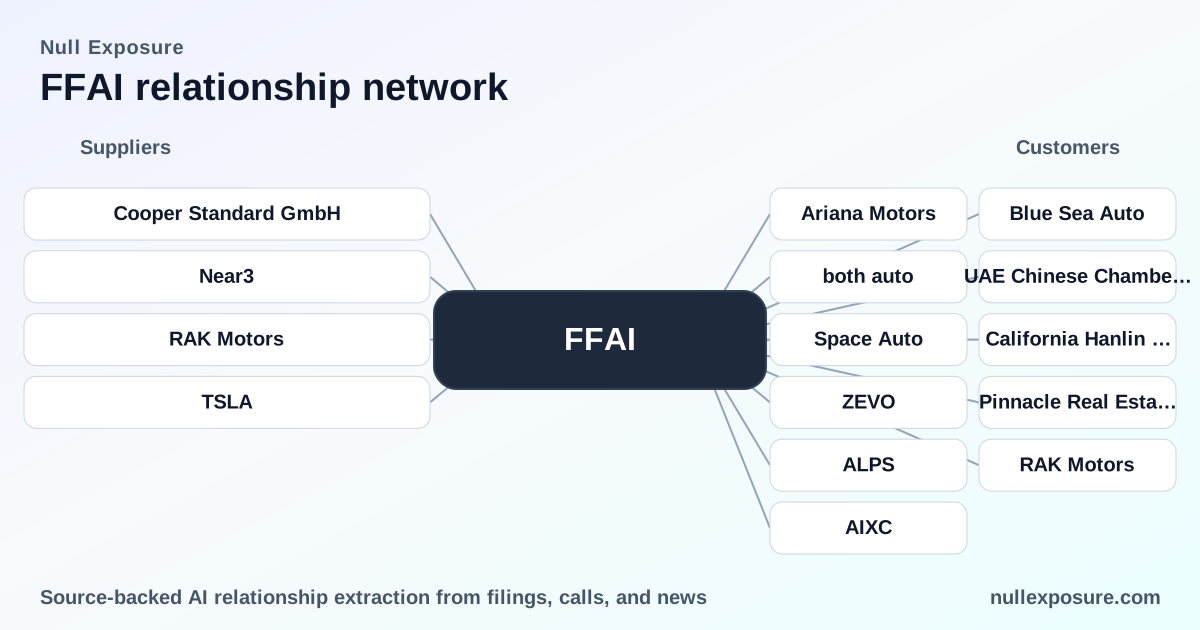
Faraday Future (FFAI) — supplier posture and relationship map investors need to read
Faraday Future Intelligent Electric Inc. designs, engineers and sells electric vehicles and after‑sales services, monetizing through vehicle sales, service revenue, and strategic licensing and regional distribution partnerships. The core commercial model combines low-volume manufacturing with outsourced components and third‑party service providers; revenue is therefore tightly coupled to supply continuity, partner execution, and regional distribution agreements. Investors should treat FFAI as a capital‑intensive OEM with concentrated supplier reliance, active international go‑to‑market partnerships, and material legal and execution risk. For a concise supplier intelligence view, visit NullExposure.
How FFAI runs its supply chain and what that means for returns
Faraday Future operates with a dual‑home strategy across the United States and China and sources components from North America, Europe and Asia. This global supplier footprint gives the company flexibility to source advanced automotive subsystems, but the filing language also signals single‑source dependency for a number of parts: the FF 91 program reportedly uses roughly 2,200 purchased components from about 200 suppliers, and many of those are single‑source for the parts they supply. According to FFAI’s public filings, a failure by a supplier to deliver on time, at required quality or price, “could have a material adverse effect” on operations — an explicit acknowledgement that supply continuity is a critical value driver.
Contracting posture is mixed. The company leases major facilities on multi‑year terms (for example the Hanford manufacturing site is leased through October 19, 2028), which is a long‑term fixed cost commitment for production capacity. At the same time, FFAI discloses it typically does not maintain long‑term purchase contracts with many single‑source suppliers and uses short‑term consulting and services agreements with automatic renewals — a structure that produces operational flexibility but increases counterparty and timing risk.
Service relationships are a meaningful portion of the supplier base: the company engages third‑party providers for battery development, after‑sales systems and strategic consulting. One disclosed consulting contract (FF Global) pays roughly $0.2 million per month and is structured as a 12‑month renewable agreement, representing a mid‑range recurring spend obligation in the $1–10 million band on an annualized basis. These service relationships are active and directly tied to the scale‑up of sales and support networks, making them both strategically important and financially visible.
Relationship-by-relationship briefing (what the market should know)
Cooper Standard GmbH — litigation over unpaid invoices
Cooper Standard filed suit in Los Angeles against Faraday & Future Inc. alleging non‑payment of approximately $1.5 million tied to purchase orders, a Letter of Tool Acceptance and invoices for supply work on the FF 91 between August 2021 and December 2022. This is a direct supplier payment dispute that signals execution and cash‑flow stress with a legacy supplier. The claim is disclosed in FFAI’s FY2024 10‑K filing (filed Dec 31, 2024).
Near3 — payment rails and crypto acceptance in the UAE
Through its UAE partner Near3, Faraday Future is introducing a dual‑payment model that accepts local currency and selected cryptocurrencies, including stablecoins, for vehicle purchases and after‑sales services. Adoption of crypto payment rails broadens the payment mix and could accelerate local conversions, but introduces regulatory and settlement complexity for receivables. This arrangement was reported by Middle East Online on March 9, 2026.
RAK Motors — local sales, delivery and after‑sales execution in the UAE
RAK Motors is the strategic partner in the UAE slated to handle localized sales, delivery and after‑sales services for the FX Super One, with initial deliveries and services expected to begin in November (as reported). Local distribution partners are central to customer experience and warranty execution — performance here will materially influence regional sales velocity. Middle East Online covered this partnership on March 9, 2026.
Tesla (TSLA) — Supercharger access under license
Faraday Future announced that future FF and FX vehicles, including a planned BEV version of the Super One, will receive licensed access to Tesla’s Supercharger network, giving drivers direct access to an established fast‑charging infrastructure. Licensed Supercharger access materially reduces a key adoption barrier for buyers and improves product competitiveness without the company having to build its own charging network. This was disclosed in a company investor update published via GlobeNewswire on November 17, 2025.
Constraints and what they tell procurement and investors
FFAI’s public disclosures create a consistent portrait of the operating model:
- Contracting posture: A hybrid of long‑term real estate commitments (manufacturing leases) and short‑term supplier and consulting arrangements. Leased manufacturing capacity creates fixed operating leverage; short supplier contracts increase execution and re‑procurement risk.
- Concentration and criticality: Production depends on a compact set of single‑source suppliers for many parts. The company explicitly warns supplier delivery failures would have a material adverse effect, making supplier performance a systemic risk.
- Maturity and stage: Relationships described in filings are largely active and service focused — consulting and after‑sales systems are central to scaling a dispersed service network as revenue grows.
- Spend profile: Evidence indicates recurring service spend in the $1–10 million annual range for strategic consulting (FF Global example: $0.2M monthly), a meaningful operating expense given the company’s current revenue run‑rate and negative EBITDA.
These company‑level signals point to a business that is still scaling its commercial network while bearing concentrated supplier risk and fixed manufacturing commitments — a combination that compresses margin upside until scale and supply reliability improve.
Visit NullExposure for a full supplier risk model and monitoring feed.
Practical implications for operators and investors
- Legal exposure matters: The Cooper Standard claim is a signal to audit payables, disputed receivables and the company’s cash‑management discipline; small contractual disputes can cascade into supplier stoppages in a single‑source environment.
- Partner execution drives revenue: The UAE launch, using Near3 for payments and RAK Motors for distribution, shows FFAI is relying on third‑party partners to deliver customer experience and convert showroom interest into revenue; those third parties will determine local success more than the factory output alone.
- Infrastructure licensing reduces capex needs: Tesla Supercharger licensing is a strategic de‑risking move — it improves product marketability without incremental charging capex, accelerating potential adoption curves.
- Cash and counterparty liquidity are critical: With negative EBITDA and modest revenue today, recurring service commitments and supplier payment timelines put pressure on liquidity and require close monitoring.
Investor action checklist (what to watch next)
- Monitor litigation roll‑up and supplier dispute disclosures for signs of broader payment issues.
- Track early UAE sales/registration metrics and after‑sales responsiveness through RAK Motors as a proxy for international demand execution.
- Confirm scope and economics of the Tesla Supercharger license (coverage, pricing, technical integration) as it materially affects resale value and buyer utility.
- Review recurring service contracts (e.g., consulting fees) and their renewal terms to assess fixed operating outflows relative to cash runway.
For continued monitoring and ranked supplier intelligence on FFAI, sign up at NullExposure.
Bold takeaways: FFAI’s commercial progress is partner‑dependent — supplier disputes, regional distribution execution and strategic licensing will determine whether the company can convert engineering capability into sustainable revenue.