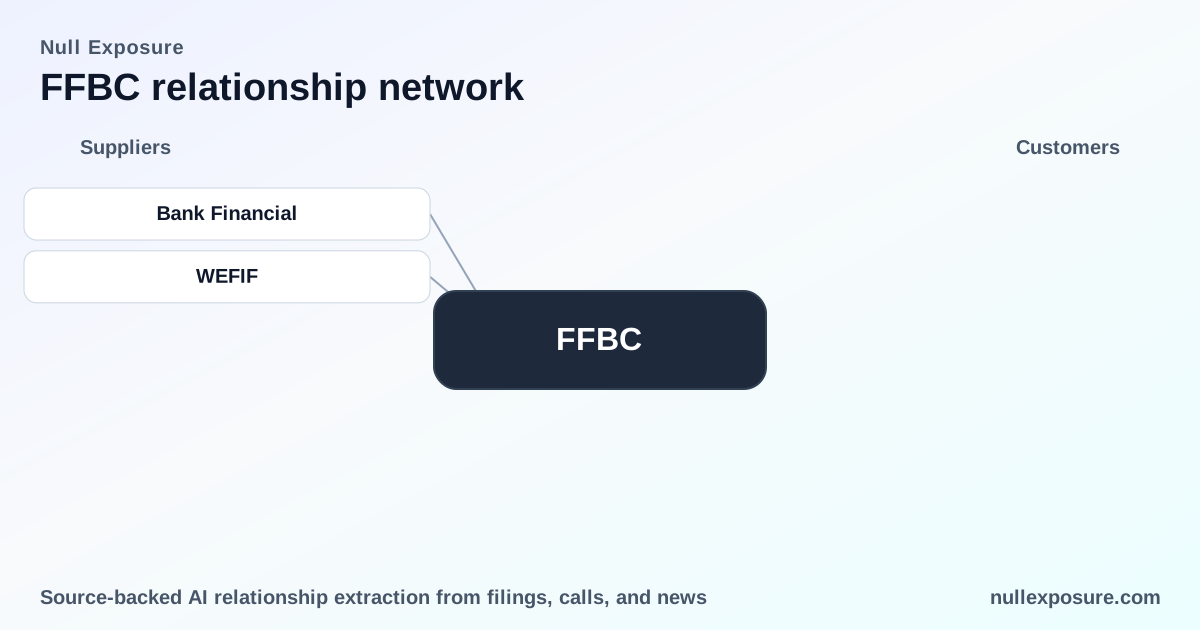
First Financial Bancorp (FFBC): Supplier relationships shaping a regional bank scaling by acquisition
First Financial Bancorp operates and monetizes as a traditional regional bank: it collects deposits, originates and acquires loans, and earns net interest income while supplementing margins with fee income and efficient cost control. Growth is execution-led — the company combines organic expansion with targeted M&A to scale deposit and loan footprint, then relies on disciplined vendor governance to integrate and operate the enlarged franchise. For a concise supplier exposure dashboard, visit https://nullexposure.com/.
What investors need to know about FFBC’s supplier posture
First Financial runs a vendor-centric operating model where third parties supply core infrastructure (processing, network, internet connectivity) and services that handle sensitive consumer and business data. The company explicitly staffs an ad hoc vendor-risk committee with senior executives — including the CISO and Chief Risk Officer — to oversee vendor diligence and incident monitoring. That governance posture signals a mature, centralized control model for vendor risk, with annual cyber reviews for critical vendors and monthly outward-facing security monitoring.
Key business-model constraints that inform supplier risk and opportunity:
- Contracting posture: FFBC relies on third-party contracts for essential infrastructure and data processing; vendor oversight is institutionalized rather than purely transactional.
- Concentration: The bank designates a subset of vendors as “critical,” implying concentrated risk where specific partners handle PII or core processing functions.
- Criticality: Vendors that interact with customer PII are treated as mission-critical and receive elevated diligence and monitoring.
- Maturity: The existence of a cross-functional oversight committee and defined annual and monthly review cycles indicates above-average vendor governance for a regional bank.
The M&A-driven supplier angle: why vendors matter now
FFBC’s recent acquisitions — including BankFinancial and Westfield-related entities — change vendor footprints materially: conversions, platform consolidations, and new regional operations increase the number of integrations and the surface area for third-party risk. Operational integration is a value-creation lever but also a source of vendor concentration and transition risk that investors should monitor closely.
For deeper coverage of supplier exposures tied to FFBC’s growth strategy, see https://nullexposure.com/.
Relationship-by-relationship review (plain English, sourced)
Gallup
First Financial has maintained a long-standing partnership with Gallup focused on employee engagement, making associate engagement part of its corporate strategy. Gallup supports FFBC’s human capital programs rather than core processing infrastructure, but engagement influence is material to retention during post-acquisition integrations. According to an earnings-call transcript published on Investing.com on May 2, 2026, management noted a partnership of more than six years with Gallup (Q1 FY2026 earnings call transcript).
BankFinancial (BFIN)
FFBC completed an all-stock acquisition of Chicago-based BankFinancial Corporation effective January 1, 2026, merging BankFinancial’s banking subsidiary into First Financial and expanding FFBC’s assets to roughly $22 billion and its retail footprint in Chicago. This transaction materially expanded FFBC’s customer base and loan balances by bringing BankFinancial’s systems and vendor relationships into FFBC’s governance perimeter. A March 9, 2026 press release reported on The Globe and Mail details the closing and strategic scale-up from the acquisition (press release, Mar 9, 2026).
Westfield Bank / WEFIF / Westfield
Management reported a conversion of Westfield Bank during the quarter and highlighted that loan balances increased by approximately $1.7 billion, with $1.6 billion attributable to the Westfield transaction. The Westfield conversion is an example of a near-term integration project that transfers significant loan and deposit servicing responsibilities into FFBC’s platforms and prompts vendor reconfigurations tied to servicing, processing, and customer-facing systems. These integration details were discussed in the company’s Q4 FY2025 earnings-call transcript posted on InsiderMonkey (Mar 9, 2026) and referenced again in the Q1 FY2026 transcript on Investing.com.
What these relationships imply for investors and operators
- Integration risk is front-of-mind. Both the BankFinancial and Westfield deals increased FFBC’s asset base and require system-to-system work to consolidate processing, data flows, and customer interfaces. Expect elevated vendor activity and one-off integration costs in the near term.
- Human capital continuity matters. The Gallup partnership signals management’s focus on employee engagement, which is a cost-effective risk-reduction tactic during workforce reshaping after acquisitions.
- Vendor governance is operationalized. FFBC’s vendor-risk committee and its annual cyber diligence program for critical vendors indicate that management treats vendor relationships as strategic levers rather than back-office inputs. That reduces but does not eliminate concentration and transition risks.
Risk checklist investors should monitor
- Conversion execution timelines and costs for BankFinancial and Westfield integrations, which drive near-term expense and operational risk.
- Vendor concentration among “critical” providers that store or process PII — FFBC’s posture is to subject these vendors to annual and monthly oversight, so look for disclosures on which partners are deemed critical.
- Incident reporting and remediation cadence from the ad hoc vendor-risk committee; prompt disclosure of vendor incidents is critical to assess contagion risk to earnings and reputation.
- Human capital metrics tied to the Gallup relationship — turnover, engagement scores, and retention of key integration teams.
Bottom line: governance reduces but does not erase supplier risk
First Financial Bancorp is scaling through M&A while running an institutionalized vendor-risk framework that treats some suppliers as critical and enforces recurring cyber diligence. For investors, the combination of active M&A and centralized vendor governance is a net positive for scale and control — provided integration execution stays on schedule and critical vendor concentration is managed transparently.
For an at-a-glance supplier exposure summary and ongoing screening tools, visit https://nullexposure.com/.