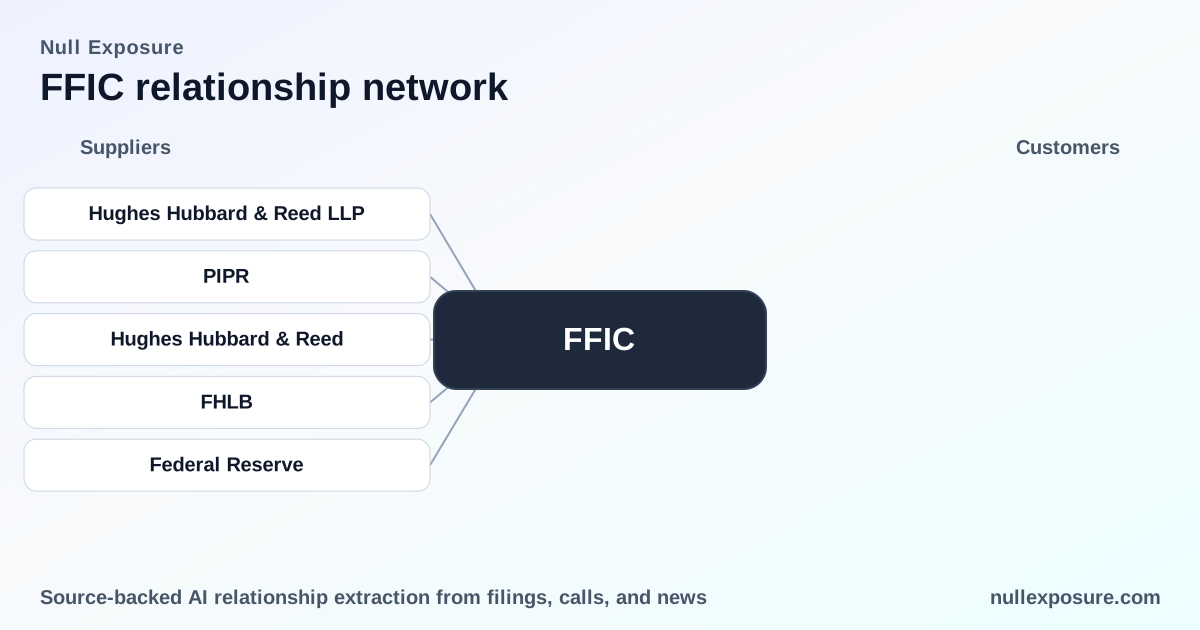
Flushing Financial (FFIC): supplier map, funding posture and what it means for counterparties
Flushing Financial Corporation is the banking holding company for Flushing Bank; it monetizes a regional deposit franchise and a traditional banking spread by deploying deposits into loan portfolios and higher‑yield securities while using brokered funding and central bank/FHLB lines to manage liquidity and interest‑rate exposure. Investor focus should be on funding concentration, vendor outsourcing that supports core operations, and the advisers engaged around strategic transactions — each drives counterparty risk and upside in different ways. For an organized look at counterparties and operating constraints, see the full view at https://nullexposure.com/.
How the advisers and counsel show where strategy is headed
Flushing engaged investment banking and legal advisers in the transaction activity disclosed in 2026, which clarifies strategic intent.
Piper Sandler & Co — strategic financial adviser
Piper Sandler served as Flushing’s financial adviser in the announced merger activity, indicating the bank used an experienced regional investment bank to structure and negotiate an all‑stock transaction in 2026. This was reported in news coverage of the OceanFirst transaction (March 9, 2026) and in related press releases (https://finance.yahoo.com/news/oceanfirst-financial-corp-flushing-financial-234500786.html; https://pulse2.com/oceanfirst-to-acquire-flushing-financial-in-579-million-all-stock-merger/).
Hughes Hubbard & Reed LLP — legal counsel on the deal
Hughes Hubbard & Reed LLP acted as legal counsel to Flushing in the same transaction, confirming that the company used national legal expertise for regulatory and transactional work tied to the merger (CityBiz and Yahoo Finance coverage, March 9, 2026; https://www.citybiz.co/article/788288/oceanfirst-financial-corp-and-flushing-financial-corp-announce-merger-agreement/).
Liquidity counterparties that underpin balance‑sheet flexibility
Funding relationships give immediate insight into balance‑sheet stability and the bank’s reliance on external liquidity.
FHLB — committed wholesale liquidity source
Flushing reports available liquidity increased to about $3.9 billion through FHLB and Federal Reserve lines and unencumbered securities, signaling that Federal Home Loan Bank advances are an active and material source of term and pledged liquidity (TradingView summary of the company 10‑K, March 2026; https://www.tradingview.com/news/tradingview:d6f8fb60d0586:0-flushing-financial-10-k-466-2m-interest-income-0-54-eps/).
Federal Reserve — discount window / standing facility access
The Federal Reserve lines are cited alongside FHLB availability as part of the bank’s liquidity buffer, underscoring access to central bank facilities as a structural backstop for funding and contingency needs (TradingView / company 10‑K summary, March 2026; https://www.tradingview.com/news/tradingview:d6f8fb60d0586:0-flushing-financial-10-k-466-2m-interest-income-0-54-eps/).
Company‑level constraints and what they mean for suppliers and investors
Flushing’s disclosures and filings provide several clear signals about contracting posture, concentration and spend scale.
- Contracting posture: The company uses a mix of long‑term and short‑term borrowings (evidence of both proceeds from long‑term borrowing and net repayments/proceeds from short‑term borrowings), showing a balanced approach to tenor management rather than exclusive reliance on one maturity bucket.
- Outsourcing framework: Flushing outsources core operational functions — data processing, loan servicing and check processing — under volume‑dependent frameworks that typically include CPI‑linked annual increases. That creates predictable vendor escalation and longer vendor relationships but also concentration in a few service providers.
- Funding concentration and materiality: Brokered deposits comprised a material share of funding — 18.4% of total deposits as of December 31, 2024 — which increases sensitivity to wholesale deposit markets and counterparty funding confidence.
- Spend profile and scale: The bank executed a large securities purchase program ($1.3 billion of available‑for‑sale securities in 2024) while vendor services purchases ran in the low‑single‑digit millions annually (about $8.4 million in 2024), indicating a high balance‑sheet driven spend band for securities and a moderate operating vendor spend band.
These signals come from the company’s filings and public summaries of its annual disclosures (notably the company’s 10‑K and related press coverage in early 2026).
If you track supplier and counterparty concentration for credit or operational risk, Flushing’s combination of material brokered funding, active use of FHLB/Fed lines and outsourced processing creates a profile where liquidity counterparties and a small group of service providers are strategic partners for the bank’s day‑to‑day operations. Learn more about mapping counterparty exposure at https://nullexposure.com/.
What the relationships imply for counterparties and operators
- Counterparty criticality: FHLB and Federal Reserve facilities are critical liquidity backstops; counterparts that provide these lines or accept pledges of securities are structurally important. Loss of access or changes in eligibility would directly pressure liquidity and funding costs.
- Vendor negotiation posture: Outsourced vendors operate under framework contracts with CPI escalators and annual reset mechanics, which means vendors can predictably price inflation‑linked increases while the bank faces steadily rising operating costs.
- Transaction activity: Engaging Piper Sandler and Hughes Hubbard for M&A shows the company is executing strategic consolidation steps, which creates short‑term legal and integration work for vendors and long‑term changes in counterparty networks.
The relationships — concise investor cheat‑sheet
Below are the relationships identified in public reporting and news coverage; each entry is a compact, investor‑oriented line with source context.
- Hughes Hubbard & Reed LLP — Served as legal counsel to Flushing in the announced merger activity (reported in CityBiz and Yahoo Finance coverage, March 9, 2026; https://www.citybiz.co/article/788288/oceanfirst-financial-corp-and-flushing-financial-corp-announce-merger-agreement/).
- Piper Sandler & Co (Piper Sandler) — Served as Flushing’s financial adviser on the OceanFirst all‑stock merger, demonstrating the bank’s use of a regional investment bank for deal execution (reported in Yahoo Finance and Pulse2 coverage, March 9, 2026; https://finance.yahoo.com/news/oceanfirst-financial-corp-flushing-financial-234500786.html; https://pulse2.com/oceanfirst-to-acquire-flushing-financial-in-579-million-all-stock-merger/).
- FHLB — Cited as part of the $3.9 billion of available liquidity alongside Federal Reserve lines and unencumbered securities, underlining a significant wholesale liquidity relationship (trading summaries of Flushing’s 10‑K, March 2026; https://www.tradingview.com/news/tradingview:d6f8fb60d0586:0-flushing-financial-10-k-466-2m-interest-income-0-54-eps/).
- Federal Reserve — Identified as a counterparty providing liquidity lines that, together with FHLB advances and securities, raised available liquidity to approximately $3.9 billion (trading/10‑K summary coverage, March 2026; https://www.tradingview.com/news/tradingview:d6f8fb60d0586:0-flushing-financial-10-k-466-2m-interest-income-0-54-eps/).
Final read: what investors and suppliers should act on
Key takeaway: Flushing runs a funding‑sensitive model where brokered deposits and wholesale liquidity lines matter as much as net interest income. For investors, monitor changes in brokered deposit ratios and access to FHLB/Fed lines; for vendors, understand that outsourced processing contracts are framework‑based with CPI escalators and multiyear obligations.
If you evaluate counterparty risk or supplier exposure for regional banks, start with the liquidity counterparties and the handful of outsourced service providers that carry day‑to‑day operational risk. For a structured supplier intelligence view and to benchmark these relationships against peers, visit https://nullexposure.com/.
For tailored diligence, map the bank’s vendor contracts, brokered deposit trends and recent M&A advisers into your risk model — and if you want a ready snapshot of those relationships for investment or operational decisions, get the full supplier map at https://nullexposure.com/.