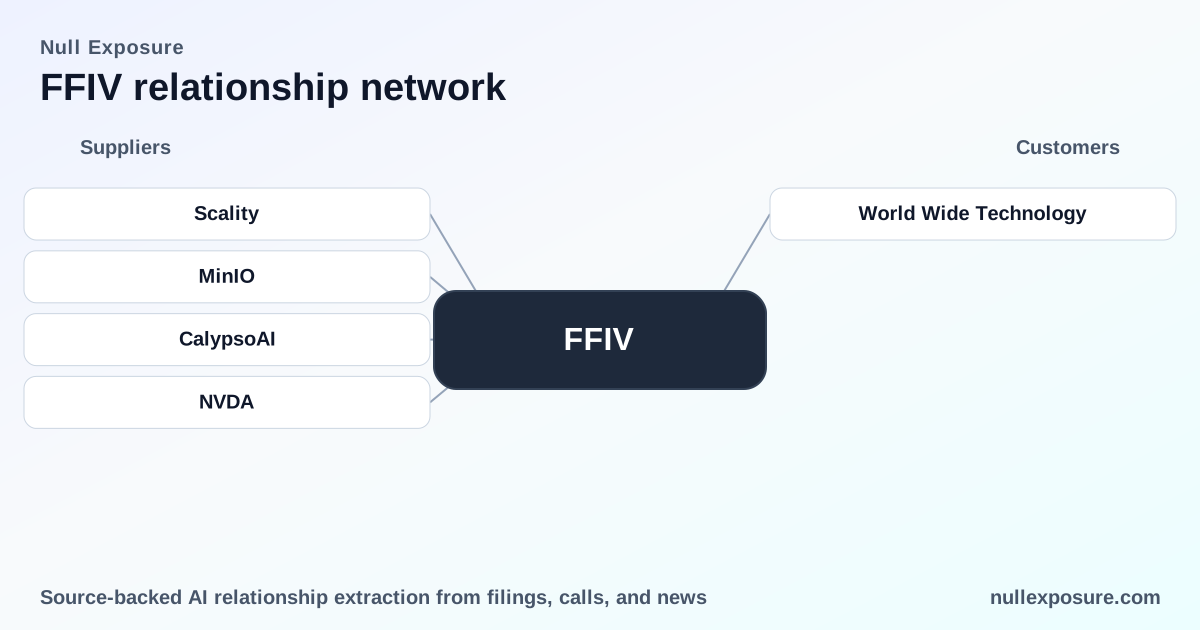
F5 Networks (FFIV) — Supplier relationships shaping its AI and application-delivery push
F5 Networks operates as a specialist vendor for application delivery, security, and multi‑cloud traffic management and monetizes through combinations of software subscriptions, support services, and appliance sales that together produce high-margin recurring revenue. Strategic supplier and technology partnerships extend F5’s insertion points into AI data delivery, model security, and high-throughput storage — effectively converting third‑party capabilities into routes for subscription and services growth.
Explore more supplier intelligence at https://nullexposure.com/ for investor-grade context and sourcing.
Why supplier posture matters for F5's operating model
F5’s business succeeds when enterprise customers can deploy secure, high-performance application delivery stacks across cloud and on‑prem environments. That dependency on third-party components and partners yields both upside and constraints: long-term purchase commitments create predictable cost structures and inventory visibility, while outsourcing manufacturing lowers capital intensity but concentrates operational risk. Company disclosures show a standing obligation to purchase inventory under a multi‑year commitment with a remaining non‑cancelable amount of roughly $10 million as of September 30, 2025, placing supplier spend in the $10M–$100M band and signaling meaningful, but not dominant, contractual exposure. According to the same filings, F5 outsources hardware assembly to contract manufacturers — specifically naming Flex Ltd. as a primary third‑party manufacturer — which reduces fixed manufacturing investment but creates concentration at the contract manufacturing node.
Geography and logistics are operational constraints: F5 references fulfillment and assembly footprints that route systems built in Zhuhai into APAC distribution channels and platforms assembled in Guadalajara forwarded into the Americas and EMEA. Those regional flows imply supply‑chain exposure tied to APAC and EMEA logistics and partners, and they shape where inventory, warranty, and service obligations land.
Taken together, these signals describe an operator with mature supplier relationships that are active and contractual, disciplined around multi‑year commitments, manufacturer outsourcing, and regional fulfillment—important context when assessing margin durability or disruption risk.
Active partnerships investors must track
Scality — integrating object storage with F5 delivery and security
F5 expanded its alliance with Scality to link F5’s Application Delivery and Security Platform (ADSP) with Scality’s S3‑compatible object storage, targeting large‑scale AI and analytics workloads across on‑prem, cloud‑native, and hybrid environments. This partnership accelerates F5’s ability to sell AI data‑delivery and security solutions tied to high‑volume storage backends. (GlobeNewswire, February 18, 2026)
MinIO — an AI data‑delivery insertion point
F5 is working with MinIO as part of its broader AI go‑to‑market, with MinIO cited alongside NVIDIA and other partners as enabling early deployments of F5’s AI offerings such as AI data delivery, AI gateway, and runtime security; these relationships create future revenue insertion points as enterprise AI adoption scales. MinIO helps F5 address object storage requirements for model training and inference pipelines, expanding recurring software and services opportunities. (SimplyWallSt commentary, March 2026)
CalypsoAI — model‑security intelligence and benchmarks
F5 incorporated CalypsoAI‑derived threat intelligence into F5 Labs benchmarks and extended support for World Wide Technology’s ARMOR AI security framework, positioning the company to provide customers with standardized ways to evaluate and defend AI models. This relationship strengthens F5’s runtime security narrative and product credibility in AI risk management. (SimplyWallSt coverage of March 2026)
NVIDIA — hardware and acceleration co‑selling
F5 is pairing AI‑focused product offerings with NVIDIA technologies such as BlueField‑3 to address performance and data‑path offload in AI deployments, creating a channel to sell F5 software and services alongside high‑performance compute and NIC acceleration. The NVIDIA tie amplifies F5’s ability to target latency‑ and throughput‑sensitive AI use cases, lifting potential deal sizes and subscription attach rates. (SimplyWallSt analysis, March 2026)
What these partnerships practically mean for revenue and margin
F5’s supplier strategy is executional rather than experimental: partnerships are designed to convert third‑party product capabilities into recurring software and service revenue by embedding F5’s delivery and security layers around external compute and storage stacks. For investors, that translates into two concrete dynamics:
- Growth vector: AI and analytics workloads offer higher‑ASP deals where F5 can price for performance, security, and management across hybrid environments.
- Margin leverage: Outsourced manufacturing and multi‑year procurement commitments stabilize gross margins by smoothing component cost volatility, but introduce counterparty concentration risk.
Given the disclosed $10M non‑cancelable commitment as of 9/30/2025 and manufacturer reliance on Flex, the company exhibits predictable supplier spend in the mid‑to‑high single‑digit millions annually, coupled with concentrated manufacturing exposure. That profile supports margin stability while making near‑term supply disruptions or contract renegotiations meaningful.
Explore supplier-level analysis and primary source links at https://nullexposure.com/ for due diligence and procurement risk scoring.
Key risks and monitoring triggers
- Supplier concentration: Dependence on a named contract manufacturer increases operational risk if that vendor faces disruption or capacity constraints.
- Contractual lock‑in: Multi‑year purchase commitments provide predictability, but they limit flexibility if component pricing or customer demand changes materially.
- Regional fulfillment exposure: APAC and EMEA routing for certain builds introduces geopolitical and logistics sensitivity into service delivery timelines.
- Execution on AI integrations: Early stage partnerships deliver runway but require sales execution to convert into sustained recurring revenue.
Monitor quarter‑over‑quarter disclosure of purchase commitments, any changes in non‑cancelable amounts, manufacturing partner statements (Flex), and adoption metrics for F5’s AI‑focused bundles to gauge trajectory.
Bottom line for investors and operators
F5 is turning supplier and technology partnerships into a deliberate route to expand subscription and services revenue into AI workloads. Partnerships with Scality, MinIO, CalypsoAI, and NVIDIA materially broaden F5’s addressable market for data‑intensive and security‑sensitive applications, while the company’s contractual profile and manufacturing outsourcing provide predictable cost structure with concentrated counterparty exposure. Investors should weigh the upside from higher‑ASP AI deals against the operational risk baked into mid‑range purchase commitments and a concentrated manufacturing model.
For deeper supplier mapping, sourcing evidence, and operational risk scoring, visit https://nullexposure.com/ — the homepage holds direct links to F5 supplier reporting and signal extraction.
Actionable next steps: watch F5’s quarterly disclosures for changes in non‑cancelable purchase commitments, monitor sales momentum for AI‑bundled offerings, and track any public statements from contract manufacturers. For ongoing supplier intelligence and investor briefs, return to https://nullexposure.com/ where primary links and summarized evidence are maintained.