First Financial Northwest (FFNW): the transfer-agent relationships that matter in a liquidation
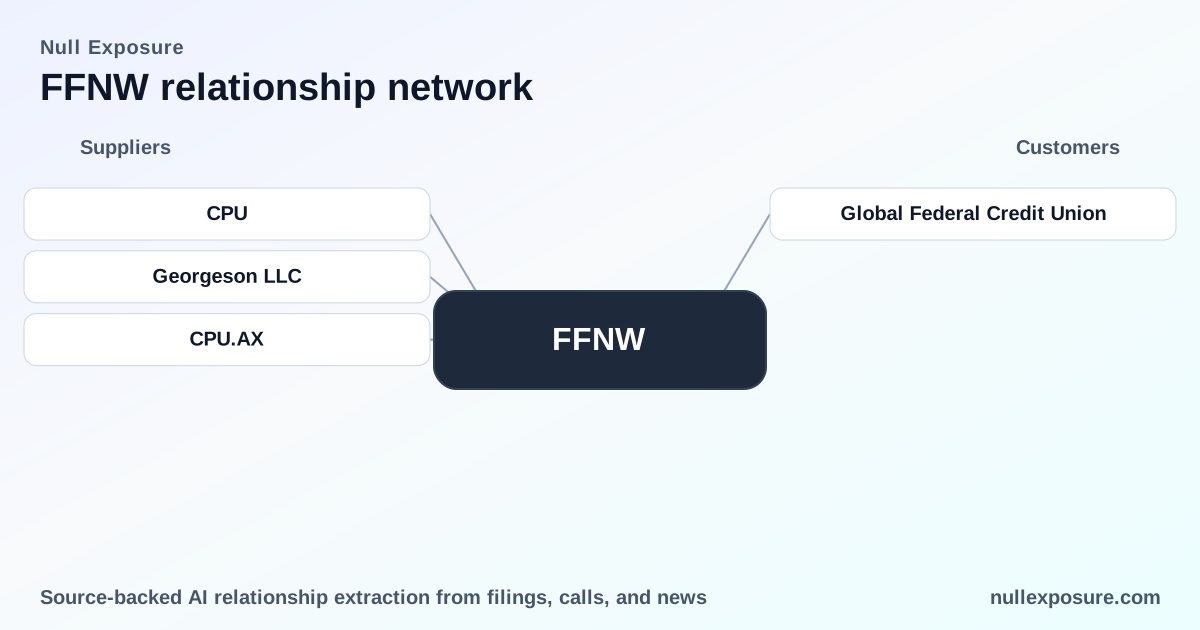
First Financial Northwest is a regional bank holding company that historically monetized through traditional commercial banking—interest margin, deposit services and fee income—and is now executing a corporate exit strategy after the sale of its bank; shareholder distributions and the mechanics of closure are central to realizing value for investors. Supplier relationships that manage shareholder records and distributions are therefore transaction-critical: they directly control the timing and completeness of cash payouts to holders. For investors evaluating counterparty risk and execution risk in this wind‑down, the transfer-agent and shareholder‑locating partners are the operative suppliers to monitor.
If you want a concise, machine‑readable supplier profile and monitoring feed for decisions, visit https://nullexposure.com/.
Why these particular suppliers matter now
FFNW’s announced closing of the bank sale to Global Federal Credit Union converted the company’s profile from an operating banking franchise to a residual public shell executing a final cash liquidation distribution. When an investment thesis is concentrated on a closing distribution, the capabilities of the transfer agent and any shareholder‑outreach vendors directly determine cash flow timing, leakage and shareholder claim rates. That elevates a normally back‑office supplier to a mission‑critical counterparty.
Computershare — the stock transfer agent handling certificate conversion
Computershare is serving as FFNW’s stock transfer agent and is responsible for converting shareholders with physical certificates into book‑entry form as a condition to payment of initial distributions. According to multiple press releases and coverage around the transaction (GlobeNewswire / The Globe and Mail and a Reuters/TradingView notice dated April 11, 2025), Computershare’s role includes the mechanics that enable pro‑rata cash payments to holders. CityBiz reporting on the asset sale also highlights Computershare’s operational role in certificate conversion tied to distributions.
Source: Reuters/TradingView and GlobeNewswire reporting on the April 2025 closing; CityBiz coverage of the asset sale (2025–2026 press cycle).
Georgeson LLC — locating and outreach for unresponsive shareholders
FFNW retained Georgeson LLC, an affiliate of Computershare, to assist in locating shareholders who have not responded to previous communications so they can receive the final distribution. A November 2025 GlobeNewswire release carried by Manilatimes reported Georgeson’s engagement as part of the company’s final cash liquidation distribution process, indicating FFNW is using dedicated outreach services to reduce unclaimed or escheatable balances.
Source: GlobeNewswire / Manilatimes press release (Nov 25, 2025).
How these relationships translate into measurable investor risk and execution risk
FFNW’s supplier footprint in this wind‑down is narrow and focused: transfer agent services and shareholder location/outreach are the two functional levers that convert the corporate sale proceeds into paid distributions. That concentrated supplier posture creates a straightforward set of operational exposures:
- Concentration risk: A single primary transfer agent (Computershare) means vendor substitution would be operationally complex and time‑consuming; any disruption to Computershare’s service continuity would delay distributions.
- Criticality of services: Transfer‑agent processing is not optional during a liquidation—certificate conversion, payment routing, and record reconciliation are preconditions of cash disbursement.
- Outreach maturity and effectiveness: Retaining Georgeson signals proactive management of non‑responsive holders; the final recovery percentage of the liquidation will depend on the success rate of that outreach.
- Contracting posture: Typical transfer‑agent engagements are vendor‑managed with fixed deliverables; in a liquidation, FFNW’s contracting likely emphasizes strict SLAs on conversion and payment timing to preserve investor value.
These are company‑level signals about operating model and concentration; they are not specific contractual excerpts tied to any single supplier in FFNW’s public statements.
If your investment process values supplier continuity and counterparty operational controls, examine the transfer‑agent engagement terms and any escrow/payment mechanics documented in transaction filings—our platform can help with that: https://nullexposure.com/.
Practical implications for valuation and monitoring
Two immediate investor actionables flow from these relationships:
- Monitor payment milestones and shareholder conversion reports. The timing when Computershare completes certificate-to-book‑entry conversions is the gating item for the initial distribution and subsequent reconciliation of residuals. Public notices through GlobeNewswire and Reuters have been the primary channels for milestone updates.
- Track Georgeson’s outreach progress and unclaimed balances. The pace at which Georgeson reduces the population of unresponsive holders determines the tail‑risk of escheatment and administrative drag on the distribution.
Operationally, these suppliers make the difference between an orderly, time‑bound cash return and a protracted administrative wind‑down that erodes net proceeds through fees and escheatment. For an investor, service execution is a value driver as real as the original bank sale price.
What to watch in the coming weeks
- Public distribution notices and the schedule for the initial and final cash payments as posted via GlobeNewswire/press outlets.
- Any amendment or vendor substitution filings that would indicate service issues with Computershare or Georgeson.
- Reports on the percentage of holders converted to book‑entry form, and the size of outstanding physical certificates still in process.
Bottom line: simple supplier footprint, high operational leverage
FFNW’s supplier relationships in the liquidation context are concentrated and decisive: Computershare handles conversion and payment mechanics; Georgeson handles the hard work of finding missing shareholders. Both are short‑term but critical vendors whose performance will determine the timing and completeness of investor returns. Investors should prioritize vendor performance metrics, public milestone notices, and any filings that document payment mechanics.
For deeper monitoring of FFNW’s supplier disclosures and to receive alerts when vendor milestones or press notices post, go to https://nullexposure.com/.
Actionable summary:
- Confirm Computershare‑posted conversion and payment timelines in the next GlobeNewswire/SEC updates.
- Request or review any available conversion reconciliation showing the percentage of shares moved to book‑entry.
- Monitor Georgeson outreach outcomes for unclaimed‑holder recoveries and the residual escheat risk.
For continuous supplier surveillance and pre‑formatted briefing notes tailored to capital allocators, visit https://nullexposure.com/ and subscribe for supplier‑level alerts.