First Foundation (FFWM): what investors should know about its supplier and advisor network
First Foundation Inc. operates as a regional bank offering personal banking, commercial banking and private wealth management services and monetizes through net interest margin on lending and deposits, wealth-management fees and transaction/service income from banking clients. The company generates modest revenue relative to peers (Revenue TTM $170.5M) but is loss-making on the bottom line (Diluted EPS -$1.88), making supplier, funding and advisory relationships disproportionately relevant to strategy and near-term valuation. Explore supplier intelligence at https://nullexposure.com/ for a full view of counterparty links and third‑party exposure.
The context: a transaction-driven advisor roster with operational dependencies
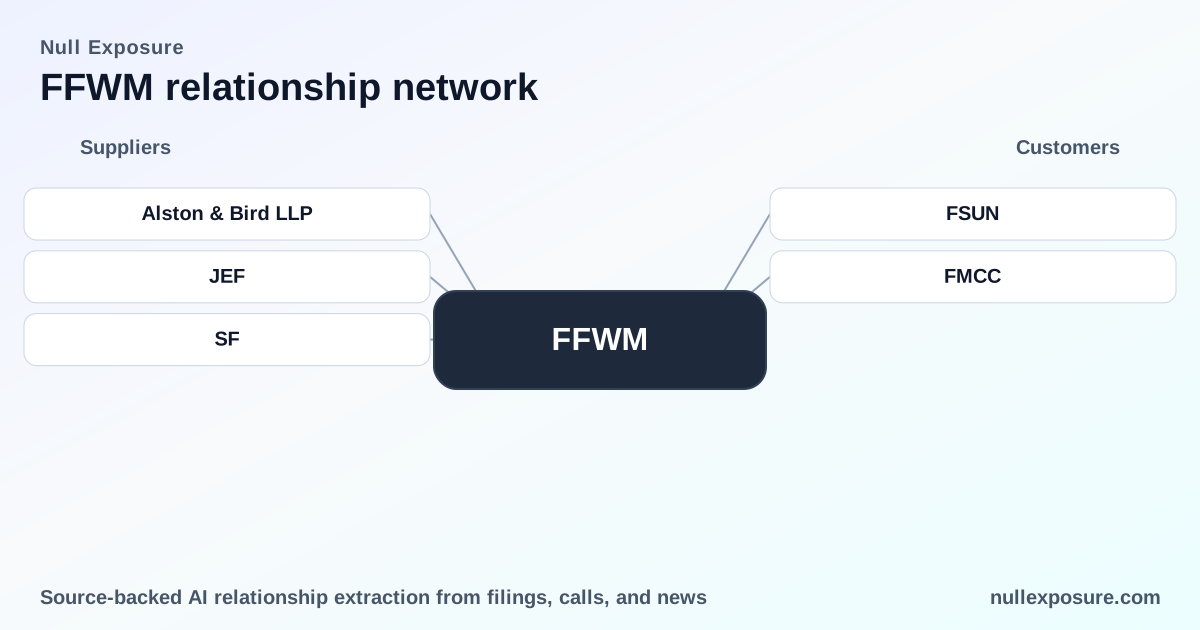
First Foundation’s supplier signals are dominated by a combination of transactional advisors tied to a FY2025 strategic process and an ongoing reliance on third‑party technology and funding infrastructure. In the strategic thread, outside advisors provided legal and fairness opinions to the board during a material all‑stock transaction reported in early 2026, which is a governance and valuation event investors must weigh against the bank’s financial profile and share metrics (Market Cap ~$468M; Analyst target price $6.75). Operationally, the company relies heavily on external vendors for internet banking, data processing and other core systems, which makes vendor performance and cyber controls a first‑order variable for credit and operational risk. For deeper supplier maps and contract exposure, see https://nullexposure.com/.
Who the company engaged (and why it matters)
Below are the named relationships surfaced in the reporting on First Foundation’s FY2025 activities. Each entry is a concise, plain‑English description with the reporting source.
Alston & Bird LLP
Alston & Bird served as legal counsel to First Foundation in connection with the FY2025 transaction process reported alongside the all‑stock merger announcement. A ConnectMoney report dated March 9, 2026 documents the firm’s role as the company’s legal adviser. (Source: ConnectMoney, 2026-03-09 — https://www.connectmoney.com/stories/firstsun-capital-bancorp-to-acquire-first-foundation-inc-in-785m-all-stock-merger/)
Jefferies LLC
Jefferies acted as financial advisor to First Foundation and rendered a fairness opinion to the board, providing valuation and process validation in the strategic transaction reported in FY2025. The same ConnectMoney coverage lists Jefferies’ advisory and fairness‑opinion role. (Source: ConnectMoney, 2026-03-09 — https://www.connectmoney.com/stories/firstsun-capital-bancorp-to-acquire-first-foundation-inc-in-785m-all-stock-merger/)
Keefe Bruyette & Woods, a Stifel Company
Keefe Bruyette & Woods served as lead advisor to First Foundation and provided a fairness opinion to the board as part of the FY2025 transaction process, signaling a standard sell‑side advisory posture for a regional bank deal. This was reported in the same March 2026 news item. (Source: ConnectMoney, 2026-03-09 — https://www.connectmoney.com/stories/firstsun-capital-bancorp-to-acquire-first-foundation-inc-in-785m-all-stock-merger/)
Operational constraints that define the procurement posture
The supplier constraints extracted from First Foundation’s disclosures form a clear company‑level operational profile:
- Government counterparty exposure (FHLB, Federal Reserve): The bank maintains secured and unsecured lines of credit from the Federal Home Loan Bank and the Federal Reserve Bank of San Francisco, establishing formal wholesale funding channels for term and overnight liquidity. This is a funding‑backstop signal rather than a single‑vendor concentration, but it is critical for stressed liquidity scenarios.
- High criticality of third‑party services: First Foundation explicitly relies on third‑party providers for communications, information systems, internet banking and data processing — functions classified as critical to ongoing operations. That reliance elevates vendor performance into a systemic risk for daily operations and customer delivery.
- Service‑provider posture with active vendor governance: The company operates an information security program that conducts penetration testing and continuous cybersecurity assessments of providers, indicating mature ongoing monitoring rather than ad hoc engagement.
- Active relationship stage: Vendor engagements are operational and under continuous review — penetration testing and regular control assessments are performed as standard practice.
- Services segment concentration: The bank’s outsourced footprint is concentrated in services (technology, communications and financial control systems), meaning operational outages or provider failures would have high impact.
These constraints are company‑level signals about contracting posture, concentration and maturity of governance. They reflect a bank that outsources critical infrastructure while maintaining an active risk management and security oversight regime.
What investors and operators should watch next
First Foundation’s supplier mix and advisory panel highlight four investment‑relevant dynamics:
- Execution risk around the FY2025 transaction. The engagement of Jefferies and Keefe Bruyette as fairness‑opinion providers and Alston & Bird as legal counsel shows the board pursued a formally advised process; investors should monitor integration milestones, regulatory approvals, and any change in the deal economics disclosed in subsequent filings.
- Vendor concentration in core banking services. The bank’s heavy outsourcing of internet banking and data processing is a single point of operational sensitivity; service outages or contractual disputes would have immediate customer and regulatory consequences. Operational risk controls and contract remedies deserve active due diligence.
- Liquidity counterparty exposure. Lines with the FHLB and Federal Reserve provide practical liquidity resilience but also embed reliance on wholesale funding facilities; stress testing and disclosures about borrowing utilization will be material for capital planning.
- Cybersecurity and vendor governance as mitigation. The presence of an active information security program with penetration testing and third‑party control assessments is a positive governance signal that reduces but does not eliminate operational risk.
For a full picture of how these suppliers interact with balance‑sheet and governance risks, visit https://nullexposure.com/ to examine linked provider intelligence and historical contract signals.
Bottom line: where value and risk concentrate
First Foundation is a regional bank with modest revenue and negative EPS operating in a capital‑sensitive environment. The FY2025 advisory roster confirms a transaction path that affects valuation; the company’s outsized dependence on external service providers for core systems and explicit use of government lending facilities make supplier oversight central to investment risk. Investors should prioritize documentation on vendor SLAs, borrowing utilization from FHLB/Fed facilities, and post‑deal integration reporting. Operators should prioritize contractual resilience, redundancy for critical service providers, and persistent demonstration of cybersecurity testing and remediation results.
If you want a structured, supplier‑level brief that ties these relationships to contract language, performance history and regulatory flags, start with a comprehensive supplier map at https://nullexposure.com/ and request a tailored briefing.