First Guaranty Bancshares (FGBIP) — supplier relationships and operational constraints investors should know
First Guaranty Bancshares operates as the holding company for First Guaranty Bank, providing regional commercial banking services across Louisiana and Texas and monetizing through traditional banking channels: net interest margin on loans and securities, plus fee income from commercial banking services. For investors evaluating counterparty risk, the supplier footprint for critical functions like underwriting and security testing reveals a conservative, bank-style outsourcing posture with active cost discipline. For a concise portal to supplier intelligence and ongoing updates, visit https://nullexposure.com/.
Why supplier relationships matter for a regional bank
Banks live or die on service continuity, underwriting quality, and cybersecurity. External providers that touch capital-raising, trading, or security testing are de facto operational risk arteries: a single vendor issue can translate quickly into regulatory inquiries, earnings volatility, or reputational damage. First Guaranty’s public mentions show established relationships with boutique and national placement firms for capital-market activities, while corporate governance commentary highlights use of third-party security testing and an explicit program to reduce external provider costs.
Raymond James — underwriting support on capital transactions
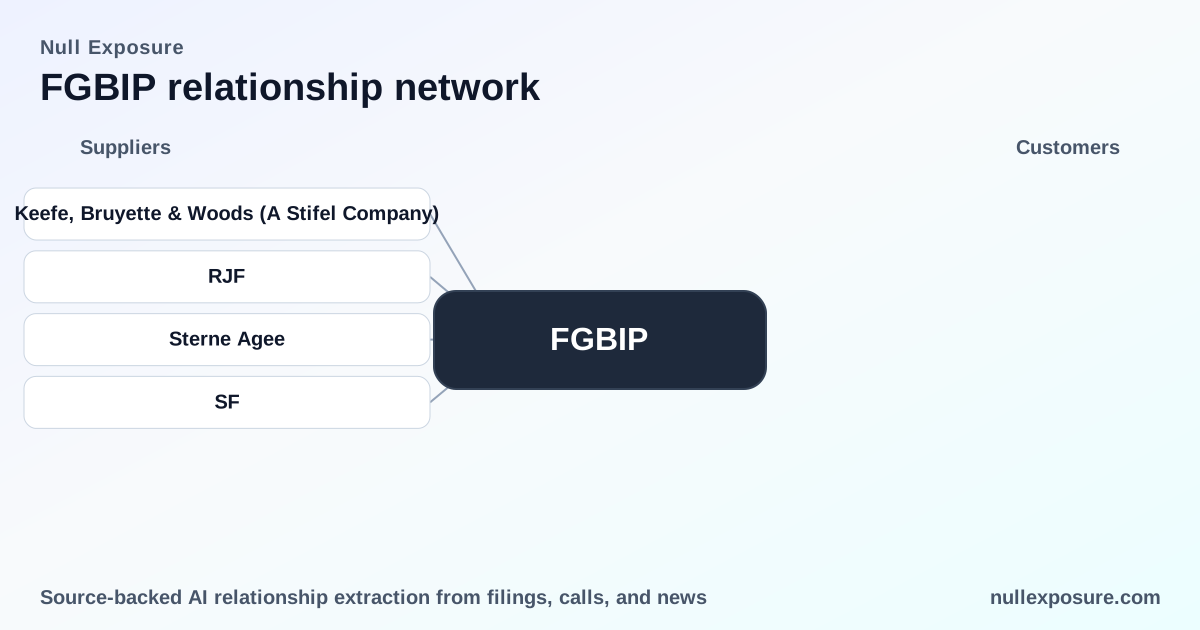
Raymond James acted as the underwriter for First Guaranty’s IPO, working alongside co-managers to structure and distribute the offering. This places Raymond James in an underwriting/advisory role on the company’s capital-market activities. Source: MarketBeat instant alert (Dec 4, 2025) and follow-up reporting tied to FY2025 activity — https://www.marketbeat.com/instant-alerts/first-guaranty-bancshares-nasdaqfgbi-stock-crosses-below-50-day-moving-average-whats-next-2025-12-04/.
Keefe, Bruyette & Woods (A Stifel Company) — co-manager on equity issuance
Keefe, Bruyette & Woods served as a co-manager on the IPO alongside Raymond James and Sterne Agee, positioning the firm as a collaborator on FGBI’s capital-raising and investor relations execution. Public coverage lists KBW in the syndicate for FY2025 capital market work. Source: MarketBeat instant alert (Dec 4, 2025) — https://www.marketbeat.com/instant-alerts/first-guaranty-bancshares-nasdaqfgbi-stock-crosses-below-50-day-moving-average-whats-next-2025-12-04/.
Sterne Agee — co-manager participation in public offering
Sterne Agee joined Raymond James and KBW as a co-manager on the IPO, reflecting a typical regional-bank syndicate structure that mixes national and specialty bank-focused underwriters. This relationship speaks to the firm’s access to targeted investor channels for regional financial issuers. Source: MarketBeat instant alert (Dec 11, 2025) and related FY2025 coverage — https://www.marketbeat.com/instant-alerts/first-guaranty-bancshares-nasdaqfgbi-director-purchases-3405000-in-stock-2025-12-11/.
What the full relationship set tells investors about operating posture
Taken together, these supplier engagements show two consistent characteristics: capital-market reliance on established underwriters for distribution and a continued use of third-party security services for cyber and controls. Market commentary for FY2025 confirms the syndicate role for Raymond James, KBW, and Sterne Agee on the IPO, while corporate disclosures flag third-party security penetration testing and an explicit program to replace external providers with lower-cost or internal solutions.
- Contracting posture: First Guaranty uses standard underwriting and advisory relationships for capital formation while outsourcing targeted operational tasks (penetration testing, security evaluations). Company statements explicitly note engaging third-party services for security testing and a concurrent program to reduce external service spend.
- Concentration and criticality: Underwriting partners are transactional and replaceable within capital markets, but security-service suppliers are strategically critical because they touch compliance and regulator-facing controls.
- Cost discipline and maturity: The company is actively replacing some third-party providers with lower-cost alternatives or internal capabilities, signaling cost focus and an operational push toward insourcing where feasible. This suggests a pragmatic, bank-style maturity curve rather than indiscriminate outsourcing.
These observations are grounded in company-level constraint evidence: corporate language confirms both the use of external security testing and an initiative to reduce reliance on external providers through lower-cost vendors or internal solutions (company disclosures summarized in FY2025 commentary).
For a single interface to monitor these supplier dynamics and related risk signals, go to https://nullexposure.com/.
Investment implications and risk checklist
- Capital-markets dependency is normal and substitutable. Relationships with Raymond James, KBW, and Sterne Agee are standard underwriting arrangements that support liquidity and access to capital when needed; these are not long-term lock-ins.
- Security outsourcing is a higher-priority operational risk. Third-party penetration testing and security evaluations are essential control functions; the company’s program to replace providers signals cost pressure but also potential transition risk if internal capabilities are not fully mature.
- Cost-cutting can improve margins but raises execution risk. Replacing established third parties with lower-cost vendors or internal teams reduces vendor spend but creates a window of elevated operational risk; investors must watch implementation milestones and any regulator commentary on control robustness.
- Regulatory and reputational tail risk is asymmetric. A failure in security testing or a mishandled transition would attract disproportionate regulatory attention relative to underwriter performance.
How investors should monitor these relationships
- Track proxy and 10-K/10-Q disclosure language around third-party risk, penetration testing, and vendor transitions each quarter.
- Watch syndicate announcements tied to capital raises for changes in underwriter mix that could indicate shifting capital access.
- Monitor regulatory filings and local press coverage for any control-related findings tied to transition programs.
For an organized view of supplier exposures and ongoing monitoring tools, visit https://nullexposure.com/ to see how these relationships map to operational risk.
Bottom line
First Guaranty’s supplier picture is conventional for a regional bank: underwriting relationships that support capital access, and third-party security providers that are operationally critical. The explicit corporate program to reduce third-party costs signals disciplined margin management but introduces execution risk during the transition to lower-cost providers or internal teams. Investors should treat underwriting partners as fungible market relationships and reserve heightened scrutiny for security and controls vendors where failures translate to regulatory and reputational losses.