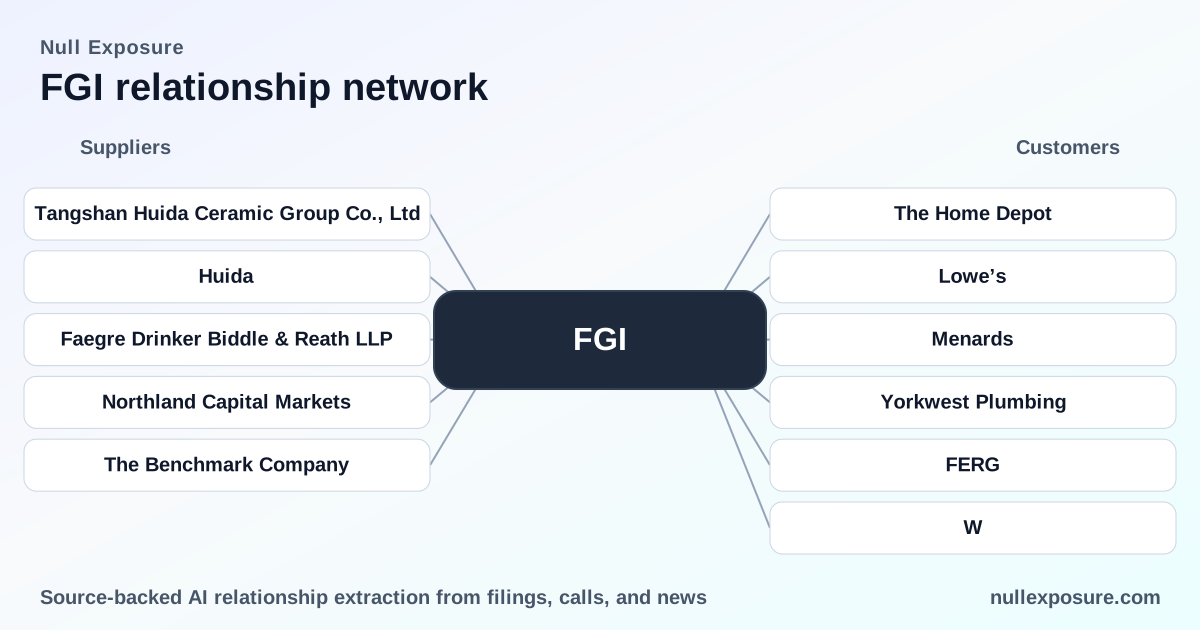
FGI Industries Ltd — supplier map, concentration risk, and what investors need to know
FGI Industries Ltd is a branded supplier in the home furnishings and fixtures segment that monetizes by sourcing sanitaryware and related products from third‑party and Foremost‑owned manufacturers and selling those products into wholesale and retail channels. The company operates with a high supplier concentration in Asia, a manufacturing outsourcing posture, and long‑term supplier arrangements that make procurement continuity a core determinant of near‑term margins and working capital dynamics. For investors assessing supplier risk and counterparty exposure, the Huida relationship and the firm’s capital‑markets partners define the most material operational levers today.
Visit https://nullexposure.com/ for more supplier intelligence.
Executive summary: why the supplier map matters for valuation
FGI’s revenue base (~$136M trailing twelve months) and thin operating margins mean that supplier disruptions or pricing shifts at a dominant vendor will transmit quickly to profitability and cash conversion. The company reports single‑vendor concentration metrics that qualify Huida as a critical supplier; contract language and geography point to long‑term, Asia‑based manufacturing reliance. Meanwhile, FGI’s underwriters and counsel from its spin‑off/IPO form the governance and capital‑markets layer that shaped its public listing and access to capital. These two axes — operational sourcing and capital‑markets support — are the practical levers investors should monitor.
Full relationship roll‑call (every result from the public record)
Below I list every relationship surfaced in FGI’s supplier scope, with a concise one‑ to two‑sentence plain‑English summary and the source reference.
-
Tangshan Huida Ceramic Group Co., Ltd (Huida) — Tangshan Huida supplies the majority of FGI’s sanitaryware and accounted for approximately 69.6% of the company’s accounts payable balance as of December 31, 2024, indicating both purchase volume concentration and payment exposure. According to FGI’s 2024 Form 10‑K, Huida is the primary source for sanitaryware. (Source: FGI 2024 Form 10‑K, FY2024)
-
Huida — Restating the disclosure: Huida accounted for 69.6% of total accounts payable as of December 31, 2024, underscoring the vendor’s outsized share of payable balances on the balance sheet. This specific excerpt is also from the company’s FY2024 Form 10‑K. (Source: FGI 2024 Form 10‑K, FY2024)
-
Faegre Drinker Biddle & Reath LLP — Faegre Drinker served as legal counsel to FGI in connection with its spin‑off and IPO transactions, providing the corporate and securities law representation that supported FGI’s path to public markets. (Source: Faegre Drinker firm web post recalling the FGI spin‑off and IPO, referenced FY2022 transaction materials)
-
Northland Capital Markets — Northland Capital Markets acted as one of the underwriters on FGI’s offering, positioning the firm in the investor syndicate that executed the public equity issuance. (Source: Faegre Drinker client/transaction page noting underwriters for the offering, referenced FY2022)
-
The Benchmark Company — The Benchmark Company was also an underwriter on FGI’s offering and participated in the underwriting syndicate that launched the company as a public issuer. (Source: Faegre Drinker client/transaction page noting underwriters for the offering, referenced FY2022)
What the disclosure constraints tell us about how FGI operates
FGI’s public disclosure contains several explicit signals about its operating model and supplier posture. These are company‑level structural characteristics unless the excerpt names a specific vendor.
-
Long‑term contracting posture. FGI states it maintains long‑term agreements with sanitaryware suppliers with terms “ranging from one year, renewable, to perpetuity,” which indicates contractual stability for key inputs and a preference for durable supplier relationships rather than spot procurement. (Company 10‑K language, FY2024)
-
Geographic manufacturing concentration in APAC. The majority of manufacturing is outsourced to Foremost‑owned facilities and third‑party manufacturers primarily based in China and parts of Southeast Asia; this is a structural geographic concentration that creates regional risk (logistics, tariffs, policy, and geo‑political exposure). (Company 10‑K language, FY2024)
-
Supplier role and manufacturing outsourcing. FGI operates largely as an outsourcing integrator — it sources finished sanitaryware from manufacturers rather than producing those core items in‑house, making supplier relationships functionally equivalent to internal capacity. (Company 10‑K language, FY2024)
-
Vendor materiality is critical for Huida. Tangshan Huida is explicitly called out as material: for FY2024 it accounted for 55.5% of the company’s total purchases and 69.6% of accounts payable, which elevates Huida to a critical single‑supplier risk. Because this constraint names Huida directly, treat this as a vendor‑level concentration risk rather than a generic company signal. (Company 10‑K language, FY2024)
If you track working capital volatility, supplier credit terms, or negotiate alternative sourcing, Huida’s dominance is the first operational counterparty to model.
Risk and opportunity for investors
-
Concentration risk is the dominant operational threat. With a single supplier responsible for more than half of purchases, any disruption — quality control, pricing renegotiation, capacity constraints, or geopolitical trade issues — will have disproportionate earnings and cash‑flow impact. This is reflected in the company’s thin margins and modest market capitalization. (FGI 2024 Form 10‑K)
-
Contract structure provides partial mitigation. Long‑term agreements reduce the immediacy of supply shocks but do not eliminate counterparty or geographic risk; the contracts' existence means disruption would be more likely operational (manufacturing downtime, logistics) than contractual in the short term. (FGI 2024 Form 10‑K)
-
Capital markets support is mature enough for listing but not a substitute for operational diversity. Legal counsel and underwriting relationships (Faegre Drinker, Northland, Benchmark) facilitated the firm’s market access; ongoing capitalization will depend on the company’s ability to stabilize margins and reduce vendor concentration. (Faegre Drinker web post, FY2022)
Mid‑analysis reading and tools for deeper diligence are available at https://nullexposure.com/ — use the platform to monitor counterparty concentration and filing excerpts in real time.
Actionable monitoring checklist for operators and investors
- Track quarterly changes to accounts payable composition and purchases to see if Huida’s share is shifting.
- Monitor contract renewal dates and any public indications of renegotiation or price adjustments with Asian suppliers.
- Watch logistics and tariff headlines affecting China/SE Asia manufacturing that could compress margins or extend lead times.
- Review any filings or press releases that name new manufacturing partners or disclose capacity investments reducing single‑vendor reliance.
For a deeper analysis of supplier contracts, counterparties, and exposure modeling, visit https://nullexposure.com/ for curated supplier intelligence and filing‑level evidence.
Bottom line
FGI’s commercial model is straightforward but concentrated: it outsources core sanitaryware manufacturing to Asia, relies heavily on Huida for purchases and payables, and used established legal and underwriting partners to access public capital. That concentration is the principal investment lever — it can produce stable supply under long‑term contracts, but it also concentrates operational risk. Investors should prioritize monitoring vendor concentration metrics, contract renewals, and Asia‑specific supply‑chain developments as the most direct determinants of near‑term valuation outcomes.