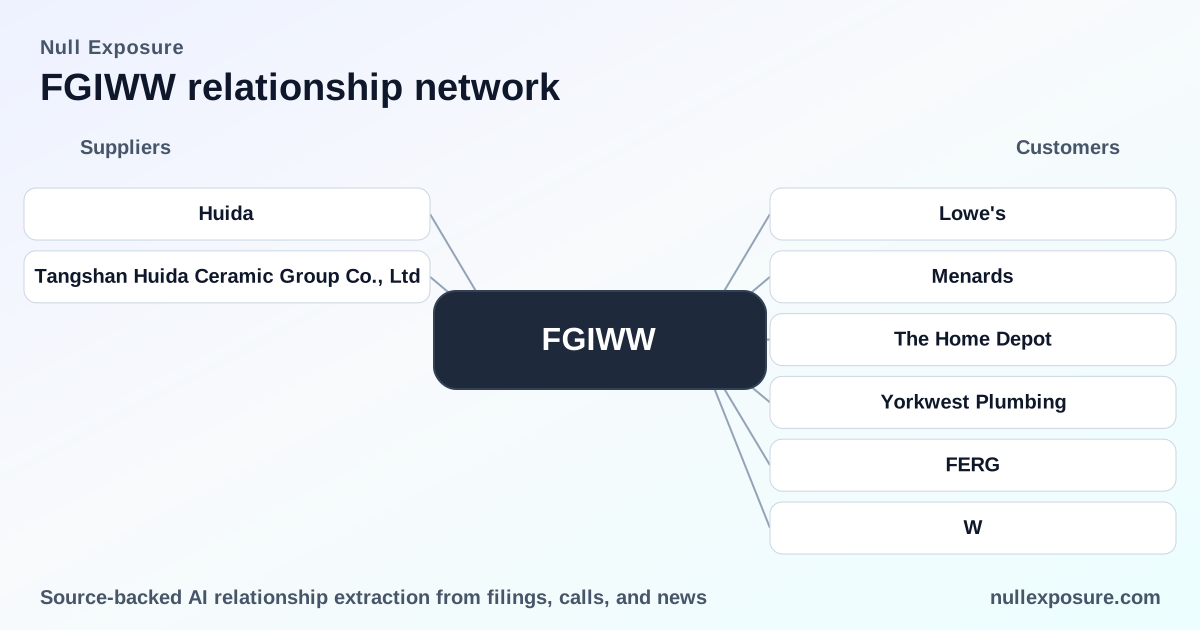
FGI Industries (FGIWW) — Supplier Concentration Risk and Operational Takeaways
FGI Industries monetizes by sourcing and selling sanitaryware products while outsourcing the bulk of manufacturing capacity to third parties; revenue flows from product sales while the company’s operating model leverages low-capital manufacturing relationships to scale. The economics depend on outsourced production, concentrated supplier relationships, and working-capital dynamics as reflected in FY2024 financials and disclosures. If you evaluate counterparties or underwrite exposure to FGIWW, focus on supplier concentration, contract tenor, and AP aging as primary operational levers. For more detailed supplier intelligence and relationship mapping, visit https://nullexposure.com/.
How FGI runs its supply chain in plain terms
FGI’s public disclosures describe a business that outsources most sanitaryware manufacturing to Foremost-owned facilities and several third-party manufacturers concentrated in China and Southeast Asia. The company operates with long-dated supplier agreements and a small number of large vendors that carry outsized accounts-payable balances — a structure that trades manufacturing asset intensity for vendor dependence and working-capital sensitivity.
Who supplies FGI — the two relationships in the filing
Tangshan Huida Ceramic Group Co., Ltd (Huida) supplies the majority of FGI’s sanitaryware products and is the company’s principal manufacturing partner, underlying both product flow and payables exposure; the FY2024 Form 10‑K states Huida supplies the majority of sanitaryware and accounted for approximately 69.6% of accounts payable as of December 31, 2024. According to FGI’s 2024 Form 10‑K, this is the primary supplier relationship and a core operational dependency.
Huida (listed again in the filing summary) is identified as the single supplier representing 69.6% of total accounts payable at year-end 2024, making the vendor a critical counterparty for working-capital and continuity of supply. The FY2024 disclosure quantifies the vendor concentration directly in accounts‑payable balances. (Source: FGI Industries 2024 Form 10‑K, filed for FY2024.)
What the constraints in the filing say about the business model
FGI’s constraints provide clear signals about how the company contracts and where operational fragility resides:
-
Contracting posture — long-term orientation. The company states it has long-term agreements with sanitaryware suppliers “for terms ranging from one year, renewable, to perpetuity,” indicating multi-year vendor commitments that increase predictability but also lock in dependency and sourcing pathways. This is a company-level signal.
-
Geography — APAC concentrated sourcing. FGI outsources primarily to suppliers based in China and parts of Southeast Asia, concentrating supply‑chain risk regionally and tying FGI’s operations to APAC manufacturing capacity and geopolitical, logistics, and currency volatility. This is a company-level signal.
-
Materiality & concentration — single critical supplier. Tangshan Huida Ceramic Group Co., Ltd is explicitly named as supplying the majority of sanitaryware and accounting for ~69.6% of accounts payable, marking it as a critical, high-concentration supplier whose disruption would materially impair operations. This constraint excerpt names the relationship directly and therefore is attributed to Huida.
-
Relationship roles — buyer and manufacturer dynamics. The disclosures reference purchases from related parties and Foremost-owned facilities plus third-party manufacturers, signaling that FGI functions primarily as a buyer while relying on external manufacturing capacity. This framing suggests low fixed-asset intensity at FGI and high counterparty reliance for production continuity. This is presented as a company-level characteristic since the excerpt does not name a specific vendor.
Investor implications — what to watch and why it matters
The filing constructs a clear risk/reward trade-off for investors and operators:
-
Concentration risk is the top operational exposure. With one supplier representing almost 70% of AP, any financial stress, quality issue, or capacity constraint at Huida will transmit immediately to FGI’s P&L and working capital. That concentration reduces negotiating leverage and elevates supplier counterparty risk. (Source: FGI 2024 Form 10‑K.)
-
Long-term contracts reduce short-run volatility but raise strategic lock‑in. Contract tenors that extend beyond a year create predictable supply but make rapid supplier substitution difficult, increasing the cost of addressing supplier failure or geopolitical shifts. This is a company-level disclosure.
-
APAC sourcing means regional risk exposure. Logistics disruptions, tariff shifts, or regulatory changes in China/Southeast Asia could materially affect lead times and input costs. The filing’s geographic detail frames these as primary sourcing regions.
-
Working-capital sensitivity. High accounts-payable concentration implies that vendor payment terms and supplier financing are central to liquidity management; any deterioration in supplier relationships could force either inventory build-up or cash strain. (Source: FY2024 financial disclosures summarized in the 10‑K.)
If you are evaluating FGIWW exposure, prioritize counterparty stress-testing around Huida and stress scenarios that extend supply lead times, increase input costs, or tighten payment terms.
For a deeper look at supplier exposures across peers and to model counterparty scenarios, see https://nullexposure.com/.
Practical mitigants operators and investors should track
Operational teams and investors should monitor a short set of high-leverage indicators:
- Contract renewal cadence and termination clauses for the Huida relationship.
- Accounts-payable aging and any concentration trends quarter-over-quarter.
- Inventory days and changes in lead times from APAC suppliers.
- Evidence of dual-sourcing initiatives or capital investments to onshore/near‑shore manufacturing.
- Related-party purchase disclosures and any changes in purchase volumes that could indicate shifting supply relationships.
These items are actionable and can be tracked in quarterly filings and supplier communications.
Bottom line and recommended next steps
FGI’s supply model offers scalability through outsourcing but concentrates operational and liquidity risk in a single dominant APAC supplier — Huida — which accounted for roughly 69.6% of accounts payable in FY2024. Long-term contracts increase predictability but raise strategic lock-in and raise the cost of supplier failure. Investors should treat supplier concentration as a primary factor in valuation and covenant stress testing; operators should pursue diversification or contingency arrangements to reduce single-vendor exposure.
For a structured supplier-risk scorecard and deeper relationship maps, visit https://nullexposure.com/. Conduct targeted due diligence on Huida’s financial health, contractual remedies, and FGI’s contingency plans as the next step in underwriting or operating oversight.