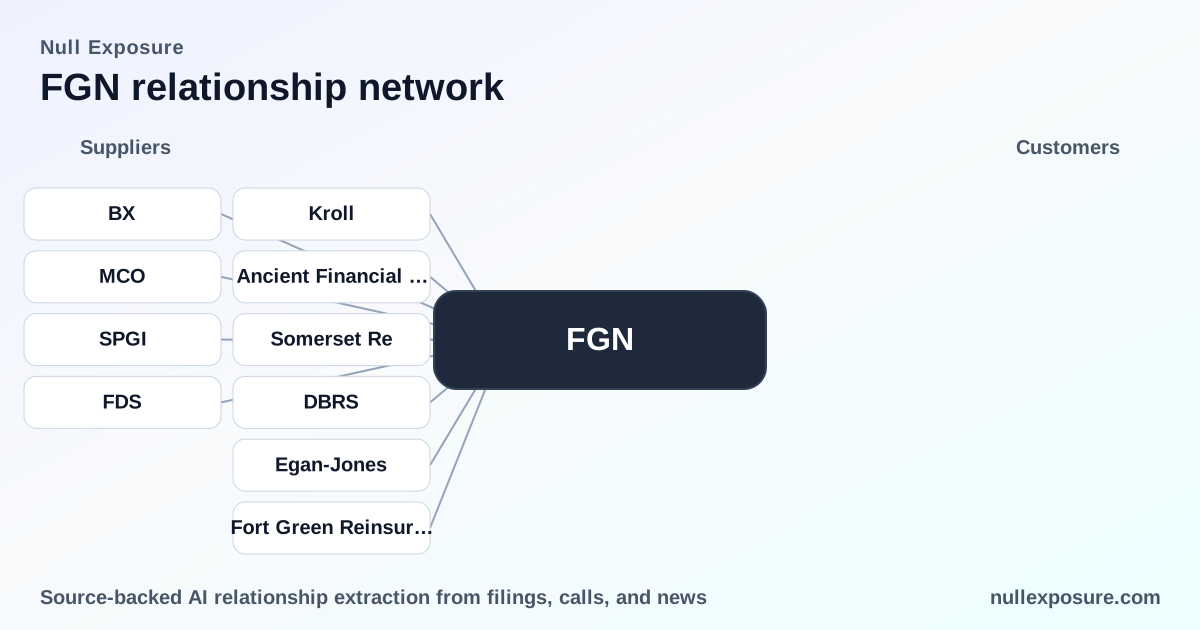
F&G Annuities & Life (FGN): supplier relationships that shape capital, hedging and reinsurance risk
F&G Annuities & Life monetizes by selling fixed annuities and life insurance and then managing the spread between guaranteed liabilities and invested assets; the business relies on reinsurance, external asset managers, rating agencies and private capital partners to protect capital, hedge indexed exposures and support growth. Investor focus should be on counterparty concentration, the maturity of reinsurance and capital relationships, and how third‑party managers and rating providers influence funding and capital efficiency.
For a deeper supplier-risk view across dozens of counterparties, visit https://nullexposure.com/.
How F&G runs the engine: contracts, capital and where suppliers sit in the value chain
F&G’s operating model is built around three monetization levers: (1) originating fixed annuity and life liabilities, (2) investing premiums to generate spread, and (3) transferring or sharing risk through reinsurance and hedging. The company outsources a large proportion of asset management and uses structured capital and reinsurance deals to dampen volatility and free up capital—so supplier relationships are central to execution and solvency.
The company’s contracting posture shows a preference for framework agreements and standardized legal constructs: management confirmed use of ISDA master agreements for derivatives, which signals a standardized, counterparty‑managed hedging program. At the same time F&G retains short‑term liquidity lines (a revolving credit facility at floating rate) that reflect tactical cash management rather than long‑term bank financing. These corporate constraints point to an operator that is nimble on funding but dependent on counterparties for hedging and capital deployment.
Supplier map: every named partner and why each matters
Below are all relationships named in the most recent disclosures, each with a plain-English summary and the source for that mention.
-
Kroll — Kroll is listed among the top five rating or external agencies whose ratings cover most of F&G’s fixed income holdings, indicating reliance on third‑party credit opinions for portfolio oversight. According to F&G’s 2025 Q4 earnings call, the company’s private origination and fixed income portfolios are largely rated by Moody’s, S&P, Fitch, Kroll and DBRS (2025 Q4 earnings call, March 2026).
-
DBRS — DBRS is also part of the core set of agencies covering roughly 90–94% of F&G’s fixed income exposure, reinforcing that multiple rating providers are used for credit assessment and capital planning (2025 Q4 earnings call, March 2026).
-
Moody’s (MCO) — Moody’s is one of the principal agencies rating F&G’s private origination debt and fixed income portfolio, a material input for capital and risk modeling (2025 Q4 earnings call, March 2026).
-
S&P (SPGI) — S&P likewise contributes to the multi‑agency rating coverage that underpins the firm’s portfolio governance and regulatory capital discussions (2025 Q4 earnings call, March 2026).
-
Fitch (FDS) — Fitch completes the set of major agencies cited as covering most of the company’s fixed income book (2025 Q4 earnings call, March 2026).
-
Egan‑Jones — Egan‑Jones ratings are de minimis for F&G, representing less than 1% of the retained portfolio, indicating limited reliance on this smaller ratings firm (2025 Q4 earnings call, March 2026).
-
Blackstone (BX) — Blackstone is a long‑standing capital partner; management described a “strong and seasoned relationship” extending eight to nine years, and a March 2026 Artemis report noted Blackstone‑managed funds backing a $1 billion life and annuities reinsurance sidecar for F&G (earnings commentary and Artemis news, FY2025–2026).
-
Fort Green Reinsurance — Fort Green Reinsurance is identified in news coverage as the vehicle providing long‑term, on‑demand capital to support F&G’s life and annuity business and to moderate volatility as part of a sidecar structure backed by private capital (Artemis report, FY2025).
-
Somerset Re — Somerset is named among F&G’s reinsurance partners and was discussed in the supplement to the earnings call in the context of reinsurance relationships and market connections to other industry transactions (2025 Q4 earnings call, March 2026).
-
Ancient Financial Holdings LP — F&G disclosed a capital transaction to sell F&G Life Re Limited, its Bermuda affiliate-only reinsurer, to Ancient Financial Holdings LP with the transaction effective March 1, which represents a portfolio and structural capital change—management flagged this as an on‑track closing in Q1 (2025 Q4 earnings call, March 2026).
Each mention above comes from the company’s 2025 Q4 earnings call or contemporaneous market reporting; see the Q4 earnings materials (March 2026) and Artemis coverage (March 2026) for the full context.
For a consolidated view of supplier risk and deal flow, explore our platform at https://nullexposure.com/.
What the constraints tell investors about F&G’s business model
The disclosed constraints and excerpts shape a clear picture of F&G’s supplier risks and commercial posture:
-
Contracting posture — standardized and enforceable. Management requires ISDA Master Agreements for derivatives, which signals disciplined, standardized counterparty documentation for hedging. This reduces legal friction and speeds execution, but it also formalizes exposures to dealer counterparties.
-
Concentration of reinsurance risk — material and active. The company admits material concentration with several third‑party reinsurers (Aspida Life Re, Wilton Re, Somerset and Everlake), and flow reinsurance arrangements with Everlake and Somerset are active (transactions effective in 2023). This concentration creates a single‑point risk for liability transfer and capital relief.
-
Critical reliance on third‑party asset management. Approximately 81% of a $60 billion investment portfolio is managed by a named external manager (BIS) per management’s disclosure, with only 1% internally managed. That degree of outsourcing is operationally efficient but heightens dependency on a small set of managers for execution and counterparty controls.
-
Short‑term liquidity posture. The company maintains a short‑term revolving facility at a floating rate, indicating willingness to use short‑dated financing for liquidity needs rather than locking long‑term bank credit.
-
Hedging counterparties are buyers and structured dealers. F&G buys OTC equity index options from approved broker‑dealer derivative counterparties; that is the primary route for hedging indexed annuities and IUL exposure, confirming exposure to dealer counterparty and market liquidity risk.
These constraints collectively describe a firm that is operationally mature and contractually standardized, but exposed to concentrated counterparties—particularly in reinsurance and external asset management. Investors should weigh the benefits of capital-efficient reinsurance and private capital sidecars against the operational and counterparty concentration risks they introduce.
What operators and investors should monitor next
- Counterparty health and collateral mechanics for major reinsurers and brokerage counterparties. Stress the capitalization and credit lines of Aspida/Wilton/Somerset/Everlake where disclosed.
- Performance and alignment of Blackstone/Fort Green capital commitments under the sidecar structure, since these drive available on‑demand capital.
- Third‑party manager governance and service agreements with BIS; 81% outsourced is a single cluster worth ongoing oversight.
For more supplier-level intelligence and to modelThese exposures into your investment thesis, see our in-depth supplier reports at https://nullexposure.com/.
F&G’s model delivers attractive capital leverage when counterparties perform; the key investor question is whether that counterparty set remains diversified and resilient through stress. For continual monitoring and supplier analytics that surface these exact relationships and constraints, visit https://nullexposure.com/ and subscribe to supplier alerts.