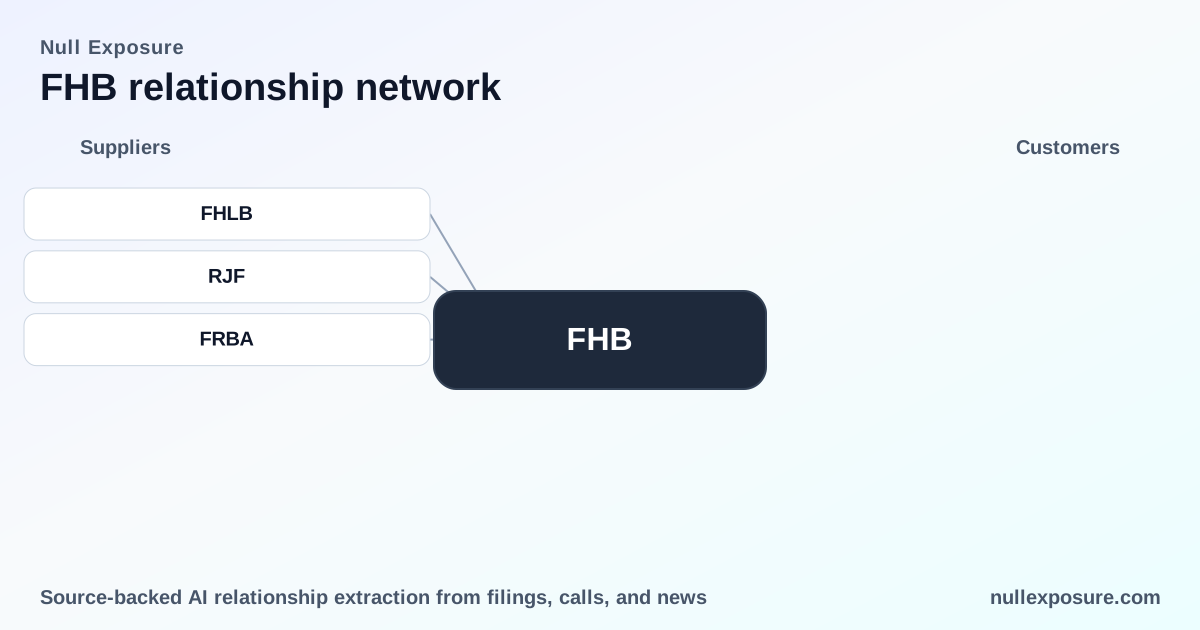
First Hawaiian Inc (FHB) — supplier and counterparty map that matters for credit and operations
First Hawaiian, Inc. is a regional bank holding company that monetizes a franchise on net interest margin, fee income from deposit and loan services, and wealth-management brokerage flows; the balance sheet tilts toward interest-bearing assets and government-backed securities while liquidity is supplemented by committed borrowings. Investors should treat FHB as a deposit-funded, interest-margin-driven regional bank with material external funding and outsourced service dependencies that directly affect operational resilience and funding optionality. For deeper supplier and counterparty intelligence, visit https://nullexposure.com/.
How to read FHB’s supplier signal: liquidity partners, broker-dealer transition, and IT dependencies
First Hawaiian’s public disclosures surface three supplier/counterparty relationships that are functionally distinct: central bank and Federal Home Loan Bank funding lines, and a wealth-management platform transition to an external broker-dealer. Each relationship influences either liquidity/funding policy or fee-generation capability; together they shape the bank’s operational and market risk profile.
FHLB — committed liquidity and short-term advance
First Hawaiian reports borrowing capacity and active advances with the Federal Home Loan Bank (FHLB); the FY2026 filing noted both a large committed borrowing line and a discrete $250 million short-term fixed-rate FHLB advance that matured in September 2025. According to the company’s FY2026 10‑K as reported on TradingView, the firm holds $1.5 billion in cash and cash equivalents and borrowing capacity of $3.3 billion from the FHLB, and earlier disclosures show a $250.0 million short-term FHLB advance at a 4.16% weighted average rate (maturing September 2025). (TradingView, FY2026; company 10‑K disclosures.)
FRB — emergency and routine Federal Reserve access
First Hawaiian discloses borrowing capacity with the Federal Reserve Bank (FRB) on terms that augment its liquidity runway; the FY2026 10‑K cited equal borrowing capacity of $3.3 billion from both the FHLB and the FRB as part of its liquidity position. This is a structural funding backstop that underpins the bank’s liquidity policy and short-term funding contingency planning. (TradingView, FY2026 company filing.)
Raymond James Financial — broker-dealer platform transition in wealth
The company is executing a strategic operational shift in wealth management by transitioning its broker-dealer platform to Raymond James Financial; local reporting noted that the transition is part of leadership and platform realignment in FHB’s wealth unit. The move changes the operational counterparty for broker-dealer services and fee flows, and will reconfigure revenue capture and operational integration around Raymond James’ platform. (Maui Now, Feb 24, 2026.)
What the constraints tell investors about FHB’s operating model
The contract and constraints signals in FHB’s filings reveal a mix of long-duration real estate exposure, concentrated funding counterparties, and critical third-party IT dependencies:
- Long-term real estate commitments: First Hawaiian is the lessee on noncancelable operating leases for branches extending up to 39 years with rent adjustments tied to economic indices, indicating a highly committed physical footprint and limited short-term flexibility on premises costs. This is a company-level structural fact that shapes fixed-cost sensitivity to revenue shocks.
- Short-term borrowing exposure tied to FHLB: The presence of a $250 million short-term FHLB advance is explicit in the disclosure and signals episodic utilization of wholesale sources; this same excerpt supports a 100M+ spend band designation because it represents material short-term funding activity with a single counterparty. This is a relationship-specific constraint tied to FHLB (company 10‑K disclosures).
- Dependence on third‑party IT and service providers: The filing warns that operations depend “to a significant extent” on third-party service providers for information technology; this is a company-level operational-criticality signal and flags outsourced IT as a single point of operational risk that can interrupt customer-facing banking services if a vendor fails or is not replaced promptly.
- Balance-sheet buyer role and conservative securities mix: The bank’s available-for-sale and held-to-maturity securities are primarily U.S. Government and agency debt and MBS, indicating a conservative investment posture and a buyer role in government-backed fixed income that supports liquidity and regulatory capital management.
Collectively, these constraints show a banking operator with material long-duration real estate commitments, concentrated wholesale funding lines, and critical outsourced IT dependencies — a profile familiar to regional banks but one that requires active funding and vendor risk management by operators and counterparties.
Where risk and opportunity concentrate
- Liquidity and funding execution is the principal near-term operational risk: committed FHLB and FRB capacity provides meaningful backstops, but documented short-term advances and reliance on wholesale lines mean that funding tenor and roll-over economics should be monitored by investors for stress scenarios. (TradingView, FY2026 10‑K.)
- Wealth-management transition to Raymond James is an operational opportunity to scale fee income without maintaining an in‑house broker-dealer, but it also shifts execution risk to the third-party operator during migration and post-integration. (Maui Now, Feb 24, 2026.)
- Vendor concentration in IT is a non-financial risk that is nonetheless critical to customer experience, compliance, and the bank’s ability to process transactions and loans; management’s vendor-replacement flexibility is a key governance metric for underwriters and corporate borrowers.
If you want a concise, actionable map of these counterparty relationships and the associated operational constraints, check the supplier overview at https://nullexposure.com/.
Short, practical checklist for investors and operators
- Confirm the status and utilization of FHLB and FRB facilities and the tenor of any short-term advances and their interest rates. (See FY2026 10‑K referenced in public summaries.)
- Review the timeline and integration plan for the Raymond James broker-dealer transition and any termination or transitional service arrangements that affect fee income.
- Validate vendor contingency plans for critical IT providers and ask management for replacement lead times and SLAs.
Final take: what to watch and next steps
First Hawaiian’s disclosed supplier relationships underscore a bank with solid liquidity buffers by headline measures but real funding and operational concentration beneath the surface. Investors should watch funding tenor, broker-dealer migration execution, and vendor resilience as leading indicators for short-term performance and operational risk outcomes.
For a structured supplier intelligence briefing and to monitor these counterparties over time, visit https://nullexposure.com/. For ongoing updates and deeper counterparty profiling, return to https://nullexposure.com/ — the analyst toolkit will help you track funding lines, vendor concentration, and post‑transition fee impact in one place.