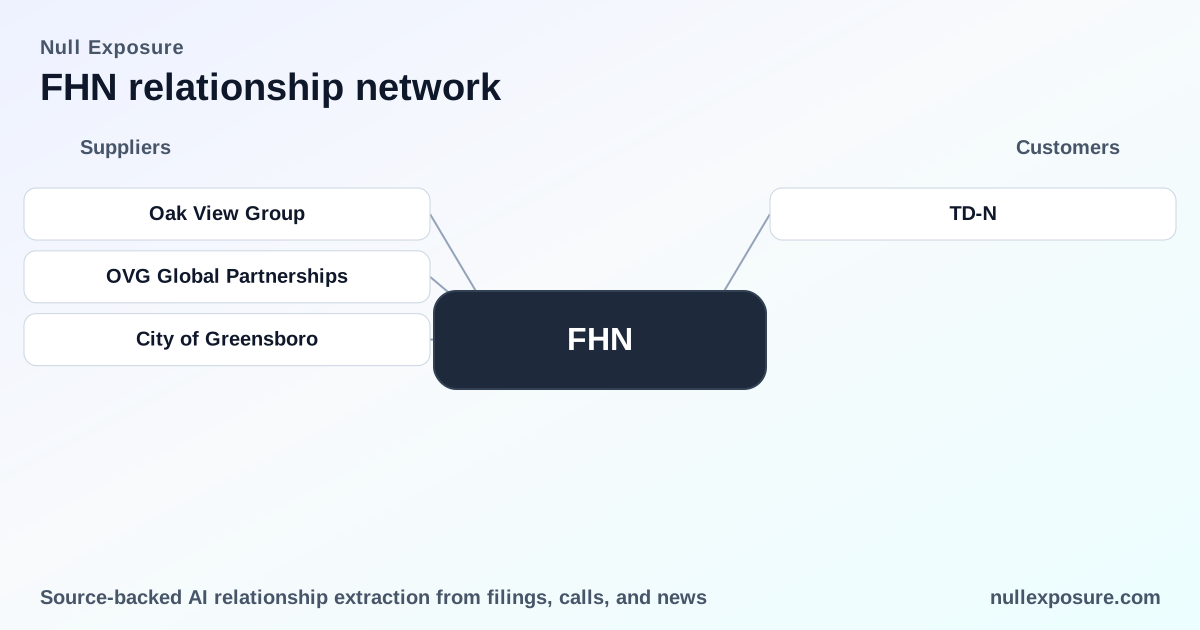
First Horizon (FHN) — supplier relationships, strategic signal, and downside vectors
First Horizon Corporation is a regional bank holding company that monetizes through traditional banking activities: net interest income from lending and deposit spreads, fee income from transaction services, and mortgage and treasury product origination. With trailing revenue of roughly $3.35 billion and a market capitalization near $10.8 billion (latest quarter 2025-12-31), First Horizon operates as a diversified regional lender with meaningful retail and commercial footprints across the Southeast. For investors evaluating supplier exposure, the recent disclosures and press activity highlight a mix of marketing/sponsorship suppliers and ongoing reliance on third‑party cybersecurity and control testing vendors — each carrying distinct commercial and operational implications. Learn more about supplier signals and monitoring at https://nullexposure.com/.
Why a naming-rights deal matters to investors (and what it does not)
A naming-rights partnership is not a material revenue driver for First Horizon, but it is a deliberately public play for regional brand amplification. The announced rebrand of the Greensboro Coliseum to the First Horizon Coliseum is a marketing investment designed to raise awareness among consumers and corporate clients in a target geography. From an investor perspective, this is a low‑criticality, visible supplier relationship that supports deposit-gathering and brand positioning rather than core credit or treasury operations.
At the same time, First Horizon’s vendor posture includes recurring use of third‑party firms to conduct security and control testing — a higher‑criticality operational relationship tied to compliance and financial reporting integrity. That dual profile — visible, low‑risk marketing partnerships alongside mission‑critical security suppliers — should shape how operators and counterparties prioritize negotiations and contractual terms.
Visit https://nullexposure.com/ for a consolidated view of supplier signals and governance implications.
Commercial partnerships: naming rights and who’s involved
Below are the relationships surfaced in public reporting. Each entry is concise, investor-oriented, and explicitly sourced.
Oak View Group
The venue management company Oak View Group is the operator partner for the Greensboro Coliseum Complex that agreed with First Horizon and the city to implement the new naming-rights program. According to a WFMY News2 report (March 9, 2026), Oak View Group remains the day‑to‑day operator coordinating the sponsorship deployment: https://www.wfmynews2.com/article/news/local/greensboro-coliseum-gets-a-new-name-first-horizon-coliseum/83-33533d78-26ed-4b20-8a12-b5e91331f8c0.
OVG Global Partnerships
OVG Global Partnerships, the sponsorship and naming-rights division of Oak View Group, secured the agreement that places First Horizon branding on the Coliseum, handling commercial terms and activation logistics. The same WFMY News2 article (March 9, 2026) credits OVG Global Partnerships with arranging the sponsorship: https://www.wfmynews2.com/article/news/local/greensboro-coliseum-gets-a-new-name-first-horizon-coliseum/83-33533d78-26ed-4b20-8a12-b5e91331f8c0.
City of Greensboro
The City of Greensboro is the municipal counterparty in the naming-rights arrangement and will host and approve the brand change as part of the Coliseum complex governance. WFMY News2 reported (March 9, 2026) that the partnership includes First Horizon, the City of Greensboro, and Oak View Group: https://www.wfmynews2.com/article/news/local/greensboro-coliseum-gets-a-new-name-first-horizon-coliseum/83-33533d78-26ed-4b20-8a12-b5e91331f8c0.
What the relationships collectively imply about First Horizon’s supplier strategy
- Brand-first marketing moves are visible but not core: Naming-rights deals are structured as finite commercial agreements designed to boost awareness; they do not substitute for balance‑sheet or fee-based growth but can support deposit flows where brand proximity matters.
- Operational robustness is outsourced where specialized: First Horizon contracts third‑party vendors to conduct periodic cybersecurity and controls testing — penetration tests, red team engagements, SOC 1 Type II attestations, PCI‑DSS attestations and SOX testing — which indicates a mature vendor-management posture that relies on external specialists for regulatory and technical assurance. This is a company-level signal derived from the firm’s disclosed controls and testing practices.
Key takeaway: marketing suppliers increase visibility; security and control suppliers are strategically critical and contractually sensitive.
Contracting posture, concentration, criticality, and maturity — a practitioner’s read
First Horizon shows a layered contracting posture: low‑dependency commercial sponsorships coexist with high-dependency compliance vendors. The disclosed evidence that the bank engages external firms for regular penetration testing, red team exercises, and SOC/SOX attestations signals repeatable procurement cycles, formal vendor oversight, and contractual continuity for security suppliers. These relationships are typically:
- High criticality for compliance and operational resilience (cybersecurity and SOC/SOX vendors).
- Lower criticality and shorter horizon for naming-rights and sponsorship partners.
- Indicative of a mature vendor-management program that retains external specialists for technical assurance rather than attempting in‑house replication.
For suppliers evaluating First Horizon as a customer, cybersecurity and controls engagements offer more durable revenue potential and stronger bargaining leverage than sponsorship arrangements, which are more promotional and episodic.
Risk and opportunity for investors and operators
- Opportunity: Regional brand investments can lift customer acquisition in targeted markets and support cross‑sell metrics without material capital outlay.
- Risk: Concentration in critical third‑party controls creates dependency on specialized vendors for regulatory attestations; any disruption to those services or deterioration in vendor performance can translate quickly into regulatory remediation costs and reputational exposure.
Operationally-focused investors and counterparties should monitor the bank’s vendor-disclosure cadence and any proxy or 10‑K language on vendor concentration and incident management.
Actionable next steps
- Ask management about vendor concentration and contract terms for cybersecurity and SOX/PCI attestations in the next earnings call. Prioritize understanding contract length, renewal terms, and service-level protections.
- Evaluate marketing ROI: request commentary on how the naming-rights deal is expected to drive deposits or commercial relationships in the targeted geography.
- Track vendor oversight disclosures and any material vendor-related incidents in regulatory filings.
For a centralized way to monitor supplier signals and governance implications across banking counterparties, visit https://nullexposure.com/.
Bottom line
First Horizon’s recent supplier visibility is a mixed signal: public-facing sponsorships provide brand uplift, while outsourced cybersecurity and control testing represent the bank’s most critical supplier relationships. Investors and operators should treat marketing suppliers as strategic but discretionary and treat security/control vendors as mission‑critical counterparts that warrant heightened contractual scrutiny. Explore further supplier and governance intelligence at https://nullexposure.com/.