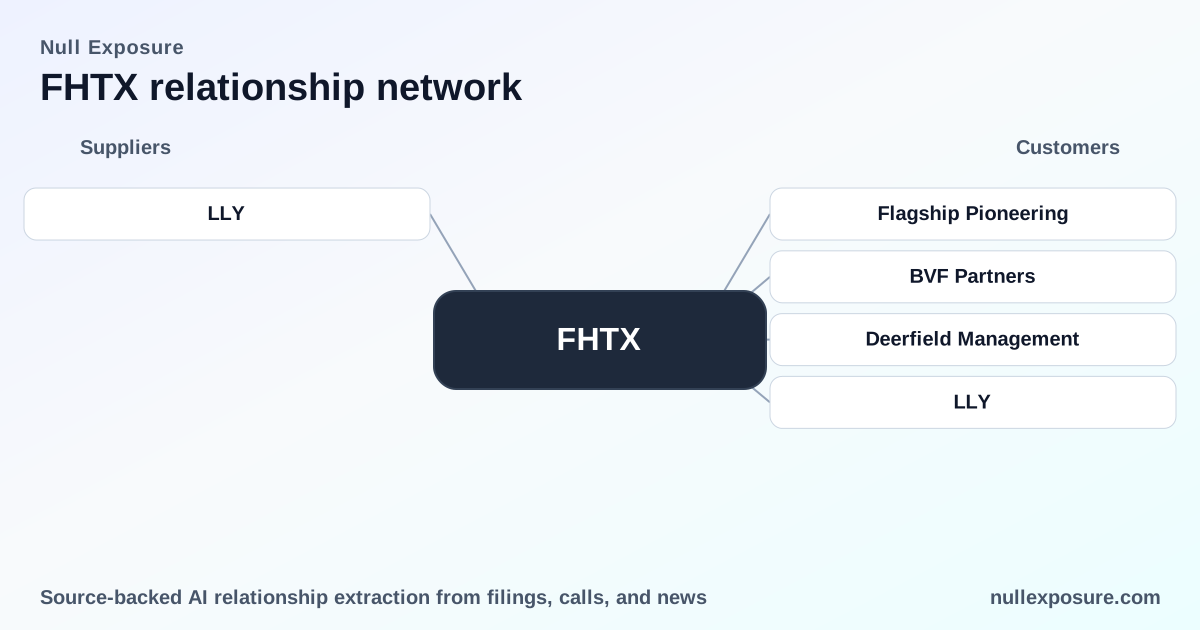
Foghorn Therapeutics (FHTX): supplier posture, the Lilly partnership, and what procurement-driven investors should watch
Foghorn Therapeutics is a clinical-stage biotechnology company that discovers therapies targeting chromatin regulatory mechanisms and monetizes primarily through collaborations and cost‑sharing partnerships with larger biopharma while it advances clinical assets. The company relies on third parties for discovery, preclinical and clinical manufacturing and trial operations, and it captures value through milestone payments, shared development economics and the upside of eventual commercialization or licensing. For a supplier- and partnership-focused view tailored to investment and operating decisions, review Nillexposure’s supplier intelligence here: https://nullexposure.com/.
How Foghorn runs the program: outsourced R&D and partnership economics
Foghorn does not operate internal manufacturing capacity; instead it pragmatically outsources discovery experiments, preclinical work, and clinical and commercial manufacturing to CDMOs and CROs. This operating model conserves capital and accelerates timelines by leveraging partner scale, but it also shifts execution risk and supply‑chain exposure onto third parties. Financially, the company’s model is built on shared-cost clinical collaborations, license economics and back‑ended value capture rather than product sales today: Foghorn’s revenue base is modest, its operating margins are negative, and it retains upside via partnership-driven milestone and royalty potential.
Key company snapshot: market capitalization roughly $292 million, revenue concentrated in early‑stage recognition, and a clinical-stage balance between cash conservation and external dependence.
Supplier posture and constraints — outsourcing is structural, not tactical
Foghorn’s contract posture is outsourcer-first. Company disclosures make three consistent signals:
- The firm does not maintain manufacturing facilities or personnel, and therefore depends on third-party manufacturers for preclinical and clinical supplies as well as potential commercial manufacture.
- Foghorn relies on CDMOs and CROs located outside the United States, explicitly flagging operations in China and the broader APAC region as part of its supply and research footprint.
- The organization uses third-party clinical investigators, CROs and consultants for trial execution and specific R&D tasks rather than internal teams.
These are company-level constraints: they define a contracting posture of dependency on external suppliers, create geographic concentration risks through APAC exposure, and imply criticality—because third parties execute core science and drug supply, any failure or disruption materially affects development timelines. The maturity profile is consistent with a clinical-stage biotech: capital-conserving outsourcing now, with the potential need to scale or dual-source if an asset advances toward commercialization.
Relationship inventory — every public supplier/partner mention
Below are the supplier and partner mentions surfaced in public reporting. Each item is presented with a concise, plain-English explanation and a source reference.
- Eli Lilly — MarketBeat coverage noted that Foghorn’s CEO highlighted the company’s most advanced efforts as being in partnership with Eli Lilly, pointing to the collaboration originally announced in December 2021. This frames Lilly as Foghorn’s strategic development partner for one of its lead programs (MarketBeat, Feb 13, 2026).
- Eli Lilly — Yahoo Finance reported that the Phase 1 study under this collaboration was operationally run by Eli Lilly with costs shared 50/50, and that dosing began around October 2024; that structure materially reduces Foghorn’s near-term cash burden while ceding operational control for that study to Lilly (Yahoo Finance, Mar 9, 2026).
Both entries are about the same counterparty but represent distinct public reportings: one emphasizes the partnership’s origin and strategic position; the other details the operational and cost-sharing terms of an active Phase 1 study.
What the Lilly relationship and supplier posture mean for investors and operators
The Lilly collaboration is strategically important because it gives Foghorn access to a large partner’s operational and clinical infrastructure while sharing development costs. The cost‑share structure (50/50 for the cited Phase 1) lowers funding pressure for Foghorn and accelerates execution, but it also gives Lilly operational control of the clinical program in practice—this shifts timeline and data‑generation dependency to the partner.
From a supplier-risk perspective, the company’s APAC exposure and reliance on outsourced manufacturing are material. Key implications:
- Concentration/criticality: Outsourced CDMOs and a single large pharma partner for major programs create single points of failure in the development timeline.
- Contracting posture: Foghorn is in a buyer role for services but in a co‑development posture with partners like Lilly; operational control and SLAs for running trials are negotiated tradeoffs against shared costs.
- Maturity and go‑to‑market risk: As a clinical-stage company without internal manufacturing, Foghorn will need to either scale its supplier base or negotiate robust dual‑sourcing and transition plans if a program advances to late‑stage/commercial scale.
If you are evaluating exposure or supplier risk, Nillexposure has deeper supplier maps and contract posture intelligence here: https://nullexposure.com/.
Practical takeaways for procurement, legal, and investors
- Demand visibility into CDMO/CRO footprints and contingency plans—know which suppliers sit in APAC and what backup capacity exists.
- Insist on clear SLAs, data access rights, and governance language in co‑development agreements so operational control by a partner does not blindside investors or operators.
- Stress‑test cost‑share clauses and milestone payment triggers to understand cash‑flow implications should pace or scope change.
Final assessment and action items
Foghorn’s model is coherent for a clinical-stage biotech: partner to conserve cash, outsource to accelerate, and retain upside through milestones or licensing. The collaboration with Eli Lilly materially de‑risks near‑term funding and execution while transferring significant operational dependency to a major pharma partner. At the same time, the company‑level reliance on external manufacturers and APAC suppliers creates clear supply‑chain and concentration risks that investors and supplier managers must monitor.
For operators and investors seeking supplier-level intelligence and governance signals on Foghorn and comparable suppliers, start your review at https://nullexposure.com/ and consider a focused audit of CDMO/CRO footprints, contract governance, and partner operational control clauses before increasing exposure.