Figma (FIG) — supplier map, strategic implications, and what investors should price in
Figma operates as a cloud-native design and collaboration platform that monetizes primarily through subscription revenue from teams and enterprises, supplemented by strategic partnerships that embed its tools into education and developer workflows. Its business model is scale-dependent: persistent gross margins on recurring revenue support R&D and AI integrations that drive engagement, while periodic capital-market activity (underwriters, lock-ups) affects share liquidity and insider selling dynamics.
Explore supplier and counterparty relationships and how they inform risk assessment and commercial strategy at https://nullexposure.com/.
Where the commercial links matter for valuation
Figma’s core monetization is subscription-led, but the latest public relationship signals show an active push to embed AI capabilities and broaden distribution through channel partners. AI integrations with advanced model providers and education distribution deals strengthen product stickiness, while recent underwriting and lock-up disclosures around capital markets activity create temporal supply-side risk to the equity. Use these relationship signals to adjust assumptions on customer retention, R&D cadence, and near-term float overhang.
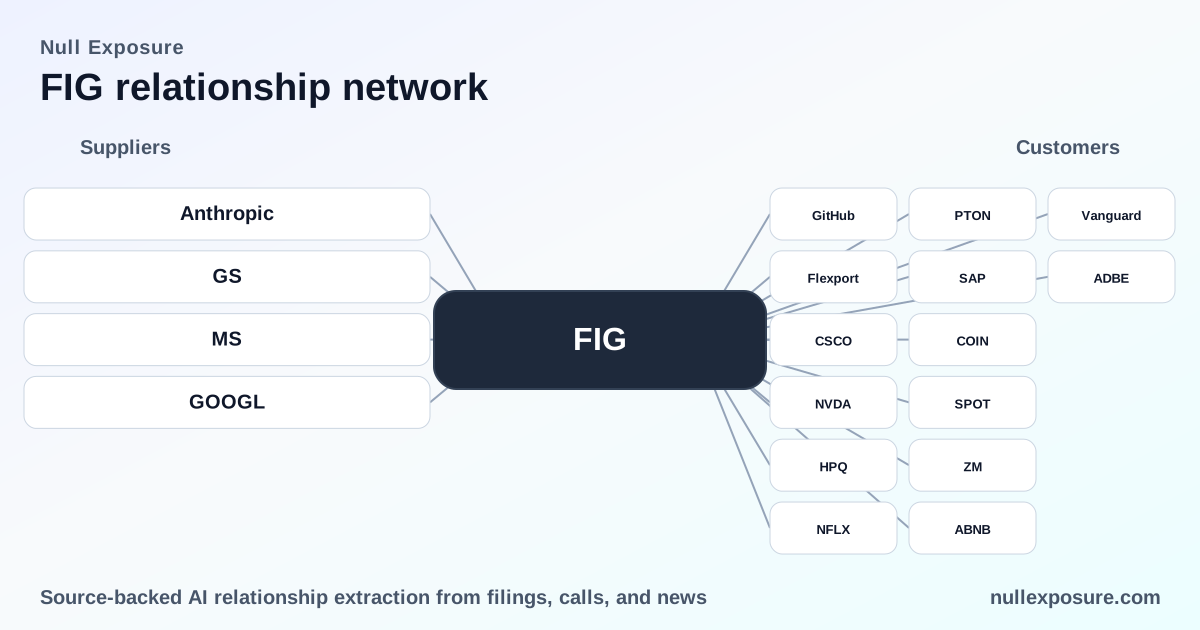
The supplier and partner roster — line by line
Anthropic
Figma has integrated Anthropic’s Claude into at least two branded offerings: “Figma Make,” an AI tool that generates prototypes and code from text prompts, and “Code to Canvas,” which converts AI-generated code into editable design layouts to bridge rapid coding and human-centered design. Both items were described in March 2026 coverage that highlights Anthropic as the model-provider behind these features. (TechS2 coverage and a Sahm Capital market note, March 2026.)
Goldman Sachs
Goldman Sachs acted as one of the lead underwriters on Figma’s public offering and is a party to the lock-up agreements that restrict certain holders’ sales for a defined post-offering period; the lock-up terms require prior written consent from Morgan Stanley and Goldman Sachs for sales during the agreed window. This detail comes from prospectus reporting summarized by MarketScreener in early 2026. (MarketScreener prospectus summary, FY2026.)
Morgan Stanley
Morgan Stanley served alongside Goldman Sachs as a lead underwriter and co-administrator of the lock-up regime described in the company’s offering materials, establishing the same 180-day/earnings-based restriction that limits executive and major holder sales absent underwriter consent. The underwriting role and lock-up terms were reported in the offering disclosure summarized by MarketScreener (FY2026). (MarketScreener prospectus summary, FY2026.)
Google for Education
Figma secured an education-distribution arrangement enabling school districts to deploy and manage free Figma licenses from the Google Admin Console, which embeds Figma into Chromebook and education IT workflows and broadens top-of-funnel adoption among students and educators. That partnership was documented in reporting around 2022 and remains a structural distribution channel for onboarding future professional users. (ChromeUnboxed coverage, FY2022.)
What the relationships imply about operating posture and vendor maturity
No explicit supplier constraints were captured in the relationship feed; this absence itself is a signal. At the company level, the record shows:
- Contracting posture: Public offering materials and underwriter lock-ups indicate standard capital-markets contracting where underwriters control short-term insider liquidity. Separately, technology partnerships (AI model licensing, Google education distribution) imply negotiated product-integration agreements rather than wholesale vendor dependency.
- Concentration and criticality: The AI integrations with a major model provider and the Google for Education channel are strategically important for product competitiveness and user acquisition, but the feed does not show a single supplier that would constitute an existential concentration risk across the platform.
- Maturity and uplift: Relationships with top-tier underwriters and large platform partners are consistent with a company transitioning from growth-phase private product expansion into public-market governance and broader platform distribution. Expect more formalized contracting and disclosure going forward.
These are company-level signals drawn from the relationship set; specific contractual maturity or exclusivity terms were not provided in the collected items.
Investment risks and strategic considerations operators should track
- Product risk and opportunity — AI integrations: The Anthropic relationships are a clear product-enablement move; success increases engagement and ARPU, but the company will carry ongoing model costs and integration maintenance. Investors should model higher R&D and service costs in the near term alongside potential revenue uplift from premium features.
- Capital-market timing risk — lock-up and supply: The underwriter-managed lock-ups administered by Morgan Stanley and Goldman Sachs create a defined window after the offering where insider sales are constrained; this compresses near-term supply, but expiry events can introduce supply shocks and volatility. MarketScreener’s prospectus summary makes the mechanism explicit (FY2026).
- Distribution durability — education channel: The Google for Education integration accelerates adoption among future professionals, creating a long lead time for monetization but a durable funnel. As ChromeUnboxed reported in 2022, the Admin Console deployment is a distribution lever for long-term market share in education and subsequently enterprise adoption.
- Earnings profile and multiples: The broader financial snapshot shows negative EPS and elevated valuation multiples against revenue (refer to company filings and market data); these relationships provide qualitative support for revenue growth vectors, but investors must balance growth potential against high operating leverage risk.
Explore more supplier mappings and how they affect valuation models at https://nullexposure.com/.
Practical next steps for investors and operators
- For investors: stress-test scenarios where AI-feature adoption lifts retention by X% while operating expenses increase by Y%; incorporate potential share-supply events at lock-up expiries into short-term volatility assumptions.
- For operators and procurement teams: prioritize contractual clarity on model-cost pass-throughs, uptime, and support SLAs with AI suppliers, and codify education-channel monetization paths so free deployments convert at predictable rates.
- For governance: monitor underwriter disclosures and lock-up calendars tied to the offering’s earnings-based release triggers.
Bottom line
Figma’s supplier footprint, as currently visible, underlines a dual strategy: embed best-in-class AI to raise product value while using platform partnerships to seed long-term adoption. Capital-market mechanics create discrete timing risks to the stock, and the AI/provider relationships create operating cost and product-differentiation vectors that warrant active monitoring. For deeper counterparty analysis and to map how these relationships feed into financial scenarios, visit https://nullexposure.com/ and review the supplier intelligence available.