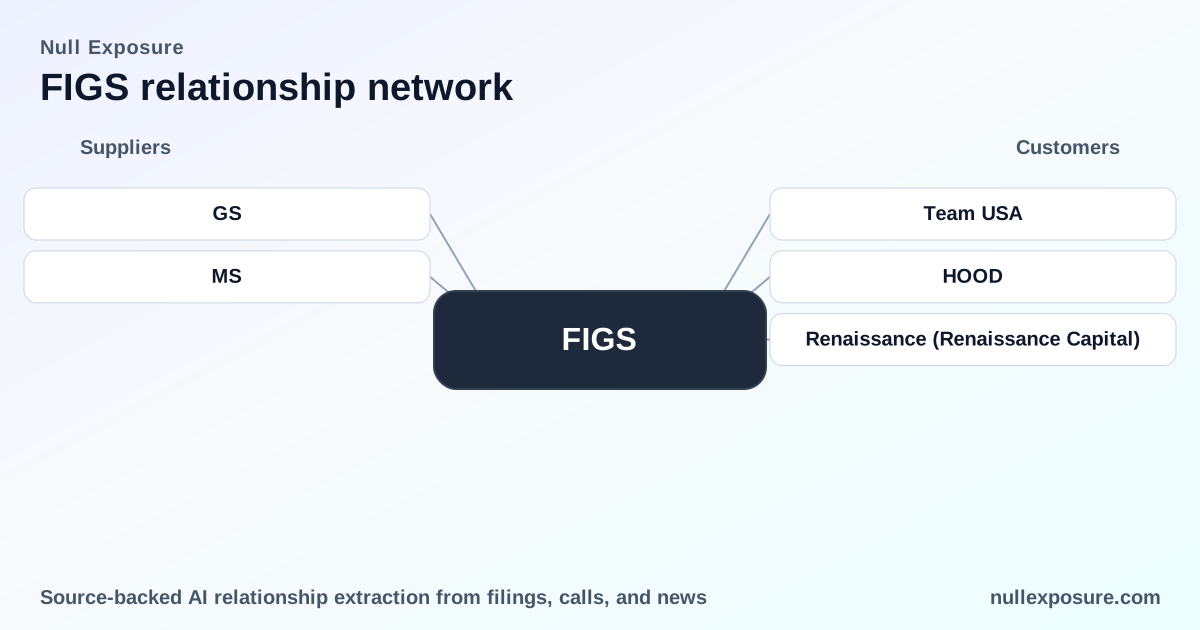
FIGS Inc.: Supplier footprint, underwriting links, and what operators should watch
FIGS operates as a vertically curated healthcare apparel brand that designs products in-house and outsources manufacture and fulfillment to global third parties, monetizing primarily through direct-to-consumer and wholesale apparel sales. The company uses shallow initial buys and data-driven restocking to control inventory and sells finished product purchased on a purchase-order basis from manufacturers, which drives a high degree of operational flexibility but concentrated supplier operational risk. For a centralized look at supplier relationships and risk signals, visit https://nullexposure.com/.
How FIGS’ supplier posture translates into economics
FIGS’ model blends brand control with outsourced production: design, brand, and channel control remain internal while manufacturing, logistics and some software components are provided by external partners. That operating split delivers high gross margins (gross profit TTM about $420M on $631M revenue) while leaving FIGS exposed to third-party execution and input-cost swings.
Several company-level disclosures frame the supplier reality:
- FIGS buys finished product on a purchase-order/spot basis: "We purchase our finished product from our manufacturers on a purchase order basis..." — this is a deliberate contracting posture that favors flexibility over long-term price locks.
- The supply chain is global, with production in South East Asia, China, South America and Jordan and “substantially all” production outside the U.S.
- A single third‑party supplier in Jordan accounts for a majority of production, creating a material concentration and a critical single-point dependency.
- Inventory purchase obligations were approximately $62.3 million as of December 31, 2024, which places supplier spend into a mid-range band and represents committed near-term cash flow tied to vendor delivery schedules.
These disclosures together describe a supplier strategy that is flexible and mature (long-standing vendor relationships and core fabric/style consistency) but also materially concentrated and operationally critical.
Known relationships worth attention
Below I cover every supplier-scope relationship surfaced in the public feed and provide the primary source for each mention.
Goldman Sachs — IPO underwriter
Goldman Sachs served as a primary underwriter when FIGS completed its IPO. According to MarketRealist coverage of FIGS’ IPO (FY2021), Goldman Sachs was listed alongside Morgan Stanley as a lead underwriter. Source: MarketRealist reporting on FIGS’ IPO (https://marketrealist.com/p/figs-ipo-date-and-price/).
Morgan Stanley — IPO underwriter
Morgan Stanley was the co‑lead underwriter on FIGS’ public offering. MarketRealist’s FY2021 IPO summary identifies Morgan Stanley as a primary underwriter for the deal. Source: MarketRealist reporting on FIGS’ IPO (https://marketrealist.com/p/figs-ipo-date-and-price/).
What the supplier constraints tell investors and operators
The company-level constraints above are not relationship-specific but they give a tight read on FIGS’ operational posture:
- Contracting posture: spot / purchase-order based. FIGS buys finished goods on a purchase-order basis rather than under long-term supplier agreements, which reduces contractual fixed cost but increases exposure to price and lead-time variability.
- Geographic diversification with a critical concentration. Production is global across Asia, South America and Jordan, but a single Jordan supplier currently produces a majority of output, making geopolitical, logistical, and single-facility disruption risk central to any scenario analysis.
- Materiality and spend. Inventory purchase obligations (~$62.3M) place supplier commitments in the $10M–$100M band, indicating meaningful working-capital and cash-flow sensitivity to supplier performance and shipment timing.
- Relationship roles and maturity. FIGS relies on third-party manufacturers and logistics providers, uses open-source licensed software components, and reports long-standing vendor relationships—a signal that supplier partnerships are operationally embedded and not ad hoc.
- Operational criticality. The company explicitly characterizes at least one supplier as critical, elevating the importance of supplier monitoring and contingency planning.
Taken together, these signals describe a high-margin consumer apparel brand that intentionally outsources production for cost and speed, but retains concentrated execution risk that directly affects revenue delivery and inventory carrying costs.
Investor and operator implications: what to monitor now
For investors and operators evaluating FIGS supplier risk, prioritize the following actions and metrics:
- Monitor supplier concentration metrics—track production share by facility and country, and especially the Jordan facility’s output share. A majority reliance here translates straight into operational and geopolitical risk.
- Track inventory purchase obligations and shipping cadence—the ~$62.3M obligation is a short-term commitment that constrains liquidity if shipments are delayed or returns spike.
- Assess contingency and diversification plans—because FIGS contracts on a spot basis, the company’s ability to re-source quickly and maintain gross margins under alternative sourcing will determine resilience.
- Operational diligence on third‑party logistics—the leased fulfillment facility operated by a third‑party logistics provider (lease through 2031) means fulfillment execution risk is outsourced but contractually bounded; track SLA performance and lease exposure.
- Vendor relationship health—long-standing relationships are a strength because they reduce start-up friction, but they also increase switching costs if alternate suppliers are required rapidly.
For a deeper supplier map and tracking dashboard tailored to investors and operators, see https://nullexposure.com/.
Final read: risk-reward in supplier terms
FIGS’ supplier model is a conscious tradeoff: flexibility, rapid assortment testing and brand control in exchange for concentration risk, spot-price exposure, and working-capital sensitivity. Underwriting relationships with Goldman Sachs and Morgan Stanley are historical financing connections that helped the company scale publicly but are not operational suppliers; the real operational levers sit with manufacturers and logistics partners cited in company filings.
Investors should weight FIGS’ strong margin profile and brand traction against the operational risk that a single geographic supplier and purchase‑order contracting posture create. Operators should prioritize supplier diversification, inventory discipline and contingency logistics to preserve margin and reduce single-point failure risk.
To inspect these supplier relationships and get ongoing alerts, visit https://nullexposure.com/.