FIGX Capital Acquisition Corp.: supplier relationships, market signals, and investor implications
FIGX Capital Acquisition Corp. is a Special Purpose Acquisition Company that monetizes through transaction execution: it raises capital in public markets, lists units/shares/warrants, and generates value for stakeholders by completing a business combination or related financing activities. As a SPAC, FIGX’s economics depend on deal flow, underwriting and listing execution, and the capacity to syndicate follow-on financing — not on operating revenue today. For institutional investors and operators evaluating FIGX as a counterparty or partner, the supplier map is narrow and transaction-focused, with counterparties that support capital-market access and distribution. Visit https://nullexposure.com/ for deeper supplier intelligence and monitoring tools.
How FIGX runs the business and where the money comes from
FIGX does not generate operating revenue; its model is transactional and capital markets–oriented. It raises cash through public offerings of units (shares plus warrants), holds that capital in trust while sourcing a target, and realizes value by completing a merger or syndicating PIPE (private investment in public equity) commitments and underwritten offerings. Monetization is therefore concentrated in underwriting, listing execution, and sponsor-led transaction fees and equity rollovers at close. This commercial posture implies the company’s supplier relationships are primarily professional services and market infrastructure providers rather than operating vendors.
The supplier relationships you need to know
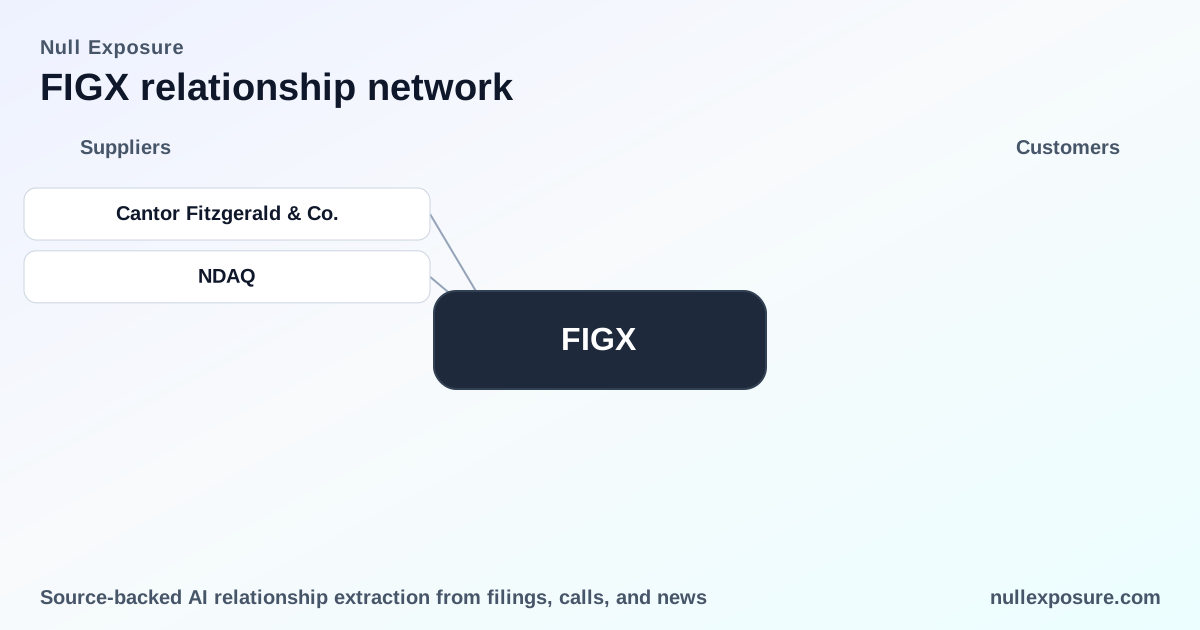
Below are every supplier relationship identified for FIGX in the available reporting, with a plain-English summary and citation for each.
Cantor Fitzgerald & Co.
Cantor Fitzgerald & Co. is serving as the sole book-running manager for FIGX’s offering, responsible for structuring and distributing units and coordinating underwriting syndication. This makes Cantor Fitzgerald a critical execution partner for FIGX’s capital formation and a primary channel to institutional demand (Yahoo Finance press release, FY2025: https://finance.yahoo.com/news/figx-capital-acquisition-corp-announces-230000615.html).
Nasdaq Global Market (Nasdaq)
FIGX’s Class A ordinary shares and warrants are set to trade on the Nasdaq Global Market under the symbols FIGX and FIGXW, establishing Nasdaq as the listing venue for reported securities. Nasdaq is the market infrastructure provider enabling secondary trading and liquidity for FIGX securities, a core dependency for any SPAC’s public market strategy (Yahoo Finance announcement, FY2025: https://finance.yahoo.com/news/figx-capital-acquisition-corp-announces-201500208.html).
The Nasdaq Global Stock Market LLC
The units were anticipated to list on The Nasdaq Global Stock Market LLC under the ticker FIGXU, indicating another Nasdaq entity handling the initial listed units before separation into shares and warrants. This confirms Nasdaq’s role across the issuance lifecycle — unit listing, deconsolidation, and continued trading — reinforcing operational reliance on Nasdaq platforms (Yahoo Finance press release, FY2025: https://finance.yahoo.com/news/figx-capital-acquisition-corp-announces-230000615.html).
What the supplier mix signals about FIGX’s operating model
The supplier set is deliberately concentrated and transactional. FIGX engages a leading investment bank for underwriting and Nasdaq for market access, which aligns with typical SPAC practices where execution partners drive deal timing and distribution.
- Contracting posture: FIGX’s contracts are short-duration and event-driven; underwriting and listing engagements are transactional, tied to specific offerings and listing milestones. This creates flexibility but also timing risk when market windows narrow.
- Concentration: Supplier concentration is high and appropriate for the SPAC model — a small number of high-impact relationships control access to capital and liquidity.
- Criticality: Both Cantor Fitzgerald and Nasdaq are mission-critical; if either relationship underperforms or terms change, FIGX’s ability to execute a merger or financing would be materially impaired.
- Maturity: These are mature, institutional counterparties with well-established playbooks for SPAC issuance and listing, which reduces execution risk relative to lesser-known service providers.
There are no explicit constraints reported against FIGX in the available supplier relationship data; the absence of constraints is itself a company-level signal that public filings and press materials emphasize normal issuance and listing activities without flagged contractual limitations.
(If you are tracking counterparty exposure or trying to replicate FIGX’s market routing, see https://nullexposure.com/ for live relationship analytics and notification services.)
Risk and opportunity considerations for investors and operators
FIGX’s business profile makes two clear investor takeaways:
- Execution risk dominates valuation. With no operating revenues, investor outcomes revolve around the successful identification of a merger target and the terms of any subsequent financing; the underwriting partner’s distribution capability directly affects pricing and deal completion.
- Liquidity depends on market infrastructure. Nasdaq’s role in initial listing and secondary trading is fundamental; listing venue and liquidity conditions will influence warrant pricing, unit mechanics, and investor exit options.
Operationally, counterparties are reputable and experienced, which is a positive for execution certainty. However, the concentrated supplier topology amplifies single-counterparty risk: any change in underwriting capacity or listing eligibility would have immediate consequences.
Practical next steps for due diligence
- Confirm underwriting engagement terms and syndicate appetite with Cantor Fitzgerald, especially fees, over-allotment structure, and lock-up arrangements (where applicable). Direct confirmation of underwriting economics is a core diligence item for investors.
- Monitor Nasdaq listing notices and trading symbols for any amendments to the unit/share/warrant structure; changes in listing timing or venue communicate shifts in execution strategy.
- Track PIPE interest and sponsor commitments as these convert issuance into dealable capital at close; the presence or absence of committed PIPE capital materially alters financing risk.
For active monitoring and supplier-risk scoring that institutional investors use, visit https://nullexposure.com/ — the platform consolidates counterparty news, filings, and exposure metrics into a single workflow.
Final read: what FIGX’s supplier map means for portfolio positioning
FIGX is a pure transaction vehicle: value derives from deal sourcing and capital markets execution rather than from operating performance today. The supplier relationships unearthed — a major investment bank and Nasdaq across issuance and listings — are consistent with a SPAC built to access public markets quickly and professionally. Investors should therefore price FIGX positions based on execution probability, counterparty strength, and prevailing market conditions for SPAC closings. For operators evaluating partnerships or potential target companies, the same calculus applies: the speed and quality of underwriting plus listing mechanics will determine how efficiently a target can convert private value into public equity.
To reassess exposure or to subscribe to alerts on changes to this supplier map, go to https://nullexposure.com/ and set up tailored monitoring for FIGX and its counterparties.