Fidelis Insurance Holdings (FIHL): Counterparty Map and What It Means for Investors
Fidelis Insurance Holdings monetizes through diversified underwriting, reinsurance placements, and capital-markets risk transfer—notably sponsoring catastrophe bond vehicles to move peak perils off the balance sheet while pursuing active capital allocation through share buybacks. The company's operating model blends traditional insurance economics with structured reinsurance solutions and occasional capital-market intermediation to lower net volatility and preserve regulatory capital. For investors and operators evaluating FIHL supplier relationships, the mix of capital-market counterparties, legal advisors, and the legacy shareholder unwind are the primary levers shaping risk-transfer capacity and governance.
Explore supplier intelligence and counterparty mapping at https://nullexposure.com/ to benchmark counterparties and exposures.
How Fidelis leverages the capital markets to underwrite catastrophe risk
Fidelis uses sponsored reinsurance vehicles to securitize catastrophe exposure, taking collateralized protection from the market rather than retaining peak-loss volatility on its balance sheet. The recent Herbie Re series is a case in point: Fidelis sponsors the vehicle, which issues notes to investors whose proceeds collateralize retrocessional and industry-loss triggered protection. This structure transfers event risk to capital-market investors while preserving Fidelis’ underwriting capacity.
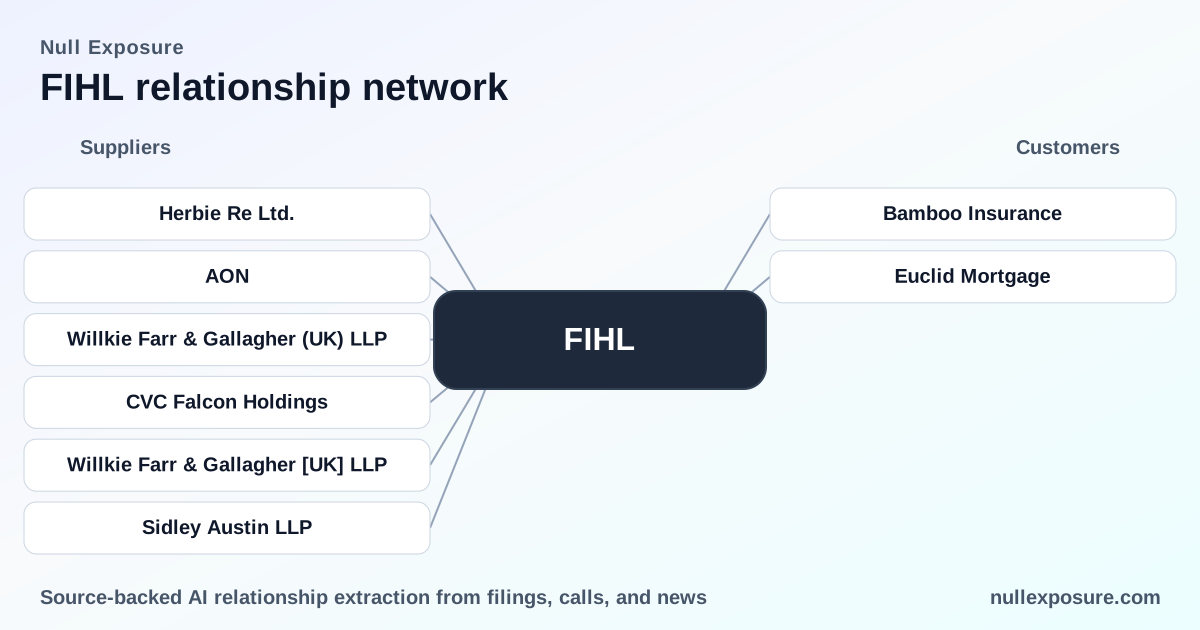
Counterparty snapshot: every relationship in the public record
The following entries cover every counterparty mention surfaced in news filings and press coverage; each entry is a concise, plain‑English summary with the cited source.
Herbie Re Ltd.
Herbie Re Ltd. is the special-purpose issuer Fidelis sponsors to issue cat bonds that collateralize annual aggregate and worldwide multi-peril retrocessional protection for Fidelis; the Series 2025-1 notes were targeted in the $75–$90 million range. According to Artemis (March 2026) and Bernews (January 2026), this is the eighth Herbie Re issuance providing earthquake and aggregate industry-loss protection for Fidelis.
Aon Securities LLC
Aon Securities acted as the Sole Structuring Agent and Sole Bookrunner on the Herbie Re transaction, directing placement and market execution for the notes. Insurance Business reported (March 2026) that Aon was pivotal to bringing the deal to market.
Willkie Farr & Gallagher (UK) LLP
Willkie Farr & Gallagher (UK) LLP provided legal counsel to Fidelis Insurance Group and Herbie Re on the recent cat-bond issuance. Insurance Business (March 2026) cites the firm as Fidelis’ counsel on the transaction.
Willkie Farr & Gallagher [UK] LLP
A parallel mention in Bernews confirms the same counsel role for Willkie Farr & Gallagher [UK] LLP on the Herbie Re issuance. This secondary citation underscores consistent legal representation in public reporting (Bernews, January 2026).
CVC Falcon Holdings
CVC Falcon Holdings was the founding shareholder whose remaining stake Fidelis agreed to buy at US$19.00 per share as part of an expanded share-repurchase program; the buyout price was below year‑end diluted book value per share. Sahm Capital (March 2026) reported that Fidelis completed and expanded repurchase programs, including the CVC buyout.
Sidley Austin LLP
Sidley Austin LLP served as legal advisor to Fidelis in connection with the share repurchase transaction that formed part of the company’s broader capital‑allocation actions. A Fidelis press release covered by Yahoo Finance (March 2026) identifies Sidley Austin as the company’s advisor.
What these relationships reveal about Fidelis’ operating posture
- Capital‑market-first risk transfer: Fidelis relies on sponsored vehicles and cat‑bond issuances to offload concentrated nat‑cat and aggregate exposures. The repeated use of Herbie Re—now in an eighth series—signals a mature, repeatable securitization program rather than one-off experimentation (Bernews; Artemis).
- Concentration in execution: Aon Securities acting as sole structuring agent and sole bookrunner represents an execution concentration that accelerates deal placement but creates single‑counterparty exposure for structuring and distribution (Insurance Business; Bernews).
- Professionalized legal support: Dual citations to Willkie Farr & Gallagher and Sidley Austin show that Fidelis uses top‑tier counsel for transaction and corporate actions, indicating high operational rigor in deal documentation and regulatory navigation (Insurance Business; Yahoo Finance).
- Active capital allocation and governance shifts: The buyout of founding shareholder CVC Falcon Holdings and expanded repurchase program are material governance signals—Fidelis is prioritizing shareholder returns and concentrate ownership changes, with the CVC buy representing a below‑book repurchase that repositions the shareholder base (Sahm Capital).
Risk and opportunity checklist for investors
- Opportunity: Structured reinsurance reduces capital strain and stabilizes underwriting volatility; repeat issuance via Herbie Re supports scalable capacity for growth.
- Risk: Concentration with a single arranger (Aon Securities) and reliance on market appetite for catastrophe risk transfer create execution and pricing sensitivity during volatile markets.
- Governance: High institutional ownership (about 90.7% according to company data) combined with an insider stake around 15% suggests focused governance and potentially decisive share‑repurchase outcomes.
- Legal/compliance: Engagement of reputable law firms reduces documentation and regulatory execution risk, but legal cost and negotiation complexity increase with larger securitizations.
For a deeper, comparative view of FIHL counterparty concentration and structured reinsurance exposure, visit https://nullexposure.com/ for supplier scoring and exposure dashboards.
Tactical takeaways for operators and counterparties
- Counterparties should price for execution concentration with Aon while recognizing the repeatability of the Herbie Re structure and the operational muscle that top law firms provide.
- Investors should track future Herbie Re issuance sizes, attachment definitions, and any change in the arranger mix as immediate indicators of capacity and price pressure.
- Management’s willingness to buy out CVC below book value signals a bias toward shareholder returns over light dilution concessions; underwriters and reinsurers should consider this when negotiating collateral and attachment terms.
Bottom line
Fidelis’ supplier map combines mature cat‑bond execution, concentrated arranger relationships, and disciplined legal support—complemented by an assertive capital‑allocation strategy that shifts ownership and reduces leverage on the balance sheet. The company’s use of Herbie Re and reliance on Aon for structuring are core operational features investors should monitor closely as forward indicators of capacity, pricing, and counterparty risk.
For tailored counterparty intelligence and ongoing tracking of FIHL supplier relationships, go to https://nullexposure.com/ and see how counterparties are scored across concentration, criticality, and maturity.