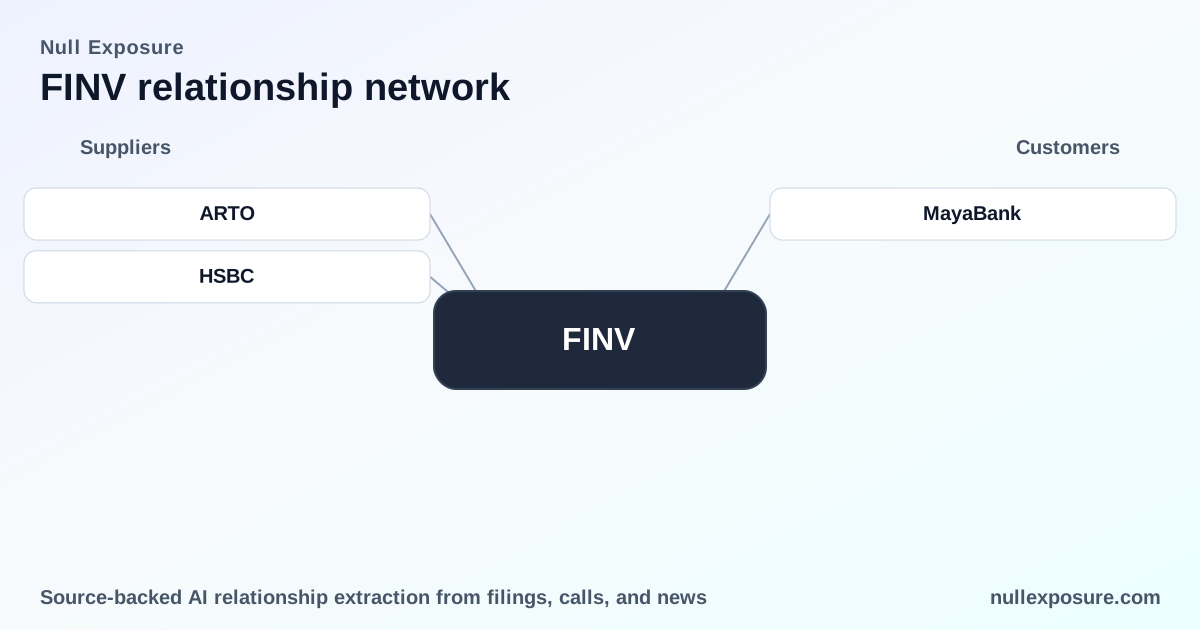
FinVolution Group (FINV): funding partnerships are the growth lever — and the risk vector
FinVolution Group operates an online consumer finance marketplace headquartered in Shanghai and monetizes by originating and servicing consumer credit through platform channels and third‑party funding arrangements, collecting origination and servicing fees and capturing finance spread where it provides or facilitates credit. FinVolution’s growth strategy relies on geographic expansion of digital lending (including Southeast Asia), strategic bank partnerships for wholesale funding, and a platform economics model that leverages data and underwriting to scale originations with relatively low additional fixed cost. For investors, the key questions are execution of cross‑border rollouts, durability of bank funding lines, and counterparty concentration in credit provision.
If you evaluate supplier and funding counterparty risk for platform lenders, review our broader coverage at https://nullexposure.com/ for comparative supplier risk signals and supplier relationship dashboards.
Why these supplier relationships matter to the business model
FinVolution is a platformed lender whose growth depends on external funding and local banking partners to underwrite and scale loans outside mainland China. The recent disclosures show two categories of counterparties: regional commercial banks (PT Bank Jago in Indonesia) and global/big‑local banks (HSBC in the Philippines). These relationships perform three roles simultaneously: liquidity backstop, on‑the‑ground distribution enablement for subsidiaries, and a credibility signal to local markets.
- Contracting posture: FinVolution behaves as an originator/marketplace that secures committed credit facilities for subsidiaries rather than fully self‑funding each book; this implies negotiating capacity is a core competency and that counterparty terms will materially affect growth pacing.
- Concentration: The available evidence shows reliance on a small number of institutional banking partners for large funding lines, which concentrates funding risk even as it reduces funding cost and operational complexity.
- Criticality: These facilities are operationally critical — they increase the lending capacity of local subsidiaries and therefore directly impact revenue scaling and credit throughput.
- Maturity and evolution: The relationships are recent and expansionary (facility increases, new credit lines), signaling an active phase of market penetration rather than a mature, stable funding base.
Mid‑analysis action: review comparative funding dependency metrics and counterparties on https://nullexposure.com/ to quantify concentration and term risk.
Every listed relationship — plain English summaries and sources
PT Bank Jago Tbk (ARTO) — FinVolution’s Indonesian subsidiary AdaKami obtained a fivefold increase in its financing facility with PT Bank Jago, materially expanding AdaKami’s capacity to originate consumer loans in Indonesia. According to a Hubbis report covering the March 9, 2026 announcement, the uplift represents a significant scaling of local funding for the Indonesian business.
HSBC — IBS Intelligence reports that FinVolution’s Philippines business secured a multi‑million‑peso credit facility from HSBC to expand access to formal financial services for underserved but creditworthy Filipinos, a structured line intended to support local origination. The piece was published March 9, 2026 and frames the facility as part of an inclusion agenda while being a direct funding arrangement.
HSBC — Kr-Asia noted the same HSBC facility in the Philippines and characterized it as a seven‑figure PHP credit line, reinforcing that HSBC’s commitment is a sizable, local currency facility to underwrite consumer lending growth there (reported March 9, 2026).
HSBC — Yicai Global covered the Philippines credit facility and highlighted its multi‑million‑peso scale, consistent with other regional outlets reporting the extension of bank funding to FinVolution’s local arm (publication dated March 9, 2026).
HSBC in the Philippines — PR Newswire published FinVolution’s own release describing the multi‑million‑peso credit facility from HSBC in the Philippines; the company framed the facility as supporting financial inclusion goals and operational expansion (PR Newswire release dated March 9, 2026).
What investors should read into these relationship entries
The corpus of reports shows consistency of message across independent press outlets and a company release: FinVolution is actively securing bank funding to support regional subsidiaries. That is a positive signal for near‑term originations growth — funding constraints are being addressed through partnership rather than balance‑sheet expansion. However, this model creates two principal risks:
- Counterparty funding risk and concentration. A fivefold facility increase from a single bank in Indonesia and repeated reliance on HSBC in the Philippines create a funding concentration that would amplify any counterparty pullback.
- Execution and regulatory risk across jurisdictions. Cross‑border consumer finance is sensitive to local regulatory shifts; bank partners have their own risk appetites that can change with local macro or regulatory cycles.
- Operational criticality. These facilities are not peripheral; they directly affect lending capacity and therefore revenue growth in those markets.
Use the relationships as a lens on liquidity flexibility: strong bank partnerships accelerate customer acquisition and reduce near‑term capital needs, but also create single‑point funding dependencies that require ongoing counterparty management.
Constraints and company‑level signals
No supplier constraints were flagged in the provided record. As a company‑level signal, the absence of documented constraints suggests the current monitored relationship set carries no disclosed contractual restrictions or flagged covenants in the data provided; it does not imply absence of commercial terms, covenants, or confidentiality in the underlying credit agreements. Investors should therefore request term sheets and covenant schedules during diligence to confirm tenor, prepayment and acceleration triggers, and cross‑default provisions.
Investment implications and recommended next steps
- Positive thesis: These bank facilities materially de‑risk short‑term funding and support accelerated origination in Southeast Asia, improving revenue trajectory without proportionate balance‑sheet expansion. FinVolution’s financial metrics (notably high operating margin and strong profitability ratios reported in FY‑TTM) indicate the platform can convert funded originations into earnings efficiently.
- Risk checklist: Obtain counterparty term sheets, check concentration limits, verify maturity and renewal clauses, and stress‑test cash flow under bank withdrawal scenarios.
- Diligence tasks: Validate local regulatory standing for each subsidiary, request collateral or credit enhancement structures, and map correlation between partner bank health and lending capacity.
For a deeper supplier‑level risk breakdown and benchmarking versus peers, go to https://nullexposure.com/ and examine the partner concentration and covenant exposure modules.
Bottom line and action
FinVolution is executing a funding‑partner playbook that supports rapid regional expansion — bank lines with PT Bank Jago and HSBC are enabling scale, but create funding concentration that is central to the company’s operating risk profile. Investors should balance the growth uplift from committed facilities against the need to verify contractual protections and diversification of funding sources.
To access cross‑supplier comparisons, term‑sheet templates and follow‑up monitoring tools, visit https://nullexposure.com/ — use these tools to convert relationship signals into portfolio decisions.