FTAI Infrastructure (FIP): How the company is run, financed and who matters
FTAI Infrastructure (FIP) acquires, develops and operates transportation and energy infrastructure and is externally managed by an affiliate of Fortress Investment Group; it monetizes through operating cash flows from owned assets, dividend distributions to shareholders and an externally negotiated management fee arrangement that drives the firm's day-to-day decision-making and capital deployment. Investors should treat FIP as an asset-owning vehicle whose economics are materially shaped by its manager and by a small set of financing counterparties. For a deeper supplier and counterparty map, visit https://nullexposure.com/.
The simple commercial thesis: assets, an external manager, and leverage
FTAI Infrastructure runs a classic externally-managed infrastructure playbook: the company owns operating terminals and rail assets that generate recurring revenue, while an affiliated investment manager (Fortress) handles acquisitions, financing and operations in exchange for fixed and incentive fees. Revenue (roughly $502m TTM) and positive operating margins coexist with a negative net EPS profile, reflecting the capital-intensive, depreciation and financing-heavy nature of infrastructure ownership. The company pays a modest dividend (yield ~2.3%) and uses secured credit to fund growth and M&A.
A reminder: if you want a concise supplier-risk briefing for portfolio work, start here: https://nullexposure.com/.
Capital partners drive optionality and risk
FIP’s recent financing activity demonstrates how concentrated its funding relationships are and how those counterparties materially affect flexibility. In February 2026 FIP secured a $1.315 billion secured term loan at 9.75% maturing in February 2028, which was presented in media coverage as simplifying the capital structure and improving liquidity. That transaction names a syndicate of credit funds and administrators as the lenders and agent — a financing structure that reduces bank covenant complexity but increases exposure to credit-fund repricing cycles. (TradingView report, Feb 2026).
Barclays and Deutsche Bank have also served as both lenders and financial advisors in prior M&A activity (notably the August 2025 agreement to acquire Wheeling Lake Erie Railway), underscoring a small group of investment banks that execute debt commitments and advisory mandates for the company (GlobeNewswire announcement, Aug 6, 2025).
Visit https://nullexposure.com/ for a supplier-risk scorecard tied to these counterparties.
Manager-led operating model: long-term contracting and concentrated decision-making
FTAI is externally managed under a multi-year Management Agreement executed in connection with the spin-off; that agreement has an initial term (six years at formation) and establishes Fortress as the operational center of gravity for acquisitions, asset management and financing. The company discloses management fees and incentive arrangements on its filings — a structural outflow that both aligns and channels value to the manager. These characteristics produce a contracting posture that is long-term, service-provider centric, and concentrated, which is relevant for investors evaluating governance and fee leakage.
Constraints from filings also signal a company-level spend band and maturity: disclosed management fee line items and fee schedules imply an operating spend dynamic consistent with a $10m–$100m annual management/incentive scale signal, and the Management Agreement’s multi-year term indicates contractual maturity and predictability in the near term.
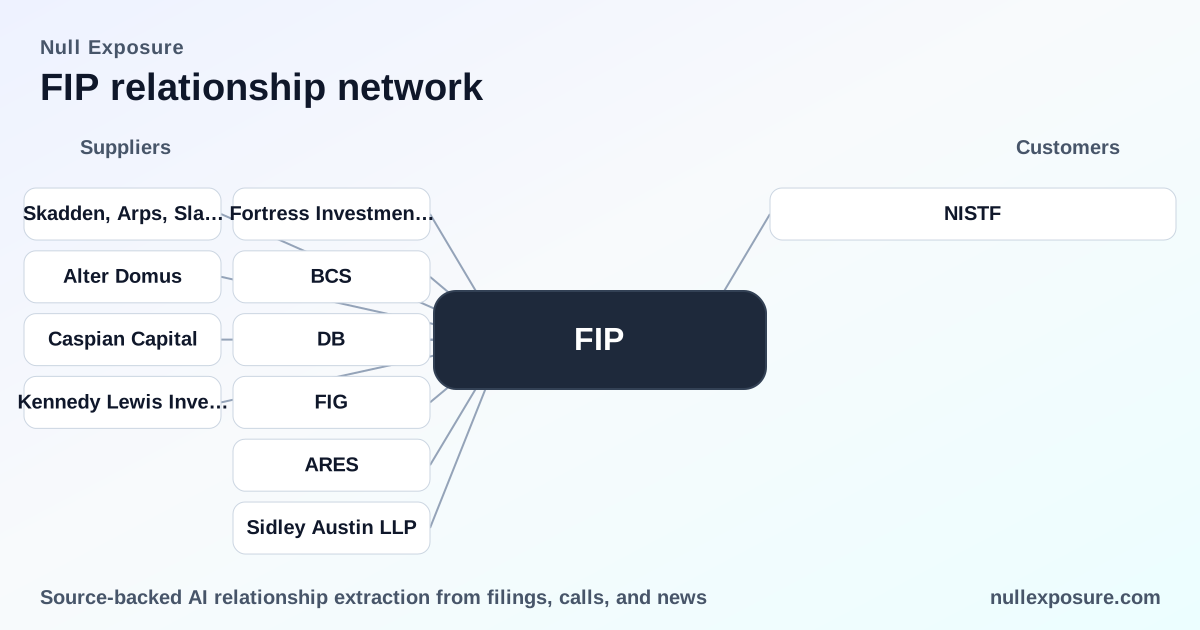
Relationship roundup: who does business with FIP (concise, sourced)
- Fortress Investment Group LLC — external manager and operational sponsor. Fortress is the affiliate that externally manages FIP, advising on investments, arranging financing and running day-to-day operations under the Management Agreement (GlobeNewswire releases Jan 29, 2026; Dec 1, 2025; Oct 30, 2025; spin-off announcement Aug 1, 2022).
- Barclays (BCS) — lender and financial advisor on M&A and credit facilities. Barclays provided debt commitments and advisory services for the Wheeling acquisition and has been cited as a lender in prior credit agreements (GlobeNewswire Aug 6, 2025; TradingView coverage, 2026).
- Deutsche Bank (DB) — debt commitments and advisory role. Deutsche Bank partnered with Barclays on debt commitments and served as a financial advisor for the Wheeling acquisition (GlobeNewswire Aug 6, 2025).
- Ares Management (ARES) — part of the lending syndicate via managed funds. Ares is identified among funds participating in the secured term loan facility supporting the company’s recapitalization (TradingView report, Feb 2026).
- Alter Domus — administrative agent on the secured term loan. Alter Domus is cited as the administrative agent for the secured term loan that closed in February 2026 (TradingView report, Feb 2026).
- Kennedy Lewis Investment Management — lender via managed funds. Kennedy Lewis is named as a fund manager participating in the secured term loan facility (TradingView report, Feb 2026).
- Caspian Capital — credit fund participant in secured loan. Caspian Capital is listed as one of the fund managers backing the secured loan (TradingView report, Feb 2026).
- Sidley Austin LLP — legal advisor to the company on transactions. Sidley served as legal counsel to FIP on the Wheeling acquisition and related filings (GlobeNewswire Aug 6, 2025).
- Skadden, Arps, Slate, Meagher & Flom LLP — legal advisor on corporate transactions. Skadden acted alongside Sidley as legal advisor in the Wheeling transaction (GlobeNewswire Aug 6, 2025).
These relationship notes summarize roles disclosed in press filings and media coverage; each counterparty contributes to either FIP’s financing, transactional execution or legal/compliance posture.
What the relationship map implies for investors
- Concentration risk is material. A small set of financial sponsors, banks and the manager dominate financing and strategic execution, so adverse moves by any of these counterparties would have outsized effects on liquidity and deal flow.
- Contractual durability reduces short-term execution risk. The long-term external management contract and recurring fee structure give Fortress de facto control over asset decisions and lower the probability of immediate governance turmoil.
- Refinancing and repricing exposure is the primary financial risk. The move from bank credit agreements to a secured term loan arranged with credit funds transfers refinancing timing risk to a finite maturity (Feb 2028) and subjects FIP to higher coupon regimes in a rising-rate environment.
If you need a tailored counterparty exposure report that maps creditors, advisors and service providers to specific clauses and maturities, start the inquiry at https://nullexposure.com/.
Bottom line — what to watch next
For investors and operators evaluating FIP supplier relationships, monitor three vectors: 1) the manager’s incentive alignment and any changes to the Management Agreement; 2) the secured term loan maturity and any near-term refinancing activity (maturing Feb 2028); and 3) the narrow set of financial institutions and credit funds that provide committed capital or advisory services. These determine liquidity, cost of capital and strategic optionality.
For an operationally focused supplier-risk briefing and regular updates on FIP counterparties, visit https://nullexposure.com/.