Financial Institutions Inc. (FISI): Capital markets partners, legal counsel, and what they signal for investors
Financial Institutions, Inc. is the holding company for Five Star Bank that earns returns primarily through interest spread on loans, fee income from deposit and banking services, and intermittent capital markets activity to manage regulatory capital and liquidity. Recent transactions show the company actively monetizes its balance sheet through subordinated debt and equity placements, relying on a small roster of investment banks, legal counsel, and rating agencies to execute and validate those transactions. For investors and operators evaluating supplier risk, these relationships define both the company’s access to markets and the operational dependencies that support loan origination, valuation and capital adequacy. Learn more about supplier signatures and counterparty concentration at https://nullexposure.com/.
How the company runs — practical operating and business-model signals investors need
Financial Institutions operates like a traditional regional bank with modern capital-market interactions layered on top. The core business is lending to consumers, businesses and municipalities, funded by deposits; the company supplements core equity and regulatory capital through underwritten offerings and subordinated notes. Key operating characteristics observable from supplier interactions:
- Contracting posture: FISI engages external capital markets firms and legal counsel for discrete transactions rather than building a large in-house investment banking capacity, indicating a vendor-first sourcing model for financings.
- Concentration: a small number of counterparties (notably Piper Sandler and Keefe Bruyette & Woods in recent deals) appear repeatedly in public filings and releases, implying concentration risk in capital markets execution.
- Criticality: rating agencies and placement agents are mission-critical — Rating affirmations and placement-agent efficacy directly impact cost of capital and timing of issuances.
- Maturity and market standing: repeated use of reputable national boutiques and law firms suggests FISI’s financing program follows standard market practices for regional banks and is executed at investment-grade-ish market terms given the BBB- rating on recent notes.
If you want a deeper supplier risk map for due diligence or counterparty exposure management, start at https://nullexposure.com/ for an integrated view.
Who FISI worked with recently — the counterparties and what they did
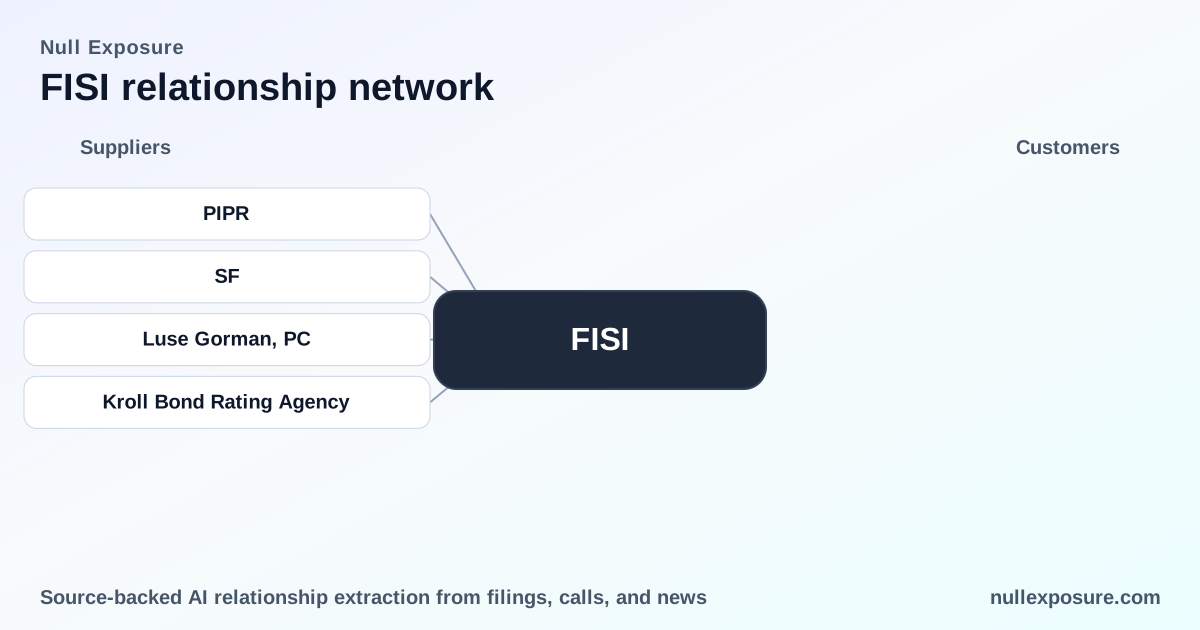
Below are the company’s recent supplier relationships as disclosed in public releases and press reports, with a one- to two-sentence plain-English takeaway for each.
Piper Sandler & Co.
Piper Sandler served as co-manager on an underwritten public offering and as sole placement agent for an $80 million private placement of subordinated notes used to strengthen capital. According to a GlobeNewswire release on December 11, 2025, Piper Sandler acted as sole placement agent for the $80 million subordinated notes, and Quiver Quant captured reporting on the public-offering role on March 9, 2026.
Keefe, Bruyette & Woods, Inc., A Stifel Company
Keefe Bruyette & Woods acted as the sole bookrunner on an underwritten public offering, anchoring distribution and price discovery for that transaction. Quiver Quant’s March 9, 2026 coverage identifies Keefe Bruyette & Woods as sole bookrunner while Piper Sandler served as co-manager.
Luse Gorman, PC
Luse Gorman served as legal counsel to Financial Institutions, Inc. for the subordinated notes offering, providing securities and regulatory documentation support necessary for issuance. GlobeNewswire’s December 11, 2025 press release and Quiver Quant’s subsequent report both note Luse Gorman’s counsel role.
Kroll Bond Rating Agency
Kroll Bond Rating Agency assigned the subordinated notes a BBB- rating and revised FISI’s long-term outlook to Stable, reflecting the agency’s view of improved profitability and capital position following the financing. This action is recorded in the company’s January 29, 2026 press release and echoed in Quiver Quant reporting.
Why these supplier ties matter for investors and operators
These relationships are not cosmetic: they determine FISI’s cost of capital, timing of access to markets, and legal robustness of offerings. A few investor-relevant interpretations:
- Capital access: Repeated engagement with Piper Sandler and a national bookrunner for underwritings shows FISI has market access under standard bank issuance channels, which reduces refinancing friction when liquidity needs arise.
- Rating sensitivity: The BBB- rating on the subordinated notes is a price and placement determinant; future downgrades or volatility in ratings will directly increase coupon demands or limit issuance windows.
- Operational dependencies: Company-level notes indicate FISI relies on third-party vendors for infrastructure, independent pricing services and appraisals — a sign that back-office critical functions are outsourced, which concentrates operational risk into supplier providers. These are company-level signals from the firm’s public statements on vendor usage and valuation practices.
For practical supplier risk monitoring and deeper counterparty exposure analysis, see the resources at https://nullexposure.com/.
What to watch — risks and a simple monitoring checklist
Investors and bank operators should track a short list of triggers tied to these supplier relationships:
- Monitor counterparty concentration: repeated reliance on the same placement agents increases execution risk if a single firm ceases coverage.
- Watch rating trends: changes in Kroll’s outlook or rating could materially affect funding costs.
- Confirm legal and documentation robustness: changes in counsel or disclosure language around collateral or subordination increase legal complexity for creditors.
- Track third-party vendor dependency: outsourced appraisal and pricing services are potential single points of failure for asset valuation and regulatory reporting.
- Watch liquidity metrics and upcoming maturities to judge whether the placement-agent pipeline is sufficient for near-term capital needs.
Bold focus on these items will protect downside and preserve financing optionality.
Bottom line and next steps
Financial Institutions Inc. runs a classic regional banking model augmented by tactical capital markets activity; its recent use of Piper Sandler, Keefe Bruyette & Woods, Luse Gorman and Kroll maps a clear market-access and governance architecture that investors can monitor to assess funding risk and valuation accuracy. The supplier roster is compact and reputable, which supports efficient execution but introduces concentration and vendor-dependency considerations that deserve active surveillance.
If you want a consolidated view of FISI’s supplier relationships and a tailored monitoring checklist for portfolio or operational risk, start here: https://nullexposure.com/. For comparative supplier-risk benchmarking across regional banks, visit https://nullexposure.com/ to get structured, investor-grade supplier intelligence.