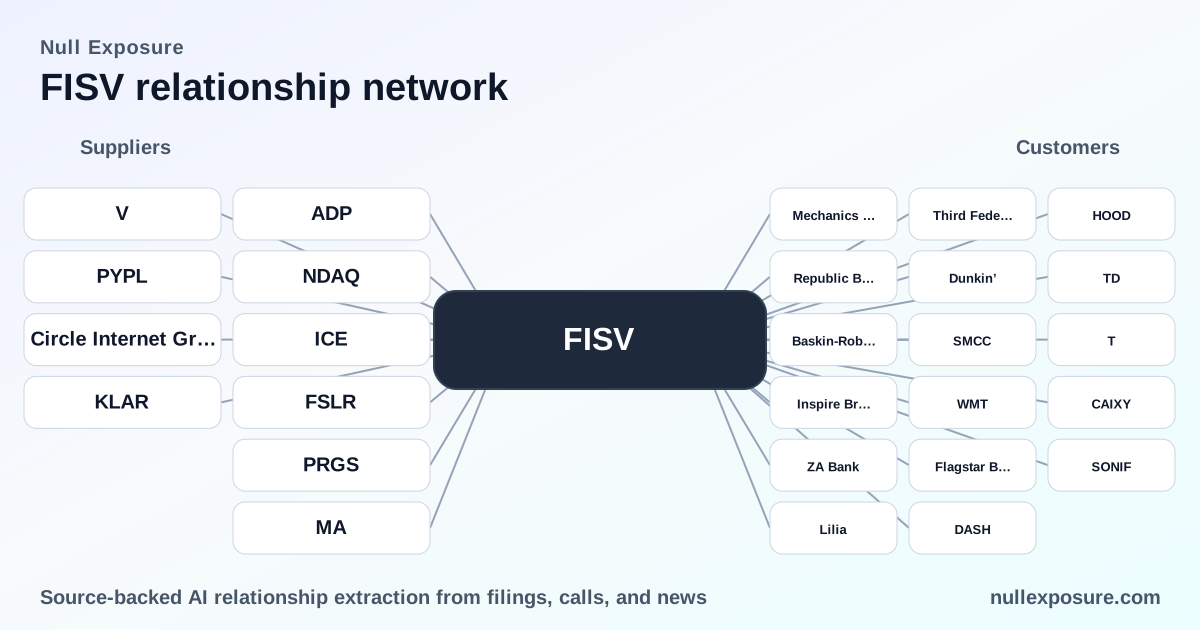
Fiserv’s supplier and partner map: what investors need to know
Fiserv operates as a payments and financial-technology platform that monetizes through software-as-a-service, transaction processing fees, and integrated merchant services delivered to banks, credit unions, fintechs and retailers. Its commercial model blends recurring software revenue with volume-sensitive interchange and processing income, and it layers strategic partnerships to accelerate distribution and product reach.
Explore deeper supplier intelligence and relationship analytics at https://nullexposure.com/.
Why these partners matter for Fiserv’s economics and risk profile
Fiserv’s partner set is a deliberate mix of card networks, payroll/HR platforms, exchanges, fintech innovators and third‑party infrastructure vendors. That blend drives both scale and concentration risks: card networks (Visa, Mastercard) and gateways are critical to transaction throughput and pricing leverage, while newer fintech ties (Circle, PayPal, Klarna) open incremental revenue streams and product differentiation. Corporate actions such as a listing transfer also influence investor liquidity and governance perception.
Company-level disclosure states: “We do not manufacture hardware, rather we purchase hardware from third‑party vendors and hold such hardware in inventory until purchased by a customer.” This excerpt is a clear signal that Fiserv’s contracting posture for hardware is as a purchaser and distributor rather than an original equipment manufacturer, implying inventory and supplier‑management exposures in its merchant hardware business (metadata flags moderate extraction confidence). Overall, the relationship map shows a mature platform provider with high criticality ties to payments rails, an expanding set of fintech collaborations, and operational dependency on third‑party infrastructure vendors.
Relationship-by-relationship notes — the facts investors should have
Below are concise, source‑anchored summaries for every relationship in the record.
ADP — earnings call (2025 Q4)
Fiserv told investors that the firm is continuing to build out a workforce‑management and payroll integration with ADP, with strong early sales collaboration and material long‑term potential. According to Fiserv’s 2025 Q4 earnings call, that partnership advances cross‑sell into small business customers and Clover point‑of‑sale integrations.
NASDAQ — news report (FY2026)
In announcing a listing transfer, Fiserv thanked NASDAQ for its long relationship, indicating an orderly exit from its existing listing arrangement and preserved institutional ties. A news piece on the listing transfer noted Fiserv’s public acknowledgment of NASDAQ’s past support in FY2026.
NYSE — news report (FY2026)
Fiserv will move its common stock listing to the NYSE; company commentary framed the NYSE as a strategic match given its global profile and alignment with Fiserv’s ambition to serve institutions worldwide. The FY2026 announcement emphasized the exchange partnership as part of Fiserv’s market positioning.
First Solar Inc. — news item (FY2024)
First Solar reported selling substantial tax‑credit instruments to Fiserv, signaling Fiserv’s willingness to deploy corporate capital into energy‑related financial arrangements. According to a FY2024 press report, Fiserv purchased $500 million and up to $200 million in separate deals from First Solar.
ADP — press release (FY2024)
Separately in FY2024, a co‑branded press release described ADP’s payroll services being technically integrated into Fiserv’s Clover platform to simplify small business cash flow and payroll management. That public release frames ADP as a go‑to distribution and features partner for merchant clients.
Progress Software (MOVEit) — news report (FY2023)
Reporting on a MOVEit‑related cyberincident identified that Fiserv uses Progress Software’s MOVEit for large file transfers, which connects vendor software risk directly to Fiserv’s data flows and client information handling. PaymentsDive coverage from FY2023 highlighted the exposure when MOVEit vulnerabilities were exploited.
Mastercard — earnings call (2025 Q4)
Management told investors it is working with Mastercard (and other partners) to scale agentic payments capabilities and bring them into mainstream commerce, positioning Mastercard as a strategic payments‑rail collaborator. This was discussed during the 2025 Q4 earnings call as part of product roadmaps.
Visa — earnings call (2025 Q4)
Fiserv referenced Visa’s “special support” in a multi‑partner initiative to evolve payments experiences, underscoring Visa’s continued role as a core network partner. The 2025 Q4 call framed Visa as central to certain go‑to‑market efforts.
PayPal Holdings Inc. — news (FY2025)
Fiserv announced collaboration to interlink FIUSD with PayPal’s PYUSD, enabling cross‑platform stablecoin transactions for merchant and bank clients and extending Fiserv into tokenized‑asset rails. Digital Transactions reported on the FY2025 collaboration to enable global stablecoin transactions.
Circle Internet Group Inc. — news (FY2025)
Fiserv and Circle publicly committed to building stablecoin‑based products for Fiserv’s bank and merchant base, putting Fiserv squarely into digital‑asset product experiments and potential new revenue channels. Digital Transactions covered this FY2025 partnership announcement.
Klarna — news (FY2025)
Fiserv added Klarna to enable buy‑now‑pay‑later and alternative payment options on its merchant technology in the U.S., a move to capture incremental checkout conversion and platform monetization. Reporting in FY2025 notes Klarna’s addition across Fiserv’s restaurant and merchant offerings.
Explore supplier relationship intelligence and stay ahead of partner risk at https://nullexposure.com/.
What the relationship set implies for investors — risks and growth levers
- Growth levers: card networks and payroll integrations (Visa, Mastercard, ADP) support recurring processing revenue and accelerate SME penetration; stablecoin partnerships (Circle, PayPal) open new cross‑border and settlement revenue opportunities.
- Operational risks: reliance on third‑party file‑transfer and infrastructure vendors (e.g., MOVEit/Progress Software) exposes Fiserv to vendor cybersecurity incidents and downstream client remediation obligations.
- Corporate/governance signal: the NYSE listing transfer affects liquidity, index inclusion, and investor perception — watch for immediate impacts on institutional demand and governance disclosure rhythm.
- Commercial posture: the firm’s stated role as a buyer and holder of merchant hardware inventory is a company‑level signal that inventory management and vendor contracting will remain part of merchant services P&L dynamics.
What to watch next — actionable investor checks
- Track the NYSE listing completion and any shifts in share liquidity or investor composition.
- Monitor adoption metrics and monetization from the ADP + Clover integrations; look for measurable cross‑sell or churn improvements.
- Watch regulatory and commercial progress on stablecoin linking with Circle and PayPal for new settlement revenues.
- Assess vendor risk remediation after MOVEit incidents and any related disclosure on controls and indemnities.
For a curated view of supplier exposure, partner maturity and operational constraints, visit https://nullexposure.com/ — the central source for supplier risk intelligence.
Conclusion: Fiserv’s partner roster reflects a hybrid model — entrenched card‑rail dependence feeding scale economics, supplemented by fintech collaborations that can accelerate product monetization but also raise integration and operational risk. Investors should weigh the upside of expanding rails and distribution against vendor‑sourced cybersecurity exposures and inventory/merchant hardware management spelled out in company filings.