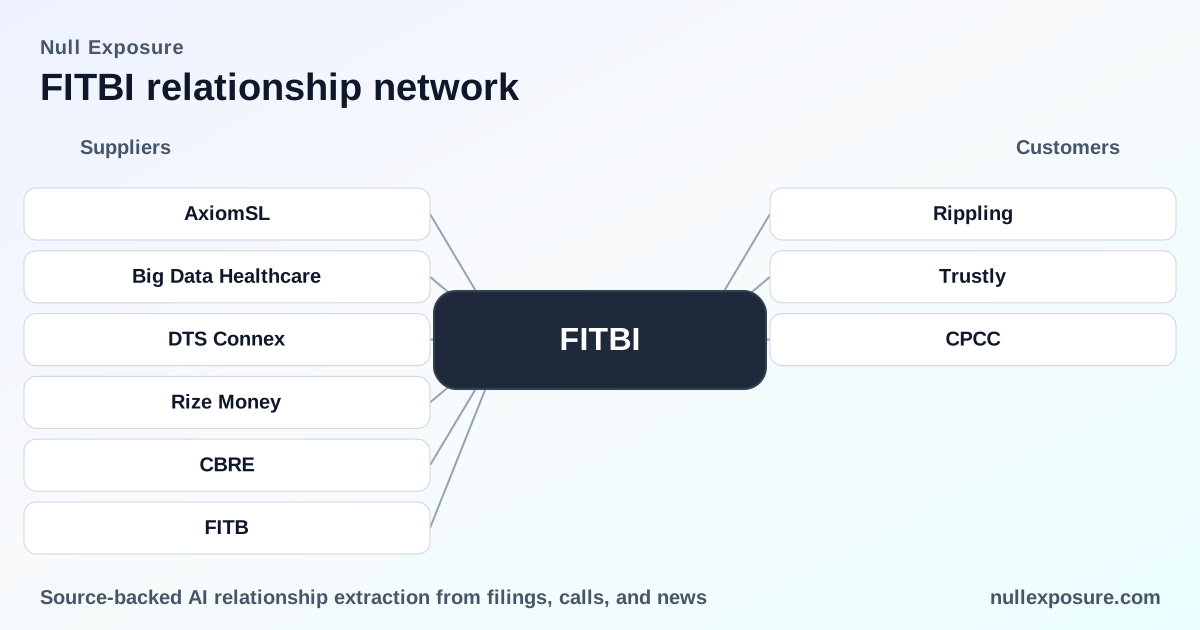
Fifth Third Bancorp (FITBI) — supplier relationships that shape payments, regulatory tech, and real estate exposure
Fifth Third Bancorp operates as a diversified regional bank that monetizes across interest spread, fee income from commercial and consumer services, and strategic tuck‑in acquisitions to accelerate payments and cash‑management capabilities. Recent supplier and acquisition relationships show a deliberate build-out of payments infrastructure and regulatory reporting technology, coupled with long-term operational commitments in real estate and outsourced platforms that influence cost structure and operational risk.
If you evaluate counterparties or underwriting exposure to Fifth Third, start with its supplier posture and outsourcing footprint: for a concise view of third‑party exposures and supplier mapping visit https://nullexposure.com/.
How these relationships reveal the operating strategy
Fifth Third’s supplier moves are purposeful. The bank combines acquisitions of specialist payments software with vendor deployments for regulatory reporting and real‑estate outsourcing. That combination creates a hybrid posture: strategic ownership where control and differentiation matter (payments software), and long‑term vendor relationships where scale and compliance drive decisions (regulatory reporting, facilities). Constraints disclosed in company materials underline this model: Fifth Third holds long‑term operating leases for branches and facilities, depends on third‑ and fourth‑party providers globally for hosting critical data and platforms, and classifies many interactions under a service‑provider relationship model. Those are company‑level operational signals that shape procurement, contract terms, and concentration risk.
For a deeper map of suppliers and to track changes in Fifth Third’s partner roster, see the full supplier index at https://nullexposure.com/.
What to watch: key business model drivers and risks
- Payments expansion through acquisitions drives fee revenue and positions Fifth Third in faster‑growing processing margins, but increases integration and legacy‑risk burdens.
- Regulatory reporting technology is critical to capital and compliance accuracy; vendor failures or contract disputes carry outsized regulatory cost.
- Long‑term leases and global hosting lock in fixed costs and create longer remediation timelines for operational incidents.
These are not theoretical: the vendor list below shows concrete examples that illustrate those levers.
(You can view a consolidated supplier snapshot and relationship signal scoring at https://nullexposure.com/.)
Relationship summaries: how each supplier or partner functions for Fifth Third
AxiomSL — regulatory reporting platform
Fifth Third selected AxiomSL to deploy a data‑driven regulatory reporting and risk management platform to satisfy analytical and regulatory reporting requirements, positioning AxiomSL as a core vendor in the bank’s compliance stack. This was reported in Financial IT in FY2017, which described the deployment as covering the bank’s analytical and regulatory reporting needs (Financial IT, FY2017).
Big Data Healthcare — acquired capability to support payments growth
Fifth Third purchased Big Data Healthcare as part of a 2023 set of acquisitions to grow its payments business, signaling a strategy of acquiring niche software providers to augment vertical‑specific payment flows and client services. American Banker documented the 2023 acquisitions, noting Big Data Healthcare as one of the purchases used to expand capabilities (American Banker, FY2025).
DTS Connex — cash management software acquisition
The bank acquired DTS Connex, a cash management software service, to expand commercial payments capabilities across cash logistics, infrastructure, and risk management; this enhances Fifth Third’s treasury and corporate client offerings. American Banker reported the DTS Connex purchase as a tactical expansion in commercial payments functionality (American Banker, FY2025).
Rize Money — embedded payments/innovation play
Rize Money was acquired alongside other payments assets in 2023 to accelerate consumer and small‑business payments innovation and to integrate new digital product flows into Fifth Third’s platform. American Banker lists Rize Money as a 2023 acquisition aimed at bolstering payments capabilities (American Banker, FY2025).
CBRE — real estate and post‑pandemic facilities consulting
Fifth Third used CBRE to host a presentation about post‑pandemic changes to its branch and facilities footprint, reflecting an ongoing vendor relationship for real‑estate advisory and facilities management. MPAMag reported on a CBRE‑hosted presentation where Fifth Third outlined operational changes (MPA Magazine, FY2022).
Detroit Tigers / Comerica Park naming‑rights mention — brand and sponsorship transition
A news report described Comerica’s planned rebrand to Fifth Third, including the transfer or rebranding of sports sponsorships and naming rights such as Comerica Park (home of the Detroit Tigers), which would shift marketing and sponsorship obligations as part of larger corporate consolidation. NewsBreak covered reporting on the rebrand and naming‑rights timeline extending through 2034 (NewsBreak, FY2025).
What the relationships collectively signal for investors and operators
- Contracting posture: Fifth Third’s mix of acquisitions and vendor deployments points to a dual contracting strategy: pursue long‑term vendor commitments for infrastructure and compliance, and use acquisitions to internalize capabilities where product differentiation and control matter.
- Concentration and criticality: Regulatory reporting (AxiomSL) and payments/cash‑management platforms (DTS Connex, Rize Money, Big Data Healthcare) are operationally critical; disruption in those relationships would have immediate compliance or revenue impact.
- Maturity and integration risk: Acquired companies expand capability but raise integration, governance, and legacy‑tech risks that require rigorous vendor management and carve‑out controls.
- Geographic scope: The company uses global third‑ and fourth‑party providers for hosting and services, creating cross‑border operational and regulatory considerations for incident response and continuity.
Those company‑level constraints—long‑term leases, global third‑party hosting, and supplier service‑provider classifications—translate into measurable exposures on procurement, continuity planning, and vendor governance.
Practical takeaways for evaluation
- Prioritize diligence on regulatory and payments vendors. AxiomSL and DTS Connex sit at the intersection of compliance and revenue; evaluate contingency plans and SLAs.
- Assess integration governance. Review how Fifth Third has integrated past acquisitions (Rize Money, Big Data Healthcare) and the associated tech‑stack rationalization.
- Factor in fixed real‑estate commitments. Long‑term leases increase operational leverage and lengthen recovery timelines after strategic changes.
For a supplier risk scorecard and continuous monitoring of Fifth Third’s partner set, visit https://nullexposure.com/.
Conclusion: what investors and operators should do next
Fifth Third has a coherent approach to building payments and compliance capability through both acquisition and vendor selection, but that strategy raises classic banking tradeoffs between control and complexity. Focus on vendor criticality, contract tenure, and cross‑border hosting arrangements when underwriting operational risk or negotiating commercial terms. For up‑to‑date supplier mappings and relationship signals that support investment and operational decisions, consult the supplier index at https://nullexposure.com/.