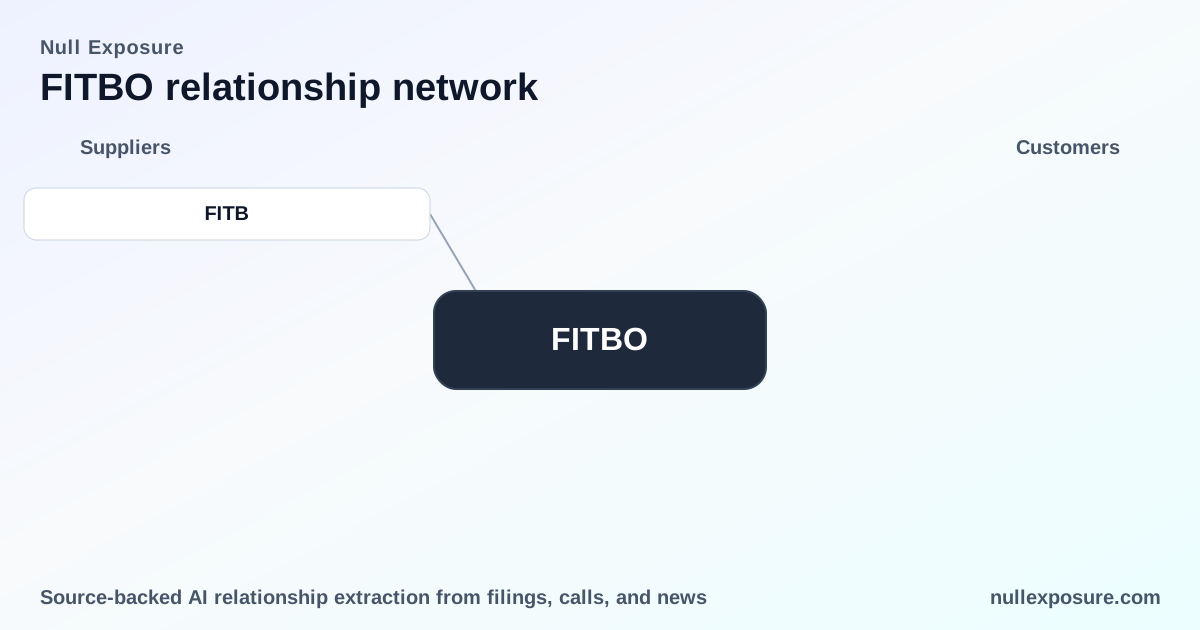
Fifth Third Bancorp (FITBO) — supplier relationships and what they tell investors
Fifth Third Bancorp operates as a diversified regional bank through its federally chartered bank subsidiary, monetizing primarily through net interest income, fee-based services and securities activities. Supplier and partner relationships are instruments to extend customer services, manage risk, and compress operating costs; where commercial hedges and large institutional counterparties underpin balance-sheet stability while consumer-facing vendors expand customer lifecycle value. For investors and operators, the interaction between long-term hedging contracts and selective consumer vendors defines both capital efficiency and growth optionality.
If you want a concise, sourced supplier map and constraint analysis for decision-making, see the full coverage at https://nullexposure.com/.
How suppliers fit into Fifth Third’s business model
Fifth Third is a regional bank with $8.36 billion in trailing twelve-month revenue, healthy operating margins, and a return on equity above 12% (return on equity TTM: 0.122). The firm uses external suppliers in two distinct ways that matter to investors:
- To manage financial risk: the bank executes long-dated interest-rate swaps and related derivatives with major financial institutions to hedge commercial lending exposures and interest-rate risk, which reduces earnings volatility and regulatory balance-sheet sensitivity.
- To extend customer services and distribution: fintech and service vendors — for example consumer legal-tech partners — increase product stickiness and create fee or cross-sell opportunities without large incremental capital investment.
These dual supplier roles create a mixed operating posture: capital-protection through long-term financial contracts, and customer-acquisition through targeted vendor partnerships.
Visit https://nullexposure.com/ for additional supplier diligence and alerts.
The Trust & Will relationship — what the market reported
Fifth Third is offering free wills to its customers through a partnership with Trust & Will, a consumer legal-tech provider. According to CNBC, the bank has arranged to give customers access to complimentary online wills via Trust & Will as part of a customer benefits program disclosed in March 2026. This is a straightforward retail-facing partnership intended to deepen customer relationships and increase wallet share by delivering a high-utility peripheral service. (Source: CNBC, March 9, 2026 — https://www.cnbc.com/select/fifth-third-bank-giving-free-wills/)
All supplier relationships identified in public reporting
- Trust & Will: Fifth Third has partnered with Trust & Will to provide customers with free online wills as a customer benefit; this ties a low-cost consumer service to retention and cross-sell objectives (CNBC, March 2026 — https://www.cnbc.com/select/fifth-third-bank-giving-free-wills/).
This is the complete list of supplier relationships surfaced in the reviewed public items for FITBO.
What the contractual constraints tell investors about operating posture
Several constraint signals extracted from filings and disclosures reveal company-level operating characteristics — these are not tied to any single supplier unless the disclosure explicitly names one.
- Long-term contracts dominate risk management: Filings disclose long-dated interest-rate swaps tied to commercial and industrial loans (evidence excerpts referencing receive-fixed swaps and dollar notional schedules). This indicates a deliberate hedging posture that stabilizes net interest income over extended maturities, reducing short-term earnings sensitivity to rate changes.
- Counterparties are large financial institutions: The bank discloses derivative relationships with major financial institutions used to economically hedge customer-facing interest-rate positions, which implies high counterparty quality and concentration toward large counterparties for core hedging functions.
- Active relationship lifecycle for hedges: Management regularly adjusts the volume, maturity and mix of portfolio swaps to reflect changing interest-rate risk and balance-sheet positions, indicating an active and dynamic hedging program rather than static buy-and-hold positions.
Collectively, these constraints show a bank that treats its financial-supplier relationships as critical infrastructure (high criticality, long maturity, concentrated counterparties) while simultaneously using consumer vendors for growth initiatives (shorter-term, lower criticality).
Operational and risk implications for investors and operators
- Concentration risk is real but managed: Using large institutional counterparties to hedge interest-rate exposure concentrates counterparty risk but also improves creditworthiness and execution capacity. Operational teams should monitor counterparty exposure metrics and collateral triggers in stress scenarios.
- Contracting posture is mixed: The bank’s hedging strategy relies on long-term contracts that lock in hedged economics, while consumer partnerships like Trust & Will are modular and reversible — a combination that stabilizes core earnings while allowing marketing flexibility.
- Supplier criticality varies by function: Derivative counterparties are mission-critical to capital and earnings stability; consumer vendors are important for retention and fee generation but are replaceable with moderate switching costs.
- Maturity profile favors stability: Long-term swaps smooth earnings and funding volatility; this favors conservative capital allocation but reduces upside from sudden rate moves.
Key investor takeaway: Fifth Third’s supplier profile balances defensive, long-dated financial contracts with opportunistic, consumer-facing partnerships — a configuration that preserves capital stability while enabling low-cost customer-product experimentation.
For deeper supplier intelligence and relationship footprints visit https://nullexposure.com/.
Practical next steps for analysts and operators
- Monitor derivative counterparty disclosures in periodic filings for changes in notional, maturity, and collateral terms; these drive funding and earnings sensitivity.
- Track announcements of new customer-facing vendor partnerships for their potential to increase fee income or improve retention metrics.
- Stress-test counterparty concentration in scenarios of collateral calls and counterparty distress, given the reliance on large financial institutions for hedging.
Conclusion: Where value and risk converge
Fifth Third’s approach to suppliers shows a deliberate trade-off: protect earnings volatility through long-term financial contracts with large counterparties while pursuing low-cost consumer partnerships for growth. For investors focused on preferred securities and bank counterparty exposure, the stability delivered by the hedging program is the primary value driver, while initiatives like the Trust & Will partnership are tactical levers to enhance customer economics without significant capital deployment.
If you evaluate bank supplier risk or construct counterparty-focused portfolios, start with our curated supplier profiles and constraint signals at https://nullexposure.com/ for a structured view of counterparties, contract types, and operational exposure.