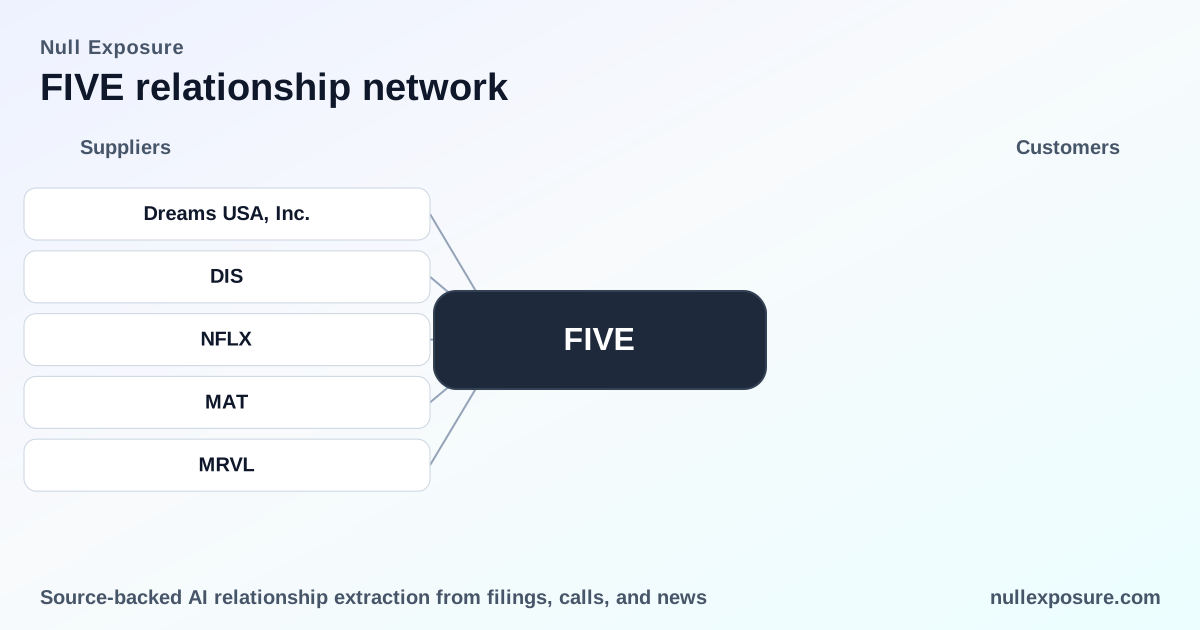
Five Below (FIVE) — supplier relationships and what they mean for investors
Five Below is a U.S.-based specialty value retailer that monetizes through high-frequency retail sales across value-price merchandising, seasonal licensed goods, and ancillary promotional programs. The company sources the majority of its merchandise from overseas manufacturers, generates margin through scale and merchandising mix, and translates product assortment and brand partnerships into customer traffic and same-store sales growth; revenue for the trailing twelve months was roughly $4.43 billion with a market capitalization near $11.7 billion. For investors and operators, the core question is whether Five Below’s supplier posture and licensing relationships support continued margin expansion without introducing outsized supply-chain concentration or working-capital risk.
Explore a structured view of supplier relationships and constraints at https://nullexposure.com/ to dig deeper into vendor-level exposures.
How Five Below sources and structures supplier risk — the quick take
Five Below operates with a short-term contracting posture and a broadly diversified vendor base. The company works with roughly 1,000 vendors, sources a significant majority of merchandise outside the U.S. (China is the largest single source), and reports that no single vendor accounted for more than 5% of purchases in fiscal 2024. Payment terms to participating suppliers “generally range up to 90 days,” and the company typically has no long-term or exclusive supply agreements.
These characteristics create a predictable set of operating model trade-offs:
- Flexibility and nimbleness: Short-term contracts and large vendor breadth allow rapid assortment changes and aggressive seasonal merchandising.
- Limited supplier concentration risk: No vendor over 5% reduces single-counterparty disruption risk at the purchase level.
- Exposure to offshore manufacturing dynamics: Heavy reliance on China and global sourcing transmits geopolitical, freight, and tariff volatility into cost of goods sold and timing.
- Low single-contract dollar concentration: Reported purchase commitments and supply-chain-finance obligations are modest relative to revenue (see later figures).
If you want a vendor-level view and supplier scoring, visit the Five Below supplier profile on Null Exposure at https://nullexposure.com/.
Supplier relationships analysts should monitor
Below are the supplier/partner mentions surfaced across recent coverage; each relationship is summarized in plain English with the cited source.
Dreams USA, Inc.
Five Below pursued authorization to retail the Sonny Angel brand but was denied distribution rights, illustrating limits to its brand access strategy for certain collectibles and small-figure merchandise. This was reported by RLS Media on March 9, 2026. (Source: RLS Media, 2026-03-09)
Disney
Bank of America commentary reported on CNBC notes Five Below has enhanced its seasonal and studio-licensed merchandising and established a closer merchandising relationship with major studios including Disney, which supports higher-margin licensed tie-in product categories. (Source: CNBC, February 4, 2026)
Netflix
Five Below has expanded studio-licensed merchandise aimed at holidays and event-driven assortments, with Netflix included among the content partners cited by analysts as part of the company’s strengthened licensing mix. (Source: CNBC, February 4, 2026)
Barbie (Mattel)
Analysts highlighted closer ties with the Barbie franchise for seasonal and studio-license merchandising, positioning Five Below to capture impulse purchases tied to franchise moments; this coverage was published on CNBC. (Source: CNBC, February 4, 2026)
Marvel
Marvel-branded merchandise has been cited as part of Five Below’s enhanced licensing strategy for holiday and studio-driven assortments, supporting traffic and mix improvements according to analyst commentary reported on CNBC. (Source: CNBC, February 4, 2026)
What the supplier constraints reveal about operating levers and risks
The company disclosures compiled into constraints provide company-level signals that should shape both valuation and operational diligence.
- Contracting posture — short-term: Evidence shows payment terms up to 90 days and an absence of long-term supplier exclusivity. This creates operational flexibility and reduces long-term fixed supplier commitments while shifting inventory and working-capital dynamics toward rolling replenishment.
- Geography and manufacturing role — global manufacturer sourcing: A significant majority of merchandise is manufactured outside the U.S., with China as the largest single source. This signals sensitivity to freight, tariffs, and offshore production cycles.
- Materiality and concentration — immaterial single-vendor exposure: Working with ~1,000 vendors and capping any single vendor below 5% of purchases limits vendor concentration; supplier failure is unlikely to produce catastrophic procurement disruption at the company level.
- Buyer role and promotional terms: Five Below functions primarily as a buyer of finished goods and receives vendor allowances, free product, and promotional funds, which points to a merchandising model that uses vendor-funded marketing to offset marketing spend and support margin.
- Spend bands and commitments — modest absolute exposure: The company reported $0.7 million outstanding under a supply-chain-finance program as of February 1, 2025, and approximately $2.1 million in purchase commitments tied to new store construction—dollar exposures that are immaterial relative to multi-billion-dollar annual revenue.
These constraints create a risk/reward profile: the sourcing model enables rapid assortment shifts and licensing-led margin capture, while the global manufacturing footprint concentrates operational risk in the global supply chain rather than in single-vendor dependency.
If you want to translate these supplier signals into transaction-level risk metrics and sourcing heat maps, review the supplier analytics hub at https://nullexposure.com/.
Portfolio implications and actionable monitoring for investors and operators
For investors, the key monitoring points are licensing execution, inventory turns, and supply-chain cost inputs:
- License execution: Increased merchandising with Disney, Netflix, Barbie, and Marvel is a clear growth lever for higher-margin, event-driven sales; quantify uplift via same-store sales and sell-through during franchise events.
- Working capital and COGS sensitivity: Short payment terms and offshore sourcing amplify sensitivity to freight and tariff swings; monitor Days Inventory Outstanding and supplier-payable timing.
- Operational resilience: Low vendor concentration reduces counterparty risk, but geographic concentration in China raises macro and logistics exposure—track shipping lead times and landed cost inflation.
Operators should prioritize supplier diversification where freight or tariff risk is concentrated, tighten promotional ROI measurement on licensed merchandise, and keep a close watch on supply-chain-finance usage given the small but existent program obligations reported.
Bottom line and next steps
Five Below runs a low-concentration, short-term supplier model that supports merchandising agility and licensing-driven margin expansion, but the sourcing footprint creates clear exposure to global logistics and tariff dynamics. Brand partnerships with Disney, Netflix, Barbie, and Marvel are meaningful strategic levers for seasonal and studio-licensed assortment growth; counterparty denials such as the Dreams USA/Sonny Angel example show limits to universal brand access.
For a deeper supplier-level dossier, risk scoring, and to monitor new relationship developments, visit the Null Exposure portal at https://nullexposure.com/.