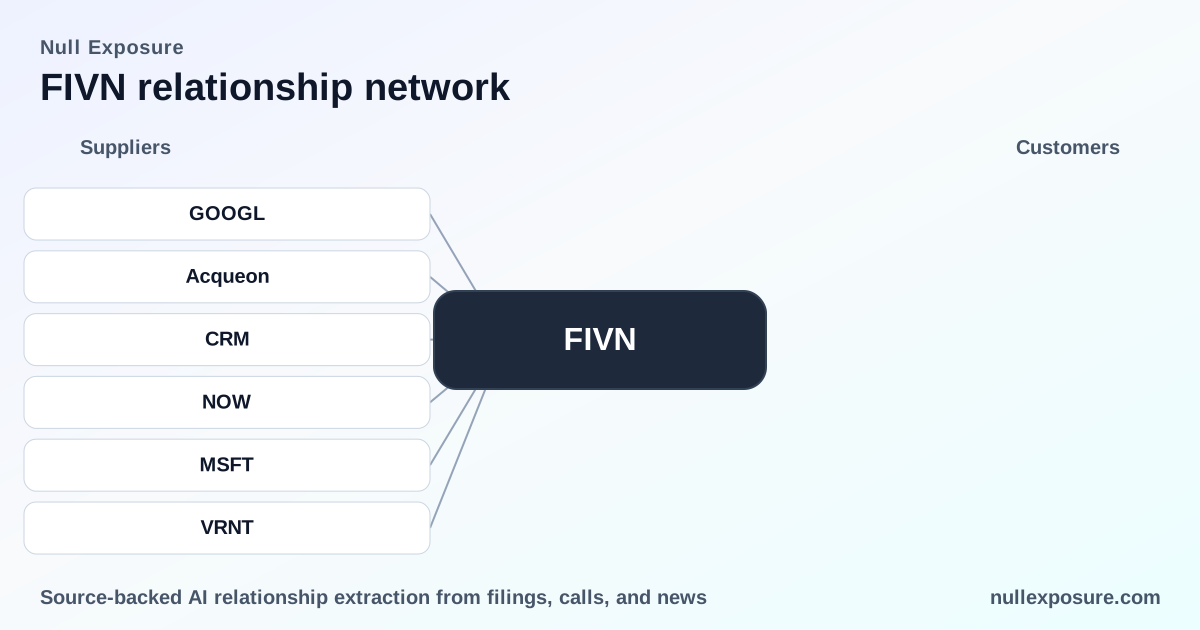
Five9 (FIVN) Supplier Landscape: Strategic AI Alliances and Infrastructure Dependencies
Five9 operates a cloud-native contact center platform that it sells mostly through subscription and usage-based contracts to enterprise customers; the company monetizes by layering AI-enabled contact center features and third-party licensed software on top of recurring SaaS revenue and by selling enterprise integrations and professional services. Five9’s commercial strategy is increasingly partnership-led — large cloud and software alliances accelerate product capability and sales motion while infrastructure contracts lock in delivery and cost commitments. For a deeper supplier-risk signal view, visit https://nullexposure.com/.
Quick investor thesis: why supplier strategy matters to valuation
Five9’s pathway to revenue growth is driven by AI bookings and distribution through hyperscalers and CRM platforms. Partnerships with Google Cloud and other platform vendors turn product features into sales hooks, improving enterprise retention and average contract value, while long-term hosting and telecom obligations create predictable operating leverage and a modest capitalized commitment profile.
- Growth driver: AI integration and joint productization with cloud vendors.
- Operational risk: Dependence on third-party telecom, colo and cloud providers for availability.
- Spend profile: Commitments concentrated in the $10m–$100m band, small relative to Five9’s ~$1.15B revenue TTM but material to gross margin and continuity of service.
Supplier roster and what each relationship delivers
Google Cloud — a strategic product and go‑to‑market partner
Five9 expanded a partnership with Google Cloud to deliver a joint Enterprise CX AI solution that ties Five9’s Intelligent CX Platform to Google’s Gemini Enterprise and Vertex AI, enabling orchestrated human/AI workflows in healthcare and retail; leadership publicly emphasized the partnership as a core capability driver in FY2026. Source: Simply Wall St and InsiderMonkey coverage of the FY2026 partnership announcement.
Salesforce — integration with CRM ecosystems for workflows
Five9 maintains integration ties with Salesforce that help the company embed contact-center intelligence directly into CRM workflows and improve customer-facing automation and analytics. Source: Zacks coverage republished on TradingView (FY2026 commentary).
Microsoft — platform compatibility for enterprise deployments
Five9 lists Microsoft among platform partners that improve integration and enterprise reach, supporting customers that standardize on Microsoft cloud and productivity stacks. Source: Zacks / TradingView summary of Five9’s partner ecosystem (FY2026).
ServiceNow — workflow automation and IT/HR customer journey links
ServiceNow is part of Five9’s partner set for extending contact center intelligence into enterprise service workflows, enabling downstream automation across incident and case management. Source: Zacks / TradingView partner overview (FY2026).
Verint — complementary customer engagement and analytics tooling
Verint is cited as a partner that complements Five9’s portfolio with analytics and workforce optimization capabilities that customers combine with Five9’s voice and AI routing. Source: Zacks / TradingView partner summary (FY2026).
Acqueon — an acquisition to accelerate generative AI-driven revenue generation
Five9 announced plans to acquire Acqueon, a revenue-generation platform provider, to strengthen its generative AI capabilities and boost customer engagement features; management framed the deal as raising the bar on AI-driven customer engagement. Source: CRN coverage of the acquisition commentary (reported in FY2026 press coverage).
What the contractual and operating constraints tell investors
Five9’s disclosed supplier commitments show a deliberate operating posture and predictable cost base:
- Long-term contracting with fixed monthly payments is the dominant posture; Five9 reports agreements that expire through 2029, which supports revenue and cost predictability for delivery partners.
- Licensing exposure to third‑party software is explicit: Five9 incorporates third‑party AI offerings under license, meaning some advanced AI capability and cost are sourced rather than in‑house.
- Global delivery footprint is confirmed: Five9 operates from co‑location and public cloud facilities across the US, UK, Europe, Australia, Canada and India, indicating operational complexity and multi‑jurisdictional dependency.
- Supplier role is primarily service‑provider / infrastructure: telecom, colo and cloud providers are central to uptime and customer experience; failure or degradation would directly impact customer SLAs.
- Commitment scale is material but contained: Five9 disclosed $14.6 million of outstanding hosting and telecom obligations and $38.1 million of cloud services and maintenance commitments (with ~$20.0 million expected in 2025 and $18.1 million in 2026), placing supplier spend in the $10m–$100m band. These figures indicate predictable operating cash requirements without large single‑vendor capex exposures.
These constraints are company‑level signals describing contracting posture, concentration, criticality and maturity of Five9’s supplier relationships rather than relationship‑specific caveats.
For an expanded supplier signal readout, visit https://nullexposure.com/.
Investment implications: concentration, runway and downside vectors
Five9’s partnership strategy delivers high optionality on AI monetization while keeping capital intensity low. The expanded Google Cloud collaboration and Acqueon deal accelerate product-market fit for enterprise AI contact center use cases, and management highlighted 50% year-over-year enterprise AI growth in recent commentary, underscoring bookings momentum reported in FY2026 press. Source: InsiderMonkey / Finviz FY2026 summaries.
At the same time:
- Concentration risk exists around a small number of hyperscalers and software platforms that materially shape product capability and sales channels.
- Operational risk is non-trivial because Five9’s service delivery depends on telecom, colo and cloud providers; long-term contracts reduce churn risk but lock in spend.
- Spend scale is manageable: the disclosed $14.6M hosting obligation and $38.1M cloud commitments are meaningful to margins but not on the scale that would threaten free cash flow given ~$1.15B revenue TTM and positive EBITDA.
Bottom line: Five9’s supplier relationships are a net positive for growth and productization but create a clear third‑party dependency that investors must watch through disclosure on renewals, SLA performance and the company’s progress in internalizing critical AI components.
Practical next steps for investors and procurement teams
- Monitor Five9’s quarterly disclosures for changes to the $10m–$100m spend bands and any concentration shifts among cloud partners.
- Track the Acqueon integration milestones as a proxy for accelerated AI monetization and cross-sell potential.
- Validate SLA performance and incident history with telecom and colo partners as part of operational due diligence.
To access a structured supplier-signal dashboard and see how these relationships surface across vendor risk vectors, visit https://nullexposure.com/. For tailored supplier intelligence and monitoring for portfolio companies, start at https://nullexposure.com/.
Five9’s supplier mix combines strategic cloud and CRM alliances that materially improve product competitiveness with infrastructure and licensing commitments that deliver predictability and operational risk — a balance investors and operators must actively monitor as AI becomes the core revenue lever.