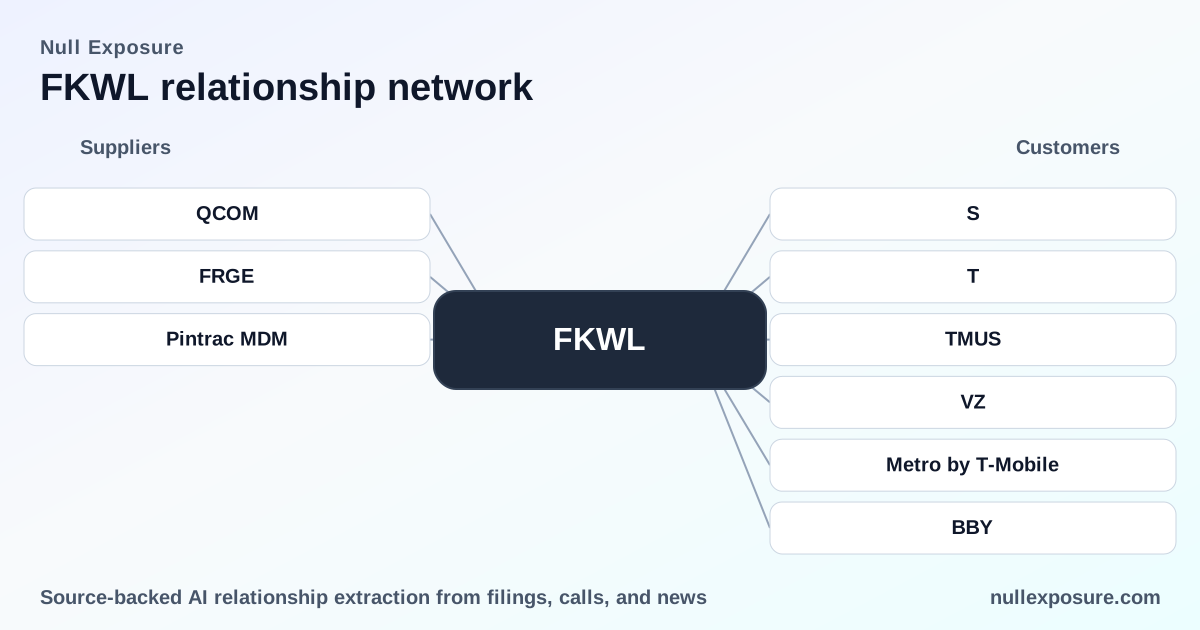
Franklin Wireless (FKWL) — supplier map and what it means for investors
Franklin Wireless designs and sells mobile broadband devices — principally carrier-branded and enterprise mobile hotspots — and monetizes by purchasing components and finished products from third‑party manufacturers and chipset suppliers, then reselling those devices to carriers, channel partners and enterprise customers. The company’s margins and product competitiveness depend on semiconductor partnerships (chipsets) and a small number of Asian manufacturers that produce the finished units; Franklin recognizes revenue through device sales to carriers and distributors while accounting for concentrated supplier payables on the balance sheet. For a vendor-risk view and supplier intelligence on Franklin, visit https://nullexposure.com/.
The high-level commercial posture: concentrated supply, outsourced manufacturing, tight margins
Franklin operates a lean manufacturing posture: it outsources production to independent manufacturers in Asia instead of vertically integrating production. The FY2025 filing states that the majority of manufacturing was performed by two independent companies located in Asia, which positions Franklin as a buyer-dependent company with concentrated supplier exposure. That concentration translates into negotiating leverage for suppliers and operational sensitivity to geographic disruption.
- Concentration is material: Franklin purchased $31,999,540 of wireless data products from two suppliers in the year ended June 30, 2025, representing 85.3% of total purchases, and carried related accounts payable of $5,641,183 (69.5% of payables) as of that date. This level of vendor concentration creates single‑counterparty risk and working‑capital sensitivity. (Source: Franklin Wireless FY2025 10‑K.)
- Outsourced manufacturing in APAC is the norm: the company confirms majority manufacturing occurred in Asia, which increases exposure to regional supply‑chain events and logistics costs. (Source: Franklin Wireless FY2025 10‑K.)
These company‑level signals indicate high supplier criticality, mid‑stage maturity of vendor relationships, and concentrated spend—key inputs for underwriting counterparty and operational risk.
Supplier relationship roll call (what every investor should know)
Below I cover each supplier relationship surfaced in public filings and press reporting. Each entry is a plain‑English summary with the cited source.
Qualcomm — Franklin sources Qualcomm modem/RF chipsets (X62 and X35 families) that power its 5G hotspots; Qualcomm technology is integral to Franklin’s performance positioning and carrier certifications. According to company and press announcements, Franklin’s A50 and subsequent hotspots used the Qualcomm X62, and the RG350 is marketed as the first commercially approved RedCap hotspot to feature the Qualcomm Snapdragon X35 modem-RF system (press releases from 2022 and 2025). (Sources: Franklin press releases and news coverage — Newswire and GlobeNewswire, 2022 and 2025; Yahoo Finance/press, FY2025; QuiverQuant coverage, 2025.)
Forge — Franklin entered a Purchase and Supply Agreement with Forge on June 20, 2024, under which Franklin purchases certain products from Forge for resale to customers, formalizing a supplier/distributor relationship for specific product lines. This is a contractually documented supply channel disclosed in Franklin’s FY2025 10‑K. (Source: Franklin Wireless FY2025 10‑K, Purchase and Supply Agreement disclosure.)
Pintrac MDM — Franklin’s A10 hotspot was intentionally designed to integrate with the Pintrac MDM remote management platform, positioning the device for business and education use where device management is required. That integration is presented in Franklin’s marketing around its AT&T/T‑Mobile launches and enterprise positioning. (Source: Franklin press release / Newswire coverage, FY2022.)
What the supplier mix implies for operations and valuation
The mix of Qualcomm (chipset partner), contract manufacturers in Asia, a named supply agreement with Forge, and device integration with management platforms like Pintrac tells a consistent story:
- Product competitiveness depends on chipset access. Qualcomm chipsets determine radio capability (RedCap 5G, etc.) and directly drive carrier certification and user experience. That makes Qualcomm a strategic technology partner rather than a commoditized parts vendor.
- Manufacturing risk is concentrated and regional. Two Asian manufacturers account for the majority of output; this is a single‑point operational vulnerability for production continuity and cost shocks.
- Contracting posture is supplier‑dependent but formalized. The Purchase and Supply Agreement with Forge indicates Franklin uses formal contracts to secure reseller inventory, which improves predictability relative to ad‑hoc buying but does not eliminate concentration risk.
- Financial sensitivity is real. With full‑year revenue of about $39.6M and gross profit of roughly $7.5M (FY‑TTM figures in public filings), a single supplier pricing shift or production interruption can move margins materially. Market capitalization of roughly $41.95M places Franklin in a small‑cap bracket where supplier disruption would show up quickly in liquidity and earnings. (Source: Franklin financials, FY‑2025 and TTM data.)
Risk and opportunity checklist for investors and operators
- Watch supplier concentration metrics and payables trends. The $31.99M of purchases from two suppliers (85.3% of purchases) is a leading risk signal; monitor changes in that concentration, accounts payable, and any new supplier agreements disclosed in SEC filings. (Source: Franklin FY2025 10‑K.)
- Track chipset roadmaps and certification milestones. Qualcomm relationships underpin product roadmaps; any shift in chipset availability, pricing, or preferential allocation (e.g., for larger OEMs) would affect Franklin’s go‑to‑market timing and margins. (Source: Franklin press releases 2022–2025.)
- Assess geographical supply risk and supplier maturity. Manufacturing in APAC is efficient but exposes Franklin to regional labor, logistics and tariff risk; investors should evaluate whether Franklin is diversifying manufacturers or building buffer inventory. (Source: Franklin FY2025 10‑K.)
- Leverage device management partnerships as margin enhancers. Integration with Pintrac MDM and carrier certifications offer upsell pathways into education and enterprise segments where device management and recurring services can increase lifetime value. (Source: Newswire FY2022.)
For an investor‑grade supplier risk report or to map counterparty exposure across Franklin’s partner set, see https://nullexposure.com/.
Practical next steps for due diligence
- Obtain the latest 10‑K/10‑Q to confirm whether the two‑supplier concentration has changed and to review the full terms of the Forge Purchase and Supply Agreement.
- Request supplier contract summaries and certification timelines from management calls: chipset supply cadence (Qualcomm) and capacity commitments from the Asian manufacturers are critical for forecasting production and margin scenarios.
- Stress test working capital: model a 30–90 day disruption to the primary manufacturers to quantify earnings and cash‑flow vulnerability.
Franklin’s model is simple and capital‑light but concentrated: product differentiation rests on Qualcomm silicon and certified carrier integrations, while execution depends on a small set of Asian manufacturers and a formal supply relationship with Forge. For deeper supplier intelligence and tailored exposure mapping, visit https://nullexposure.com/.
Final takeaway: investors should treat Franklin as a small‑cap device merchant whose upside is tied to chipset access, carrier certifications, and the company’s ability to de‑risk manufacturing concentration; diligence should focus on contract terms, geographic supplier resilience, and accounts‑payable dynamics.