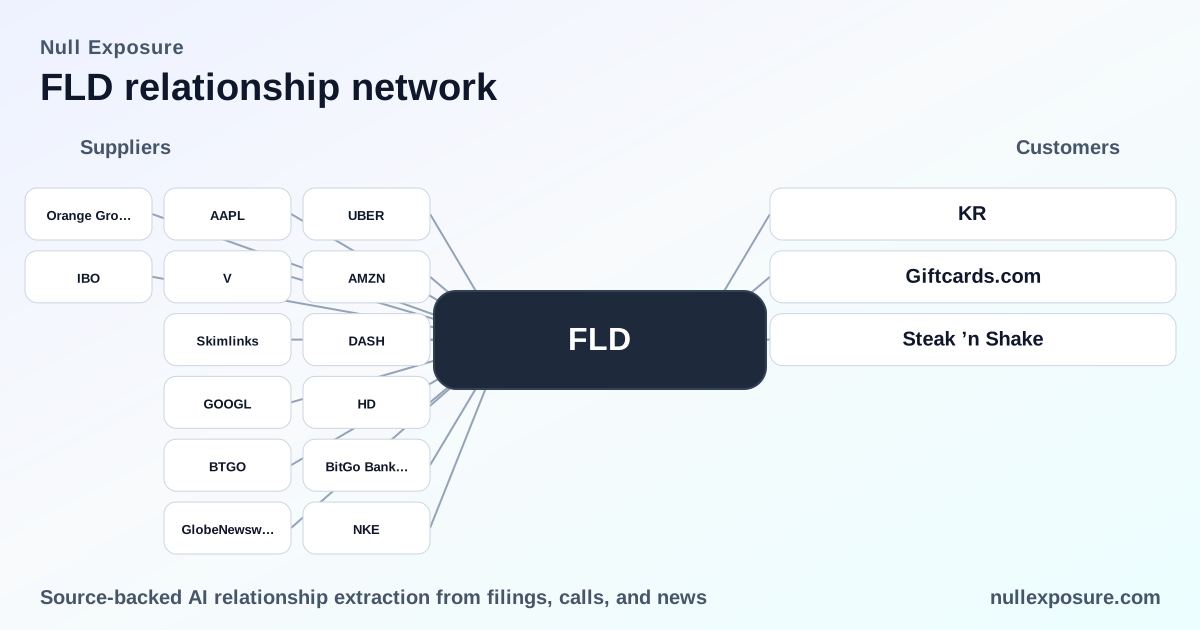
Fold Holdings (FLD): supplier map and what operators should price into risk
Fold is a bitcoin-first financial services company that monetizes by converting everyday payments into bitcoin rewards and by selling adjacent financial products and merchant-linked gift cards. Its core product set — a prepaid Visa debit card that pays bitcoin rewards, a bitcoin gift-card program, custody and exchange services, and an emerging affiliate and creator marketing channel — generates revenue from payment flows, gift-card margins, platform fees and partnership economics. Key commercial dependencies include payment rails, a federally chartered digital-asset banking partner for nationwide availability, app distribution channels, and large-brand gift-card suppliers. Learn more on the platform at https://nullexposure.com/.
Why this supplier map matters for investors and operators
Fold’s commercial model is simple to state and complex to operate: everyday payments are routed through payment processors and Visa rails, settlement and custody are handled with digital-asset banking and custody partners, and customer acquisition scales through both app stores and third‑party affiliate networks. That architecture creates a small set of high‑criticality suppliers whose terms, uptime and regulatory posture directly affect revenue, operating leverage and growth execution.
- Contracting posture: Company-level signals show a mix of contract types — long‑term promissory arrangements and subscription-style agreements coexist with operational spot activity (Fold executes daily bitcoin purchases to match customer rewards). These modalities indicate both capital commitments and transactional flexibility.
- Service dependency: Fold relies materially on third‑party service providers (payment processors, cloud infrastructure, outsourced support and compliance) for live customer operations; these are active relationships that are central to the product experience.
- Concentration and criticality: A handful of partners (Visa for rails, a federally chartered bank/custody partner for national availability, and app distribution channels) are mission-critical. Loss or disruption of any would meaningfully impair customer acquisition, settlement, or custody.
- Maturity and commercialization: The company is layering growth channels (affiliate networks, gift-card partnerships, and an upcoming credit card) on top of a functioning payments product, shifting the intensity of commercial risk from product build to partner management.
Explore supplier analytics and benchmarking at https://nullexposure.com/ to quantify counterparty exposures and contract maturities.
The relationships you need to know (one‑line readouts and sources)
Below are each of the counterparties surfaced in the public records and news feeds, with a concise business description and the original reporting.
Uber
Fold distributes gift cards from major retailers and brands, including Uber, as part of its bitcoin gift‑card catalog sold through the Fold affiliate program and marketplace. According to InvestingNews (March 2026), the Fold Bitcoin Gift Card offers units from brands such as Uber.
Amazon
Amazon is listed among the hundreds of top‑brand gift cards Fold offers to affiliates and customers, supplying inventory that enables Fold’s gift‑card driven monetization. InvestingNews (March 2026) documented Amazon as a gift‑card partner in Fold’s affiliate launch announcement.
DoorDash
DoorDash gift cards are included in Fold’s gift‑card catalogue for affiliates and end customers, supporting rewards and promotional flows. InvestingNews (March 2026) lists DoorDash in the same product announcement.
Home Depot
Home Depot gift cards are another catalog item Fold markets through its affiliate program, providing cross‑sell inventory for consumer bitcoin rewards. InvestingNews (March 2026) includes Home Depot among the retailer partners named.
Nike
Nike gift cards feature in Fold’s merchant gift‑card inventory for affiliates and consumers, expanding retail breadth for rewards‑driven purchases. InvestingNews (March 2026) cites Nike as a named brand.
Apple (gift cards)
Apple gift‑card inventory is part of Fold’s product suite sold to affiliates and users as part of its gift‑card and rewards ecosystem. InvestingNews (March 2026) identified Apple among the top brands in Fold’s affiliate offering.
Visa
Visa provides the payment network for Fold’s prepaid debit card, which converts everyday currency transactions into bitcoin rewards; Visa’s rails are core to Fold’s revenue flow and card experience. MarketBeat and QuiverQuant coverage (early March 2026) describe the prepaid Visa debit card as Fold’s core offering.
BitGo Bank & Trust / BitGo
Fold announced nationwide availability via a partnership with BitGo Bank & Trust after BitGo secured a federal charter; BitGo is also cited as Fold’s digital-asset infrastructure partner for custody and expansion. QuiverQuant (March 2026) reported the partnership enabling Fold to operate in all 50 states under BitGo’s trust framework, and separate QuiverQuant items reference BitGo’s role in broader infrastructure and inclusion in index notices.
Skimlinks
Fold has integrated Skimlinks as part of its affiliate and creator monetization strategy, using the network to allow creators to monetize links and syndicate deals. InvestingNews (March 2026) notes Skimlinks as one of the press and influencer networks Fold will work with.
Impact
Fold partnered with Impact, a global partnership-marketing platform, to accelerate affiliate marketing, performance PR and creator collaborations, and interested affiliates can sign up via Fold’s Impact program. InvestingNews (March 2025/QuiverQuant March 2026) referenced the Impact relationship and the platform listing (Impact ID: 6656510).
Apple App Store
Fold’s mobile app update was distributed through the Apple App Store, which is an essential distribution and update channel for customer engagement and onboarding. QuiverQuant (March 2026) reported the app update availability on the Apple App Store.
Google Play
Fold’s Android distribution runs through Google Play, which mirrors the App Store role for broader device coverage and discoverability. QuiverQuant (March 2026) cited Google Play as the distribution channel for the app update.
GlobeNewswire
GlobeNewswire distributed Fold press releases that were summarized in secondary feeds; these releases form part of Fold’s public communications and investor outreach. QuiverQuant (March 2026) included a GlobeNewswire disclaimer when summarizing a Fold press release.
Orange Group
Orange Group serves as an investor‑relations advisor/contact for Fold (FoldIR@orangegroupadvisors.com), indicating outsourced IR support for investor communications. Manila Times (GlobeNewswire distribution, December 2025) listed Orange Group as the contact for investor inquiries.
Operating model constraints and what they signal
Fold’s public excerpts reveal a blended contracting posture: long‑term capital agreements and subscription-style securities coexist with daily spot buying of bitcoin to match reward liabilities. Company filings reference multi‑year promissory note inputs and a subscription agreement that settled for both cash and equity, indicating capital commitments beyond purely transactional relationships. Separately, operational excerpts show Fold purchases bitcoin once per day to match customer rewards — a spot, execution‑level behavior that requires reliable counterparty liquidity and custody.
Service providers are central to operations: payment processors, banks, cloud vendors, and outsourced support functions are identified as critical. The relationship stage for these suppliers is active. These constraints collectively point to a business model where partner stability, regulatory posture (especially for chartered banking/custody partners), and execution reliability carry outsized risk and value leverage.
Investment implications and operational checklist
- Concentration risk is real: Visa and BitGo/BitGo Bank & Trust are strategic; any change in their commercial or regulatory stance would be material.
- Distribution is multi‑channel but fragile: App stores and affiliate networks accelerate growth but create dependency on platform rules and partner economics.
- Capital posture includes legacy long-term obligations and subscription financings that influence leverage and runway; at the same time, daily spot bitcoin purchases require liquidity management and custody resilience.
- Governance signal: Insider ownership is high (82% insiders), indicating concentrated control and potential governance dynamics that investors should price.
If you need a structured supplier risk scorecard or a contract‑maturity view for Fold, start here: https://nullexposure.com/. For deeper counterparty benchmarking and to map contract terms to financial sensitivity, visit https://nullexposure.com/ and request access to supplier analytics.
Fold’s operating model converts transactional flows into crypto‑native rewards at scale; the path to durable margins runs through partner negotiation, custody reliability and platform distribution. Active supplier management is the single biggest lever for preserving growth and reducing tail risk.