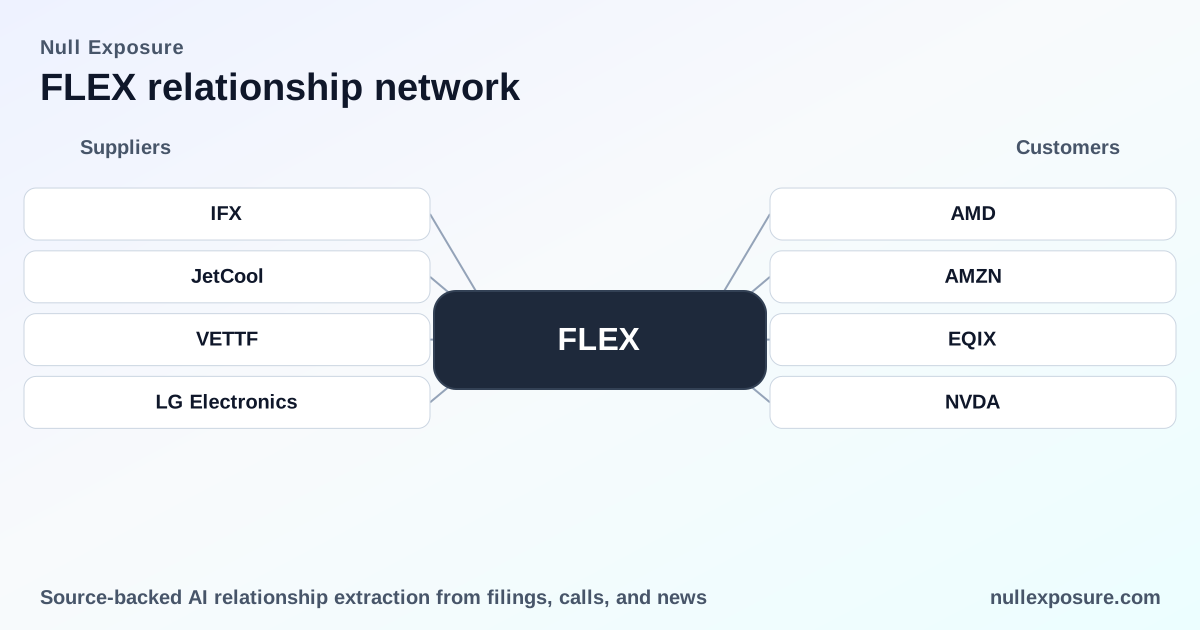
Flex Ltd (FLEX) — supplier relationships and strategic signals for investors
Flex is an integrated design-to-delivery partner that monetizes through contract manufacturing, engineering services, and modular systems sales to OEMs across automotive, data center, and industrial markets. The company captures margins by combining high-volume manufacturing with proprietary subsystems (for example, its JetCool cooling business), ongoing design-win services, and short-cycle procurement that preserves operational flexibility. For investors, the most relevant implications are how these supplier and partner ties position Flex for AI infrastructure and software-defined vehicles while keeping working capital and supplier commitments deliberately flexible. Learn more about supplier risk and discovery at https://nullexposure.com/.
Why supplier relationships are an investment lever for Flex
Flex’s business model is transaction-led but solution-driven: large OEM clients bring design and demand, and Flex sells a package of engineering, assembly, and supply chain execution. That model depends on two linked features revealed in company disclosures:
- Contracting posture is short-term — Flex discloses that “the majority of the purchase obligations are generally short-term in nature,” which is a company-level signal that procurement commitments are typically rolling rather than long-term locked contracts. This preserves agility for shifting end-markets but increases the importance of active supplier management.
- Flex operates as a buyer with active purchase orders — filings note outstanding firm purchase orders for inventory, signaling an operational stance of continuous buying rather than speculative inventory builds.
These attributes create a profile of high operational flexibility, modest supplier lock-in, and active supplier engagement, which is advantageous for rapid market shifts but requires rigorous supplier performance and testing, especially in high-precision segments like semiconductor cooling and automotive electronics.
Who Flex is partnering with right now — the relationship map
Infineon — microcontrollers for automotive zone controllers
Flex announced a collaboration with Infineon to launch a zone controller development kit for software-defined vehicles; Infineon supplies AURIX microcontrollers used in the kit, positioning Flex into the safety- and performance-critical domain of automotive compute. (Flex press release, Mar 9, 2026: https://flex.com/resources/flex-collaborates-with-infineon-and-vector-to-launch-zone-controller-development-kit-for-software-defined-vehicles)
Vector — embedded software and development tools
In the same initiative, Vector provides the embedded software stack and development tools for the zone controller development kit, giving Flex a software layer to complement its hardware and manufacturing capabilities for automotive OEMs. (Flex press release, Mar 9, 2026: https://flex.com/resources/flex-collaborates-with-infineon-and-vector-to-launch-zone-controller-development-kit-for-software-defined-vehicles)
JetCool — internal liquid-cooling hardware for AI infrastructure
As part of Flex’s U.S. manufacturing collaboration with AMD, JetCool — identified as a Flex company — supplies advanced liquid-cooling hardware used in factory testing and validation, demonstrating vertical integration on thermal subsystems for AI servers. (Sahm Capital report on the AMD collaboration, Mar 2, 2026: https://www.sahmcapital.com/news/content/flex-announces-us-manufacturing-collaboration-with-amd-to-accelerate-domestic-ai-infrastructure-2026-03-02)
LG Electronics — modular cooling systems for AI data centers
Flex announced a partnership with LG Electronics to co-develop integrated modular cooling systems targeted at the thermal challenges of AI-driven data centers, signaling joint product development across a major OEM in cooling and systems integration. (TradingView summary referencing the partnership, Mar 2026: https://www.tradingview.com/news/zacks:8cba63699094b:0-flex-stock-surges-55-in-the-past-year-will-the-uptrend-continue/)
What these relationships tell you about Flex’s strategic positioning
These four relationships form a coherent narrative: Flex is pivoting from pure contract manufacturing toward integrated systems and subsystem leadership where thermal management and domain-specific compute (automotive zone controllers) are differentiators. Key implications for investors:
- AI and data center exposure is explicit and structural. The AMD collaboration combined with JetCool and the LG partnership show Flex is building proprietary thermal capabilities as a revenue line, which supports higher attach rates and service margins versus commodity PCB assembly.
- Automotive software-defined vehicle (SDV) exposure is real and complementary. The Infineon + Vector kit is a straight-line entry into automotive electronics where recurring engineering services and validation programs drive sticky revenue.
- Vertical integration reduces external supplier risk in critical subsystems. JetCool being a Flex company demonstrates internal capability to supply high-value thermal components rather than sourcing them externally, lowering dependency for that segment.
- Operationally conservative contracting helps working capital but shifts supplier risk to short-term management. The company-level disclosure that purchase obligations are generally short-term is a deliberate posture to retain flexibility across cyclical markets; investors should balance that against execution risk for rapid demand spikes.
If you want a focused supplier-risk report or counterparty analysis tailored to these relationships, see actionable intelligence at https://nullexposure.com/.
Risks and monitoring priorities for investors
- Supplier concentration and performance: While current public relationships span major OEMs, Flex does not disclose full counterparty concentration here; monitor quarterly filings for customer concentration and supplier commitments.
- Execution on thermal and server subsystems: Revenue upside depends on converting proofs of concept (e.g., JetCool hardware, LG modules) into volume production; watch manufacturing yields, time-to-volume, and margin contribution.
- Technology and certification cadence in automotive: Infineon and Vector involvement accelerates time-to-market but requires sustained software and hardware validation; any delays can compress margins on design wins.
- Short-term contracting dynamics: The company’s short-term purchase obligation posture supports responsiveness but tightens the need for supplier diversification to avoid bottlenecks during spikes.
Investor action plan — what to do next
- Evaluate Flex as a hybrid play: exposure to AI-infrastructure thermal solutions plus SDV electronics. These are higher-margin adjacencies to its core manufacturing business and worth a premium if executed at scale.
- Track the AMD collaboration milestones, JetCool product commercialization, and LG system integration announcements as near-term catalysts.
- Monitor filings for changes in the mix of short- versus long-term purchase obligations and any disclosure of material supplier dependencies.
For continued diligence and supplier-risk monitoring tools, visit https://nullexposure.com/. If you want a tailored assessment of Flex’s supplier network or a concierge briefing based on these relationships, start at https://nullexposure.com/ and request a focused report.
Bold takeaway: Flex is actively converting manufacturing scale into systems-level value (thermal subsystems, SDV controllers) through a mix of external partnerships and internal verticals — a structural shift that increases margin optionality but raises execution and supplier-management stakes.