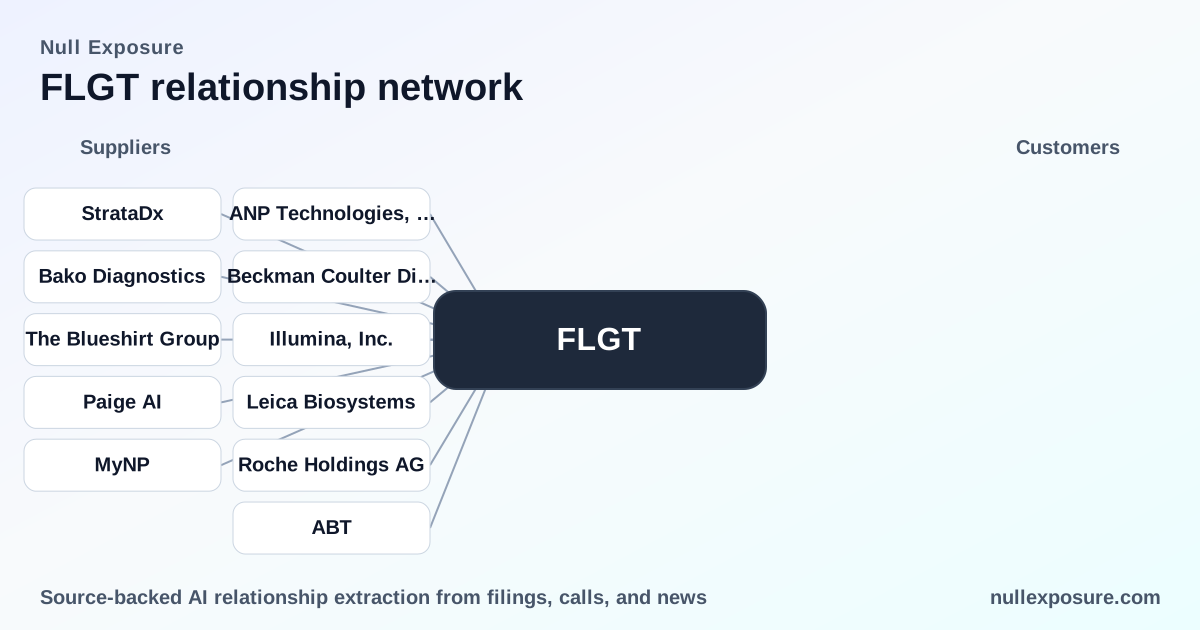
Fulgent Genetics (FLGT): supplier footprint and what it means for investors
Fulgent Genetics operates a high-volume clinical and genomic testing business that monetizes primarily through lab testing services (COVID-19 and genetic diagnostics) and related therapeutic development support; revenue comes from per‑test billing, reagent and sequencer procurement efficiencies, and now strategic acquisitions to broaden pathology services. The company’s operational economics are tightly coupled to a small set of hardware and reagent suppliers, and recent M&A indicates management is pursuing vertical expansion into pathology to capture higher-margin test flows. Learn more about supplier risk intelligence at https://nullexposure.com/.
Why suppliers are a financial issue, not just operational detail
Laboratory services are capital‑intensive and reagent‑dependent. Fulgent’s FY2024 disclosures show sole‑source dependence for next‑generation sequencers and associated reagents, plus reliance on a small group of equipment vendors for specialized assays. That contracting posture translates into concentration risk (few vendors account for critical inputs), operational criticality (disruption to a single supplier can materially impact turnaround times and revenue), and measurable near‑term spend commitments (purchase obligations reported). These are company-level signals investors must price into valuation and operational stress testing.
- Contracting posture: Explicit sole‑supplier arrangements for sequencers and reagents create single‑point failures.
- Concentration: A limited number of large‑enterprise vendors supply critical equipment and consumables.
- Criticality: The company itself warns that replacement equipment or revalidation could materially disrupt operations.
- Maturity and stage: These are active, ongoing supplier relationships reflected in FY2024 filings and recent spend obligations.
For portfolio managers assessing FLGT exposure, the supplier profile rates as high operational leverage to vendor continuity. If you need a structured supplier risk brief, visit https://nullexposure.com/ for tailored coverage.
Counterparty snapshots — every named relationship in the public record
Below are concise, plain‑English summaries of each supplier or partner cited in Fulgent’s publicly available materials and news coverage.
ANP Technologies, Inc.
Fulgent uses ANP Technologies for laboratory services, equipment and drug intermediates tied to its therapeutic development business, and recorded multi‑year expenses related to licensing and development services. This relationship is documented in Fulgent’s FY2024 Form 10‑K. (FY2024 10‑K)
Beckman Coulter Diagnostics
Beckman Coulter supplies certain laboratory equipment, supplies and services that support Fulgent’s flow cytometry tests and testing services, as disclosed in the FY2024 10‑K. (FY2024 10‑K)
Illumina, Inc.
Illumina is identified as the sole supplier of next‑generation sequencers and associated reagents used for genetic tests, and the exclusive provider of maintenance and repair for those sequencers — a single‑vendor dependency directly called out in the FY2024 10‑K. (FY2024 10‑K)
Leica Biosystems
Leica provides an automated digital scanning solution that Fulgent uses to scale digital pathology operations, per the company’s FY2024 disclosures. (FY2024 10‑K)
Roche Holdings AG
Roche supplies certain laboratory equipment, supplies and services for Fulgent’s immunohistochemistry testing, according to the FY2024 Form 10‑K. (FY2024 10‑K)
Abbott Laboratories (ABT)
Abbott supplies equipment, consumables and services used in Fulgent’s FISH testing and related services, as stated in the FY2024 10‑K. (FY2024 10‑K)
StrataDx
Fulgent announced an intention to acquire StrataDx as part of a combined transaction to expand its pathology platform; the acquisition was disclosed in company commentary in March 2026 and covered in earnings reporting. (Earnings transcript coverage, March 2026)
Bako Diagnostics
Fulgent entered into an agreement to acquire selected assets of Bako Diagnostics in a combined transaction with StrataDx valued at $55.5 million — reported in March 2026 industry press. (Finviz and earnings commentary, March 2026)
The Blueshirt Group
The Blueshirt Group is listed as the investor relations contact for Fulgent’s press materials, indicating retained communications support for investor outreach and disclosure distribution. (Company press release on Yahoo Finance, March 2026)
Paige AI
Fulgent’s Ezeopath platform supports third‑party AI modules, including Paige AI Prostate, highlighting a vendor ecosystem approach for algorithmic pathology workflows mentioned in recent earnings commentary. (Earnings transcript coverage, March 2026)
MyNP
MyNP is another third‑party AI module supported within Ezeopath for HER2 breast cancer analysis, named in Fulgent’s earnings discussion of AI partners. (Earnings transcript coverage, March 2026)
What the constraints tell investors about FLGT’s operating model
The filing excerpts and constraint signals collectively describe a company with active, high‑criticality supplier ties to large enterprise manufacturers, and measurable near‑term purchase obligations. Key implications:
- Sole‑supplier risk is concentrated and critical. Illumina’s explicit sole‑supplier role for sequencers makes uptime, reagent availability, and maintenance continuity direct drivers of revenue stability (this specific constraint names Illumina).
- Large‑enterprise counterparties dominate. The 10‑K names Roche, Beckman Coulter, Leica and Abbott as principal equipment and supplies vendors, which establishes predictable vendor bargaining power and long lead‑time dynamics.
- Spend profile is non‑trivial. Fulgent reported $40.6 million of purchase obligations as of year‑end 2024, with most payable within 12 months, which is consistent with the constraint indicating mid‑range committed spend.
- Supplier roles are multi‑dimensional. The company relies on suppliers as manufacturers (equipment and reagents) and service providers (maintenance, AI modules, CROs), underscoring operational dependency across the value chain.
If you want a scenario analysis that quantifies revenue at risk from supplier disruption, request a tailored exposure brief at https://nullexposure.com/.
Investment implications and operational takeaways
- Valuation sensitivity: A supply disruption that increases turnaround times or forces expensive revalidation would pressure margins and growth expectations; investors should stress test models for a 10–30% operational throughput shock.
- Strategic rationale for M&A: The Bako/StrataDx transaction for $55.5 million is a clear move to internalize pathology capacity and reduce downstream dependence on third‑party referral volumes — that is a deliberate hedge against vendor and market concentration.
- Operational mitigants: Management should prioritize multi‑source reagent strategies where possible, enhanced spare‑parts and maintenance agreements, and accelerated integration of acquired pathology assets to capture margin benefits.
Bottom line
Fulgent’s business model generates revenue through diagnostic testing and adjacent therapeutic work, but it carries material supplier concentration and criticality that investors must price into downside scenarios. The company’s recent pathology acquisitions and AI partnerships are constructive strategic moves to diversify revenue and control more of the value chain; however, the Illumina sole‑supplier position remains a central single‑point risk. For deeper counterparty exposure modeling and a supplier risk scorecard, visit https://nullexposure.com/ and request a tailored analysis.