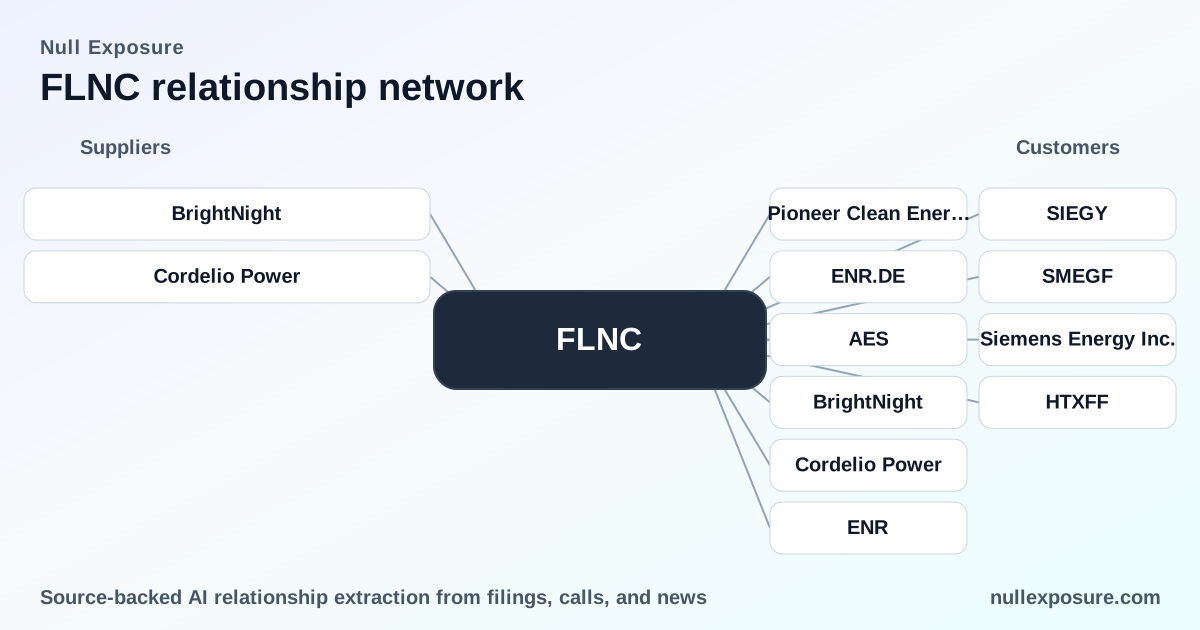
Fluence Energy (FLNC) — supplier relationships, commercial risk, and what investors should track
Fluence Energy operates as a market-facing provider of energy storage systems, services, and optimization software, monetizing through hardware sales (battery systems), recurring services and software-driven asset optimization, and large project supply contracts with utilities and independent power producers. Revenue is dominated by system sales and project-level commitments, while margin recovery depends on supply-chain execution and product commoditization. For a quick supplier-risk dashboard and ongoing monitoring, visit https://nullexposure.com/.
How Fluence makes money and why suppliers matter
Fluence sells integrated energy storage solutions — including the Gridstack Pro platform — and packages professional services and digital applications that extract value from deployed assets. The company reported trailing revenue of $2.55 billion with gross profit near $299 million, while operating and net margins remain negative as the business ramps commercial scale and absorbs supply-chain cost dynamics. Supplier economics directly affect gross margin and delivery cadence because Fluence buys major components and relies on contract manufacturers to procure, assemble, and ship finished systems, then recognizes revenue when projects are installed and operational.
Commercial partnerships under review
The public record for FY2026 highlights two project-level partners where Fluence is the equipment supplier.
BrightNight
Fluence will supply its Gridstack Pro energy storage solution for the Pioneer Clean Energy Center in Yuma County, Arizona, a project developed by BrightNight. According to a company announcement in January 2026, Fluence is the equipment provider for that project and will deliver system hardware and integration services for the site (Sahm Capital press release, Jan 15, 2026).
Cordelio Power
Cordelio Power is identified as BrightNight’s joint-venture partner on the Pioneer project; Fluence’s role is as the storage system supplier to the JV, positioning the company as the hardware and integration vendor for an independent power producer operating across the U.S. and Canada (Sahm Capital press release, Jan 15, 2026).
What the supplier constraints tell investors about Fluence’s operating model
Fluence’s public disclosures (FY2024–FY2025 filings and related press comments) reveal several company-level signals that define contracting posture, concentration, criticality, and maturity of supplier relationships:
-
Contracting posture — large, multi-year purchase commitments and structured financing. The company disclosed a $150 million supply-chain financing facility announced on August 8, 2025, and presented approximately $1.2 billion in future purchase commitments (tabled as of September 30, 2025), indicating heavy forward booking of battery cells and modules and a need to finance working capital across suppliers.
-
Geographic sourcing and concentration — multi-region sourcing with APAC exposure. Fluence has expanded battery suppliers into Asia while maintaining North American partners; one contract manufacturer operates in Vietnam, and the company explicitly notes shipping and weather-related risks from tropical storms as a logistical factor.
-
Criticality of components — single-component failures carry outsized customer impact. Fluence acknowledges that certain supplier-provided components are essential to system functionality and that a defect or failure can produce an impact materially larger than contractual remedies, highlighting high criticality for key component suppliers.
-
Role profile — buyer, integrator, and partial manufacturer. Historically reliant on third-party contract manufacturers, Fluence initiated in-house production of Fluence-made battery modules at a Utah contract-manufacturing site in September 2024, signalling partial verticalization while continuing to rely on external manufacturing and external service providers for testing and security functions.
-
Relationship lifecycle — active, programmatic supplier flows. Language in filings describes ongoing integration of third-party components into Fluence solutions and active procurement cycles, consistent with an operating model that balances long-run supplier commitments and project-by-project supply needs.
Collectively these signals define an operator that executes capital-intensive, forward-committed supply strategies while shifting toward selective in-house manufacturing to tighten control over quality.
Investment implications: where the risks and levers sit
For investors evaluating FLNC exposure, these supplier dynamics translate into a few high-conviction observations:
-
Supply-chain finance is a lever and a risk. The $150 million SCF facility reduces liquidity stress in procurement but raises dependence on capital markets and counterparty bank relationships to bridge supplier payables.
-
Geographic diversification reduces single-region concentration but introduces APAC operational risk. Expanding suppliers to Asia reduces single-source risk but introduces weather and port-vulnerability vectors that affect project timing and margin realization.
-
Component criticality increases contractual and reputational risk. Because component failures can produce outsized customer impact relative to supplier remedies, Fluence’s warranty and indemnity structures and its growing in-house production capability are central to margin protection.
-
Maturity is advancing but not complete. Initiation of module production in Utah demonstrates a strategic shift toward vertical control, but the company remains heavily dependent on third-party manufacturers and external service providers for volume and specialized testing.
If you want an at-a-glance view of these supplier risk levers and how they affect project delivery and margin profiles, explore our platform: https://nullexposure.com/.
Practical steps for operators and procurement teams
Procurement and asset teams should prioritize the following actions when negotiating with Fluence or operating alongside its projects:
- Demand transparent supply-chain mapping for APAC-sourced components and service-level commitments tied to logistics disruptions.
- Insist on contractual remedies and insurance mechanisms that reflect the high criticality of key components, not just standard limited-liability clauses.
- Model cash-flow impacts of purchase commitments and SCF behavior under stressed market conditions; stress-test delivery timetables against typhoon-season port disruptions.
- Monitor the ramp of in-house module production as a leading indicator of gross-margin stabilization and reduced supplier concentration.
Bottom line and next steps
Fluence’s commercial model combines large-scale system sales with service and software revenue, but financial performance and project delivery are tightly coupled to its supplier strategy: geographic sourcing choices, large forward purchase commitments, and a partial move to in-house manufacturing. For investors and operators, the primary value levers are execution on supply commitments, the pace of verticalization, and the company’s ability to manage APAC logistics risk while maintaining project delivery schedules.
For ongoing coverage, supplier-risk dashboards, and project-level monitoring, visit https://nullexposure.com/ and sign up for alerts on FLNC supplier exposures.