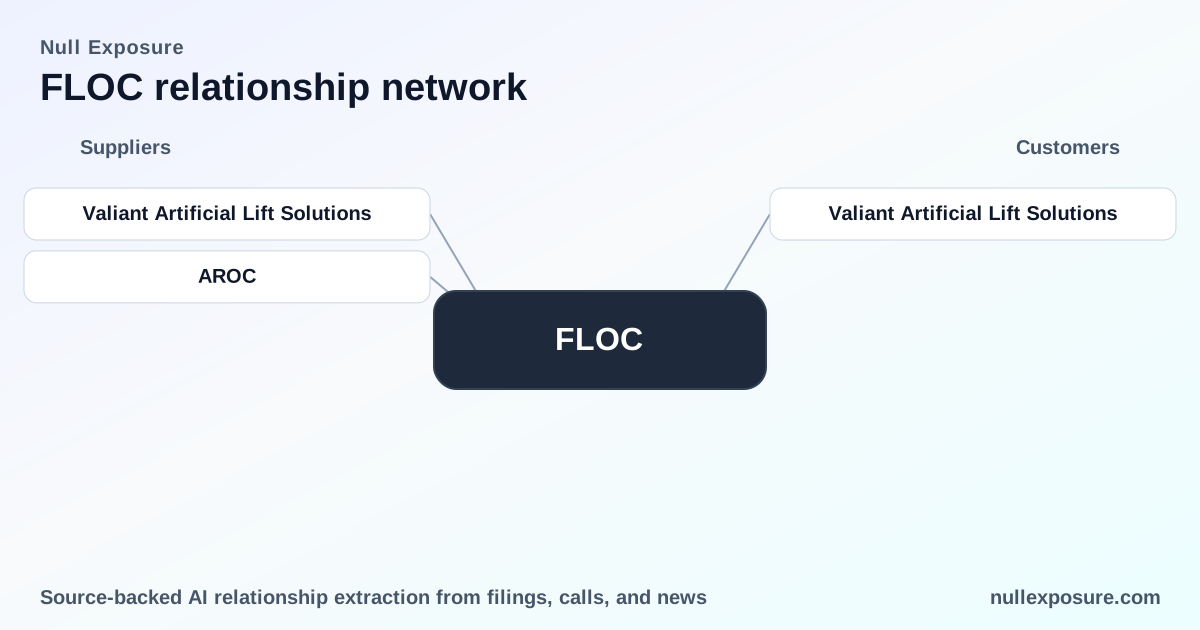
Flowco Holdings (FLOC) — Supplier relationships and what they signal for investors
Flowco monetizes proprietary fluid-management and production-enhancement technology by selling equipment and services to oil & gas operators and by acquiring complementary businesses to scale solution lines (notably artificial lift and gas-handling assets). The core commercial model is a mix of product sales, engineered services, and asset-backed revenue after selective acquisitions; operating cash flow is supported by integration of purchased assets. For investors, the supplier story is less about a single critical vendor and more about procurement volatility, acquisition-driven inorganic growth, and reliance on third-party specialists for non-core functions.
Explore deeper supplier analytics at https://nullexposure.com/.
Why supplier relationships matter for Flowco’s valuation today
Flowco’s supplier footprint influences margins through two vectors: raw-materials and subassembly cost exposure, and the operational dependencies created by acquisitions. The company explicitly purchases raw materials and sub‑assemblies, creating direct exposure to commodity price swings that pressure gross margins in cyclical energy markets. At the same time, Flowco uses outsourced service providers—for example, a third‑party cybersecurity operations center—to cover specialized capabilities that the company chooses not to run in-house.
Company-level supplier signals:
- Concentration moved materially year-over-year. Historical disclosures show two vendors once accounted for roughly 32% and 22% of purchases in earlier years, while the most recent segment disclosure (Natural Gas Technologies) reports no single vendor over 10% for 2024, indicating a deliberate or resultantly more diversified procurement posture.
- Contracting posture is primarily buyer-driven: Flowco purchases inputs for manufacturing and acquires assets to expand revenue bases.
- Criticality is mixed: no single supplier appears indispensable in the most recent period, but legacy concentration demonstrates periods of vendor dependence that can re-emerge under different sourcing strategies.
- Maturity of supplier engagement: use of outsourced SOC services signals reliance on experienced third-party providers for non-core, high-skill functions rather than building those capabilities internally.
These company-wide constraints should inform due diligence on integration risk, supplier concentration, and procurement volatility when modeling forward margins.
Active relationships and transactions you need to know about
Valiant Artificial Lift Solutions
Flowco announced the acquisition of Valiant Artificial Lift Solutions to scale its artificial-lift portfolio and accelerate the earnings story in that product line. The transaction is positioned as strategic growth in a high-margin, technical segment of Flowco’s product set. According to a Sahm Capital news report published March 3, 2026, the acquisition is intended to expand Flowco’s service and equipment offering for lift systems (Sahm Capital, 2026-03-03: https://www.sahmcapital.com/news/content/flowco-acquires-valiant-to-build-scale-in-artificial-lift-earnings-story-2026-03-03).
Archrock (HPGL and VRU asset acquisition referenced)
Flowco referenced prior asset acquisitions from Archrock in its Q4 2025 earnings call, noting management’s intention to reduce leverage to levels below where the company stood before the August transaction that transferred HPGL and VRU assets from Archrock. The comment frames the Archrock transaction as a recent inorganic expansion that affected the company’s balance sheet and is now part of the deleveraging narrative (Flowco Q4 2025 earnings call transcript).
What these relationships imply about risk and optionality
Flowco is executing a growth strategy that combines organic product sales with targeted acquisitions. That strategy creates both optionality and identifiable risks:
- Integration and execution risk is front and center. Acquisitions like Valiant and the Archrock-related asset purchases expand revenue potential but require successful integration of people, supply chains, and service networks—failure to integrate undermines projected synergies.
- Procurement volatility is an ongoing margin driver. Because Flowco purchases raw materials and subassemblies, commodity price moves and supply-chain disruption feed directly into gross margins; management disclosures confirm this exposure.
- Supplier concentration risk has been materially reduced recently but is not historical water under the bridge. The company-level disclosures show a reduction in single-vendor dominance in 2024, yet earlier years recorded heavy concentration—this history elevates the importance of monitoring procurement disclosure trends each quarter.
- Operational dependence on third-party specialists exists for non-core functions. Outsourcing cybersecurity to a SOC vendor is efficient but creates a third-party risk vector that requires strong contract terms and monitoring.
- Balance-sheet sensitivity to acquisitions. Management’s explicit comment about reducing leverage relative to the Archrock asset acquisition means financing structure and cash conversion will be important inputs to valuation going forward.
Review Flowco’s supplier picture in the context of integration timelines and margin sensitivity when stress-testing forecasts.
Explore supplier risk scoring and integration tracking at https://nullexposure.com/ for a systematic view of counterparties.
Practical next steps for investors and operators
- Demand clear integration KPIs from management: timelines for revenue migration, expected margin synergies, and headcount/service overlap reductions following acquisitions like Valiant.
- Model raw-material pass-through and scenario-test commodity shocks versus contracted pricing for subassemblies; treat procurement as a first-order margin lever.
- Insist on vendor concentration disclosures each quarter to confirm the trend away from high single-vendor dependency in Natural Gas Technologies.
- Validate third-party service SLAs and incident history for outsourced cybersecurity and other specialized providers; operational continuity is a non-trivial valuation input.
- Monitor leverage and cash conversion as the company executes acquisitions; management’s deleveraging targets following Archrock-related purchases should be tracked against free cash flow outcomes.
Bottom line: supplier story condenses to execution and procurement control
Flowco’s supplier relationships are not a single-vendor dependency story today; they are an execution and procurement story. The company combines buyer-driven procurement exposure with strategic, acquisition-led growth, and the degree to which management executes integrations and reins in leverage will determine whether acquisitions convert into durable margin expansion. For investors, the right focus is on integration KPIs, procurement cost sensitivity, and third‑party service risk mitigation.
If you want a more granular breakdown of counterparties, supplier concentration trends, and contract-level risk across Flowco, start your review at https://nullexposure.com/.