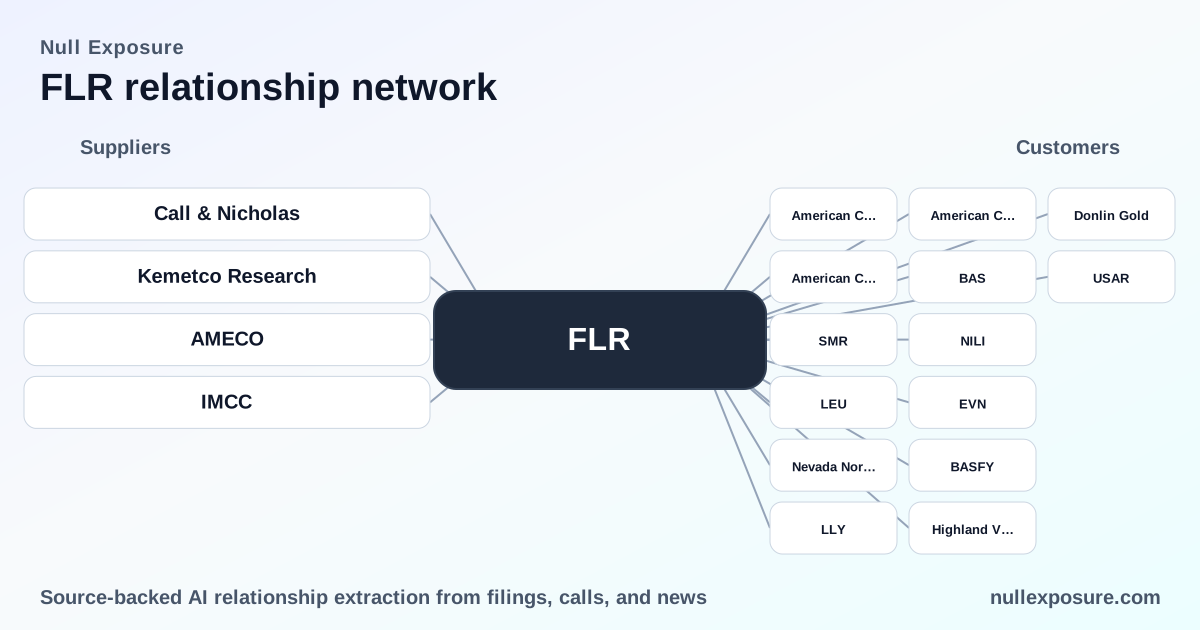
Fluor (FLR) supplier profile: consortium leadership, specialized partners, and what that means for investors
Fluor Corporation operates as a global engineering, procurement, construction and project-management contractor that monetizes through large project contracts, owner-operator services and long-cycle engineering engagements; revenue is driven by award cadence and execution on complex capital projects where Fluor usually acts as prime contractor and integrator. Understanding Fluor’s supplier relationships is essential because the company’s commercial leverage, schedule risk and margin profile flow directly from how it structures consortia and manages specialist subcontractors. For more supplier-focused intelligence and tracking, visit https://nullexposure.com/.
Why these supplier signals matter to an investor
Fluor’s business model is contract-centric: the company wins large capital projects, aggregates specialist partners into consortia, and captures fee and margin through prime-contractor scope and change-order capture. The company posted $15.503 billion in revenue TTM with a thin operating margin (about 2.0%) and a small negative profit and EBITDA line in the last reported period, which makes execution and cash conversion the central value drivers. When Fluor leads technical consortia, it retains commercial control but also inherits the delivery risk and subcontractor concentration exposure that can compress margins if a partner underperforms.
Fluor’s supplier relationships therefore act as a force multiplier for both upside (through modular expertise and faster project delivery) and downside (through schedule slips, warranty claims, or concentrated vendor counterparty risk). Institutional ownership is high (~98.6%), and analysts are split between buy and hold recommendations, reflecting the market’s focus on execution rather than growth stories alone.
Supplier relationships disclosed in the public coverage
Below are the relationships captured in the available supplier-scoped reporting, each with a plain-English summary and source.
Call & Nicholas — geotechnical partner in a Fluor-led consortium
Fluor is leading a consortium that includes Call & Nicholas as the geotechnical specialist, and the partner contributed to the project’s Preliminary Economic Assessment (PEA) workstream for the NNLP program. This placement signals Fluor’s reliance on boutique technical firms for site-specific subsurface and geotechnical deliverables. (Yahoo Finance, March 9, 2026: https://finance.yahoo.com/news/surge-announces-global-engineering-leader-120000053.html)
Kemetco Research — metallurgy specialist in the consortium
Kemetco Research is listed as the metallurgy partner inside the same Fluor-led consortium and supported metallurgical evaluation for the PEA, indicating Fluor’s outsourcing of metallurgical testing and process design to a subject-matter expert. (Yahoo Finance, March 9, 2026: https://finance.yahoo.com/news/surge-announces-global-engineering-leader-120000053.html)
IMC (symbol IMCC) — mining technical partner
IMC is identified as the mining specialist within Fluor’s consortium and contributed to the PEA for the NNLP initiative, reflecting Fluor’s strategy to assemble mining and process engineering capabilities from third parties while holding prime contractor status. (Yahoo Finance, March 9, 2026: https://finance.yahoo.com/news/surge-announces-global-engineering-leader-120000053.html)
AMECO — equipment rental partner that cites Fluor as its largest customer
AMECO’s public commentary identifies Fluor as AMECO’s largest single customer in North America, signaling customer concentration risk for certain suppliers and suggesting strong demand pull from Fluor’s project pipeline for heavy rental equipment and services. (International Rental News, March 2026: https://www.internationalrentalnews.com/news/ameco-ceo-outlines-new-strategy-and-diversification-goal/8014755.article)
What the constraints data (or lack of it) signals about Fluor’s operating model
The supplier-scope data contains no explicit constraints excerpts. At the company level that absence itself is a signal: public supplier reporting highlights consortium-based project delivery rather than long-term, captive vertical integration. From the relationships above, draw these company-level operational characteristics:
- Contracting posture: Fluor acts as prime contractor and consortium lead, retaining contract control and client interface while sourcing specialized work from boutique partners. That structure concentrates commercial risk at Fluor but distributes technical execution risk among partners.
- Supplier concentration and criticality: Evidence that Fluor is a major customer for AMECO and that a small set of technical specialists are bundled into PEA workstreams signals concentrated supplier footprints for some service types; these partners are functionally critical to early-stage project economics.
- Maturity and partner profile: Fluor’s partners are specialized and project-oriented (metallurgy, mining, geotech, equipment rental), consistent with a mature EPC model that leverages third-party expertise rather than captive capabilities.
- Execution sensitivity: Thin margins and negative EBITDA make Fluor sensitive to schedule and subcontractor performance; a single significant partner failure on a large contract can meaningfully affect reported profitability and cash flow.
Risk, opportunity and what investors should monitor
Fluor’s model creates clear monitoring priorities for investors evaluating supplier counterparty exposure:
- Watch project award cadence and contract terms (fixed-price vs. reimbursable) because the choice of contract form determines how much Fluor internalizes supplier underperformance.
- Track subcontractor concentration for categories where Fluor is the single large customer for suppliers (equipment rental, specialist testing), since supplier distress or capacity constraints can create schedule compression and cost overruns.
- Monitor PEA-to-FEED transitions: specialist partners that contribute to PEAs are critical when projects convert to FEED and construction — their performance is an early indicator of execution risk.
- Follow working-capital and backlog dynamics given the company’s thin margins and recent negative EBITDA; supplier payment terms and change-order recovery are direct levers on cash flow.
For deeper supplier relationship insight and continuous monitoring, see https://nullexposure.com/.
Bottom line: how to use this supplier intelligence
Fluor’s commercial value is concentrated at the contract level; supplier relationships are execution enablers and risk multipliers. The company captures value as prime integrator but relies on a small network of specialized partners for project-critical inputs; that structure amplifies both positive delivery outcomes and downside execution risk. Investors should prioritize diligence on counterparty concentration, contract structure, and the firm’s change-order capture history when assessing FLR exposure.
For a structured diligence briefing or to track supplier risk across FLR’s contracts, visit https://nullexposure.com/ for tailored intelligence and alerts.