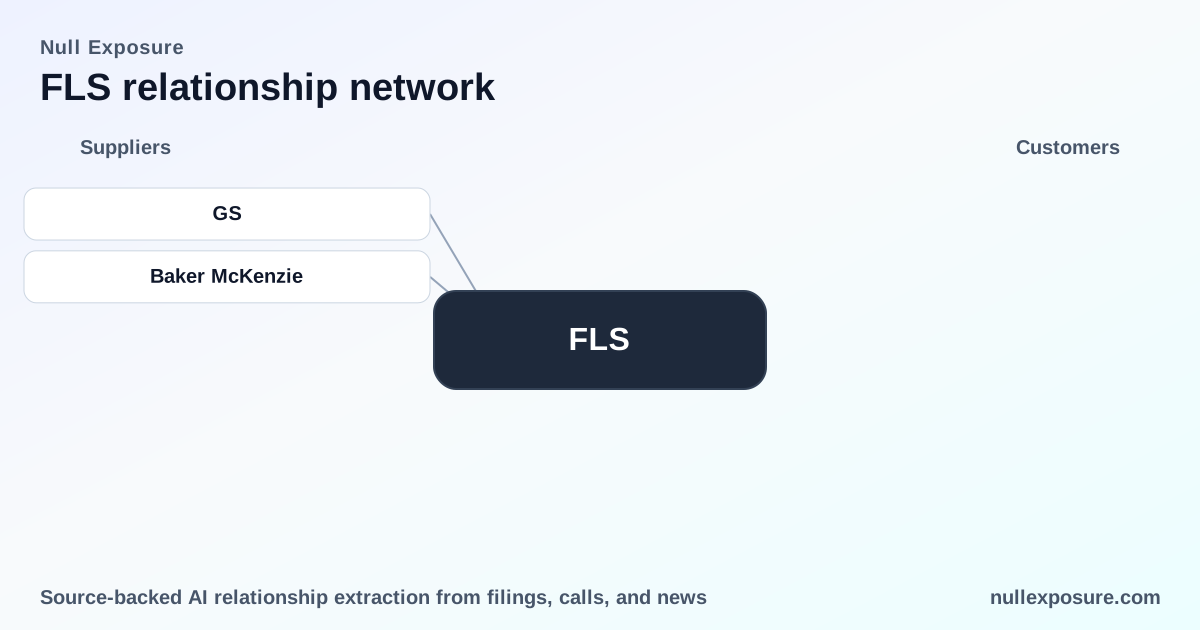
Flowserve (FLS) — Supplier partnerships, deal advisors, and what investors should price in
Flowserve is a global industrial supplier that designs, manufactures and services flow-management equipment and generates revenue from new equipment sales, long-cycle engineered projects and recurring aftermarket service contracts. The company monetizes through a blended mix of capital goods and high-margin aftermarket services, supplemented by strategic M&A to broaden product scope — most recently the acquisition of Trillium’s valves division. Investors should view Flowserve as a mature industrial equipment platform with meaningful aftermarket annuity and an M&A-driven inorganic growth posture.
Discover structured supplier and counterparty intelligence at https://nullexposure.com/.
The deal that frames current supplier relationships
In March 2026 Flowserve announced the purchase of the valves division of Trillium Flow Technologies for $490 million, a transaction explicitly supported by outside advisors. This transaction signals active portfolio expansion in valves — a core, high-service component of Flowserve’s addressable market — and explains why institutional advisors are now visible as supplier-side relationships. According to a Chem Eng Online report published on March 9, 2026, Goldman Sachs is Flowserve’s exclusive financial advisor and Baker McKenzie is acting as legal counsel on that deal.
Who the advisors are and why they matter
- Goldman Sachs & Co LLC: Financial advisory engagements of this type indicate Flowserve is engaging top-tier investment banking expertise to structure and price strategic acquisitions and to optimize transaction financing. According to a Chem Eng Online report in March 2026, Goldman Sachs is serving as Flowserve’s exclusive financial advisor on the Trillium valves acquisition.
- Baker McKenzie: The use of a global law firm for M&A legal work points to cross‑jurisdictional diligence and contract complexity associated with integrating engineered-product lines. Chem Eng Online reported in March 2026 that Baker McKenzie is serving as Flowserve’s legal advisor on the same transaction.
These advisor relationships are transactional but high-signal: the presence of a bulge‑bracket bank and global law firm on a mid‑single-digit‑hundreds‑of‑millions deal indicates Flowserve treats M&A as a repeatable tool for strategic growth rather than opportunistic tuck-ins.
Relationship-level details (the full set)
According to public reporting connected to the Trillium transaction, Flowserve’s current disclosed supplier/advisor relationships are:
- Goldman Sachs & Co LLC — Goldman is engaged as Flowserve’s exclusive financial advisor on the Trillium valves division acquisition, providing deal structuring and valuation support for the $490 million purchase. Source: Chem Eng Online, March 9, 2026.
- Baker McKenzie — Baker McKenzie is engaged as legal advisor for the same transaction, handling legal diligence and transactional documentation across the jurisdictions impacted by the acquisition. Source: Chem Eng Online, March 9, 2026.
Both relationships were disclosed in coverage of the Trillium valves acquisition and are limited to advisory roles tied to that transaction.
What this tells investors about Flowserve’s operating model
Flowserve’s business model combines engineered capital equipment with recurring aftermarket services. The company’s fiscal profile and market signals reinforce a predictable industrial operator:
- Scale and margins: Flowserve reports trailing revenue of $4.73 billion and EBITDA of $731.7 million, with an operating margin around 14.3% and a profit margin of 7.32% (latest twelve months).
- Valuation and growth orientation: The company trades at a trailing P/E of 27.9 and a forward P/E of 17.9, with an EV/EBITDA of ~15, indicating the market prices a mix of steady cash flows and expected earnings leverage from growth or margin expansion.
- Capital allocation: Active use of M&A and engagement of major advisors indicate a willingness to deploy capital for strategic acquisitions rather than relying solely on organic engineering projects.
From an operating posture perspective, Flowserve exhibits a contracting mix that blends long-cycle engineered sales with recurring aftermarket contracts: engineered projects create revenue spikes and working-capital swings, while aftermarket service and parts provide higher-margin, stickier revenues. That mix drives both revenue cyclicality and an attractive lifetime value per installed unit.
Risk and concentration considerations investors should weigh
- Integration risk from M&A: Using top-tier advisors reduces execution risk, but acquisitions still introduce integration and cultural challenges — important given Flowserve’s installed-base service model.
- Customer concentration and procurement cycles: Large engineered projects depend on clients’ capex cycles; aftermarket stabilizes cash flow but does not immunize the business from industrial downturns.
- Margin sensitivity: Industrial materials, energy, and supply-chain pressures can compress margins; Flowserve’s operating margin is healthy but vulnerable to commodity swings and execution on engineered programs.
If you track supplier counterparties or need a concise map of who Flowserve uses for strategic transactions, we compile and contextualize those links for operators and investors at https://nullexposure.com/.
What investors should monitor next
- Progress and integration metrics for the Trillium valves division: order backlog assimilation, cross-sell into Flowserve’s installed base, and realized synergies.
- Deal-related capital structure decisions: whether Flowserve finances similar deals with debt, equity, or cash on hand given its current market capitalization of ~$9.37 billion.
- Aftermarket growth and margin expansion: acceleration here would validate the company’s premium multiple versus peers.
Explore deeper supplier-relationship intelligence and transaction context at https://nullexposure.com/ — the resource investors use to translate counterparty disclosures into actionable signals.
Bottom line
Flowserve runs a balanced industrial business with material aftermarket annuity and strategic M&A activity that is now publicly supported by major financial and legal advisors for a recent valves acquisition. The appointment of Goldman Sachs and Baker McKenzie to advise on the Trillium deal is a clear signal that management is pursuing disciplined, advisor-driven inorganic growth to supplement organic revenue streams. Investors should price in integration execution risk against the potential for durable aftermarket revenue expansion and margin improvement.