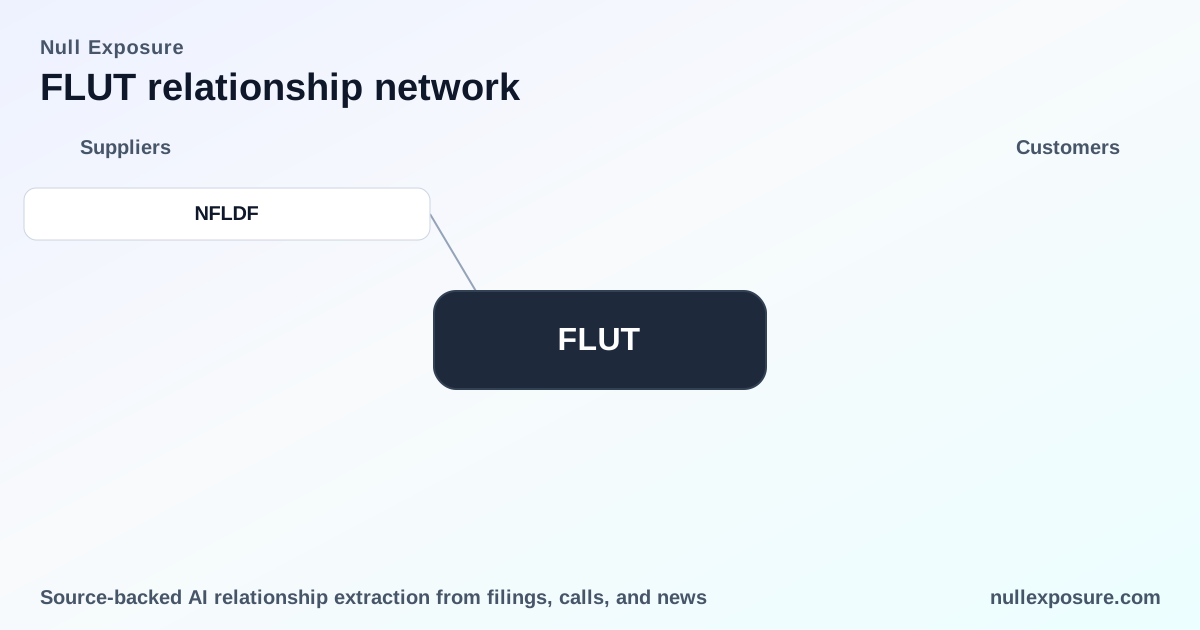
Flutter Entertainment (FLUT) — supplier relationships and what they mean for investors
Thesis: Flutter Entertainment operates as a global sports-betting and gaming platform that monetizes through wagering margins, platform fees, revenue-share partnerships, lottery operations and payments processing across regulated markets. Supplier relationships underpin real-time product delivery (data feeds, platform services, payment and geolocation) and therefore directly influence margins, latency and regulatory compliance. Learn more or compare supplier exposure analysis at https://nullexposure.com/.
Where Flutter sits in the market and why suppliers matter
Flutter is a capital-intensive consumer-facing platform with $16.38 billion in trailing revenue and $2.13 billion EBITDA, listed on the NYSE as FLUT. The business model is built on three commercial levers that are supplier-sensitive:
- Product delivery: live betting and casino content require low-latency data feeds, licensed games and resilient hosting.
- Customer flow: revenue-share affiliates, resellers and lottery distribution broaden reach but create variable cost lines.
- Regulatory and payment plumbing: licensed encryption, payment processors and geolocation services are prerequisites for compliance in regulated jurisdictions.
Cost of sales explicitly includes platform costs, royalties for casino games, payment processing fees, geolocation and revenue-share payments, so supplier arrangements are an operating lever for margin expansion or contraction (Operating margin TTM 6.38%; Profit margin -1.89%). For a concise view of supplier-driven risk/opportunity across portfolios, visit https://nullexposure.com/.
What the open-source relationship data shows
Flutter’s public disclosures and media show active, functional supplier linkages across data, technology and distribution. The available relationship record in this review covers the following counterparty.
NFL — play-by-play data integration (FY2026)
Flutter integrated a play-by-play data feed from NFL traders into its platform, executing work across trading, product and technology teams in Australia to reduce latency, improve uptime and enable faster settlement of bets. This is a product-level integration that directly improves live-betting throughput and settlement timing. According to a company blog post in March 2026 on Flutter.com, the integration was a cross-functional effort to move a critical data feed closer to the platform for operational speed gains (Flutter news blog, March 9, 2026: https://flutter.com/news-media/blogs/the-build-up-to-super-bowl-monday/).
Constraints and what they reveal about Flutter’s supplier posture
The extracted constraint excerpts from filings and public materials provide company-level signals about how Flutter contracts with vendors and the roles those vendors play:
-
Contracting posture — hybrid and decentralized: Public excerpts list several individual service agreements (e.g., Betfair Limited agreements with named individuals), indicating Flutter (and its operating entities) uses retained individual specialists alongside larger third-party contracts. That mix points to a contracting posture that balances in-house capabilities, specialist retainers and platform suppliers rather than relying exclusively on a single vendor type.
-
Role diversity — licensor, service provider, reseller and distributor: Filings explicitly reference licensed encryption/authentication technology, third-party security and threat retainer services, royalties for casino games, payment processing fees, geolocation services and payments to affiliates. These descriptions show Flutter sources capabilities across four supplier roles: licensed technology providers, operational service providers, resellers/affiliates and distribution partners.
-
Criticality and maturity — some suppliers are mission-critical: The NFL example demonstrates that real-time data feeds are mission-critical for product integrity and customer experience. Similarly, the need for licensed encryption and geolocation points to mature, regulated supplier needs where service continuity and compliance are non-negotiable.
-
Concentration and materiality — diversified but with pockets of single-source exposure: Cost descriptions and multiple supplier roles imply a broad, global supplier base that reduces single-vendor concentration, but reliance on specific licensed technology (encryption, live data feeds) creates pockets of high criticality. Filings state that cybersecurity incidents have not materially affected the company to date, which the company classifies as immaterial for the business overall.
-
Lifecycle management — active supplier governance: The company reports having developed a supplier-risk framework to manage suppliers across the lifecycle, signaling an active supplier-risk governance posture rather than ad hoc vendor management.
These signals should be read as company-level characteristics derived from public excerpts; they are not tied to any single counterparty unless explicitly named in the excerpt.
Operating model implications for investors and operators
-
Performance sensitivity: Low-latency feeds and platform uptime materially affect live-betting handle and customer retention; investments or outages in those suppliers will move short-term revenue and margin more than most other cost lines. The NFL data-feed integration is an example of supplier-driven product performance improvement.
-
Cost structure elasticity: A meaningful portion of cost of sales is variable (revenue-share, payment fees, royalties), allowing Flutter to scale with handle but keeping gross margin susceptible to supplier contract terms and revenue-share negotiations.
-
Regulatory dependency: Licensed encryption, geolocation and payment partners are operational prerequisites in regulated markets; supplier failures can trigger compliance exposure, licensing inquiries or forced market exits.
-
Supplier governance is a strategic capability: The existence of a supplier-risk framework and frequent service agreements with individuals and third parties indicates Flutter treats supplier management as an embedded function rather than an afterthought.
If you want a tailored supplier-risk briefing for an exposure or portfolio, the team at Null Exposure provides focused supplier intelligence — see https://nullexposure.com/.
Key investor takeaways
- Suppliers are value drivers — low-latency data feeds and licensed game providers directly affect product velocity and margin. The NFL integration is a concrete example of supplier-driven product optimization.
- Costs are structurally mixed — variable revenue-share and payment fees scale with activity, while licensed platforms and encryption represent fixed or semi-fixed commitments that influence operating leverage.
- Governance reduces but does not eliminate single-source risk — Flutter’s supplier-risk framework and diversified roles mitigate many concentration risks, but mission-critical feeds and licensed tech remain points of operational exposure.
- Monitor contract terms, SLAs and renewal cycles — near-term margin and uptime sensitivity make supplier contract economics and service-level agreements a primary source of alpha or risk for operators and investors.
Conclusion and next steps
For investors assessing FLUT’s operational durability and margin outlook, supplier relationships are a direct lever on both performance and compliance. The NFL play-by-play integration demonstrates proactive supplier engineering to improve product economics; filings and excerpts show a diversified supplier mix with targeted critical dependencies. To commission deeper supplier mappings, or to benchmark Flutter’s supplier posture against peers, visit https://nullexposure.com/ for bespoke supplier intelligence and portfolio-grade exposure analysis.