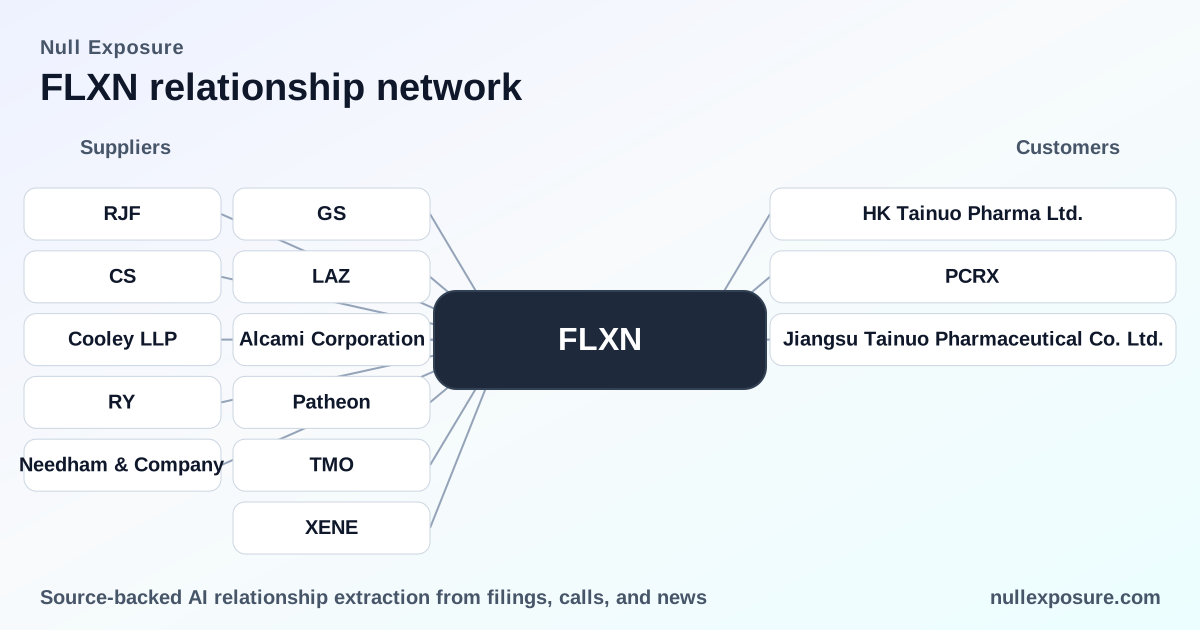
FLXN supplier map: the partners that underpin Flexion’s commercial and strategic runway
Flexion Therapeutics builds value by developing and commercializing specialty osteoarthritis pain treatments and by licensing/partnering assets; revenue is driven by product sales and strategic transactions while execution depends on external manufacturing, clinical testing and capital-market advisors. Investors should treat Flexion as a company that outsources critical production and uses external financial and legal advisors to manage capital events and M&A. For a concise inventory of the company’s supplier and advisor relationships, see the mappings below — and review deeper counterparty exposure on the NullExposure homepage: https://nullexposure.com/.
How Flexion’s operating model converts science into cash
Flexion’s commercial engine is straightforward: bring differentiated pain therapies to market, scale sales, and monetize through product sales or licensing deals. That model requires three non‑negotiable capabilities that Flexion outsources: clinical and stability testing, commercial-scale manufacturing, and capital markets/legal advisory. These outsourced relationships are not incidental — they are operational levers that determine launch velocity, product quality and transaction timing.
Key operating characteristics to track:
- Contracting posture: predominantly outsourced; Flexion relies on contract manufacturers and third‑party labs rather than in‑house production.
- Concentration risk: a small number of manufacturing and testing partners historically supported commercial launch activity, a potential single‑point risk for supply continuity.
- Criticality: manufacturing and release/stability testing are mission‑critical for revenue; any disruption has direct commercial impact.
- Maturity: relationships date from clinical‑stage support (FY2018) through capital raises and M&A advisory (FY2020–FY2021), signifying a transition from development to commercialization and exit activity.
If you want a quick view of counterparties and their roles for diligence, NullExposure keeps these supplier and advisor linkages updated on the platform: https://nullexposure.com/.
Supplier and advisor relationships investors must track
Below is a plain‑English summary of every relationship found in public reporting for Flexion. Each entry includes the role and a concise source citation.
-
Goldman Sachs (financial advisor / book‑runner): Goldman Sachs served as a financial advisor to Flexion in connection with strategic transaction activity and also acted as a joint book‑running manager on a public offering. According to a Yahoo Finance article covering the Pacira acquisition notice, Goldman acted as financial advisor to Flexion (reported March 2026), and an equity‑raise report from RyOrtho (June 2020) lists Goldman as a joint book‑runner. (Sources: Yahoo Finance / Pacira story, Mar 2026; RyOrtho, Jun 2020)
-
Lazard (lead financial advisor): Lazard acted as lead financial advisor to Flexion in the reported transaction activity around the Pacira deal. (Source: Yahoo Finance coverage of the Pacira transaction, Mar 2026)
-
Cooley LLP (legal counsel): Cooley served as legal advisor to Flexion on the announced transaction, providing customary M&A legal services. (Source: Yahoo Finance Pacira report, Mar 2026)
-
Alcami Corporation (release and stability testing): Alcami provided extended workbench support for ZILRETTA from Phase 2 through commercial launch and handled release and stability testing for commercial batches, supporting product quality and regulatory compliance. (Source: PR Newswire release, 2018)
-
Thermo Fisher Scientific / Patheon (commercial manufacturing): Thermo Fisher’s Swindon site and its Patheon custom manufacturing solutions were selected to manufacture ZILRETTA at commercial scale, with a custom suite installed to support launch volumes. (Source: Thermo Fisher/Patheon press release via PR Newswire, 2018)
-
Xenon Pharmaceuticals (in‑licensing deal): Xenon granted Flexion global rights to develop and commercialize XEN402, a NaV1.7 inhibitor for post‑operative pain, under a licensing agreement that transferred development/commercial responsibilities to Flexion. (Source: ThePharmaLetter, reporting on the Xenon–Flexion licensing deal, 2019)
-
Credit Suisse (equity offering co‑manager): Credit Suisse acted as a joint book‑running manager alongside Goldman on Flexion’s capital raise activities. (Source: RyOrtho coverage of Flexion’s $90M raise, Jun 2020)
-
RBC Capital Markets (senior manager): RBC Capital Markets acted as senior manager on a public offering for Flexion, participating in the syndicate that executed the equity issuance. (Source: RyOrtho, Jun 2020)
-
Raymond James (co‑manager): Raymond James was listed as a co‑manager on Flexion’s financing round, contributing placement support and distribution. (Source: RyOrtho, Jun 2020)
-
Needham & Company (co‑manager): Needham & Company participated as a co‑manager in the offering syndicate that supported Flexion’s capital raise. (Source: RyOrtho, Jun 2020)
What these relationships imply for investors
The counterparty map delivers a clear investment signal: Flexion operates a lean, outsourced manufacturing and testing model while leaning on top‑tier financial and legal advisors for capital and transaction execution. That combination accelerates commercialization without heavy fixed costs, but creates dependency on external providers for supply continuity and regulatory compliance.
Operational implications to monitor:
- Supplier concentration is a commercial risk: a small number of manufacturing/testing partners historically handled launch volumes and release activities; any production disruption would directly pressure sales and margins.
- Advisor network signals transaction orientation: sustained engagement of top investment banks and M&A counsel indicates the company pursued both capital markets access and strategic options (e.g., transactions / acquisitions).
- Lifecycle maturity: public records show partners engaged from Phase‑2 support through commercial launch and later capital/M&A activity, corroborating transition from development to commercialization and exit readiness.
For a deeper counterparty breakdown and to integrate these supplier exposures into your operational risk model, visit NullExposure’s platform: https://nullexposure.com/.
Diligence checklist for counterparties and next steps
Before underwriting operational or acquisition risk, verify:
- Current manufacturing footprints and redundancy plans.
- Long‑form contracts for release/stability testing and whether SLAs include supply guarantees or penalties.
- Any exclusivity or long‑term supply commitments that affect flexibility.
- Recent capital‑markets activity and whether advisor engagements continue under current corporate strategy.
NullExposure aggregates counterparty evidence and timelines that make that verification faster — start your review here: https://nullexposure.com/.
Bottom line
Flexion’s business model converts scientific differentiation into cash through commercialization and licensing, but execution is externally coupled: product quality, launch momentum and strategic optionality are materially dependent on contract manufacturers, testing partners and high‑tier advisors. Investors should treat these relationships as core operational assets and price counterparty concentration and continuity into any valuation or M&A thesis.