Flexsteel Industries (FLXS): Supplier Ecosystem, Strategic Implications, and Investment Takeaways
Flexsteel Industries operates as a vertically integrated furniture manufacturer and marketer that combines in‑house production with sourced finished components and technology-enabled accessories. The company monetizes through direct sales into residential and contract channels, margin capture on proprietary steel‑spring and upholstered products, and licensing/co‑branded product extensions that carry higher per‑unit margins. According to company reporting, Flexsteel’s trailing twelve‑month revenue stands at $457.3M with a market capitalization near $243M, giving investors a compact, cash‑generative industrial exposure with a 12x trailing P/E. Explore the supplier intelligence hub for a closer look: https://nullexposure.com/
Industry press in March 2026 highlights a cluster of product partnerships around Flexsteel’s Zecliner® motion seating platform. These relationships add functionality, premium positioning, and cross‑channel distribution benefits without large capital investment into new manufacturing capabilities.
How these partnerships actually move the needle for investors
Flexsteel’s commercial strategy uses selective partnerships to extend product functionality and access adjacent consumer segments while keeping fixed capital low. By integrating third‑party technologies—massage systems, advanced fabrics, cooling materials, and specialty head supports—Flexsteel adds premium SKUs that justify higher ASPs and improve retail sell‑through. For investors, that translates to revenue mix diversification, improved gross margins on select SKUs, and lower capital intensity versus building the technologies internally.
Flexsteel’s financial footprint supports this model: gross profit margin around 23% (gross profit $105.5M on $457.3M revenue) and positive operating margin, enabling strategic supplier spends and co‑development investments financed from operations.
Explore a mapped view of Flexsteel’s supplier relationships and risk signals at Null Exposure: https://nullexposure.com/
What the March 2026 coverage lists — partner-by-partner reads (all relationships)
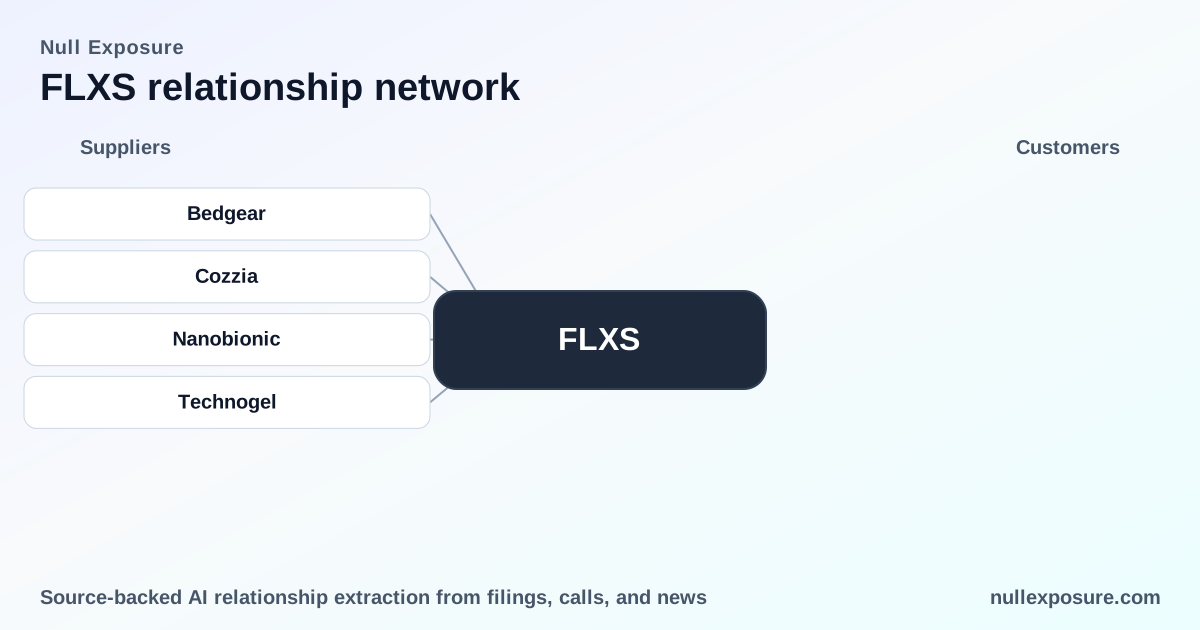
Below are the partnerships cited in FurnInfo industry coverage; each includes a concise, plain‑English description and source.
Bedgear
Flexsteel introduced Zecliner® accessories developed with Bedgear that use Dri‑Tec® moisture‑management technology; these accessories position the Zecliner line for consumers seeking enhanced sleep and comfort features. According to FurnInfo coverage (March 9, 2026), the collaboration targets accessory differentiation rather than core mechanism changes. Source: FurnInfo, March 9, 2026 — https://www.furninfo.com/furniture-industry-news/25331
Cozzia
Flexsteel developed the Ziggy collection in partnership with Cozzia to integrate foot‑massage functionality into traditional motion seating, effectively adding therapeutic features to mainstream reclining products. FurnInfo reported this co‑development as a route to premiumize a motion seating sub‑category (March 9, 2026). Source: FurnInfo, March 9, 2026 — https://www.furninfo.com/furniture-industry-news/25331
Nanobionic
Certain Zecliner® chairs incorporate Nanobionic fabric and companion app connectivity to support relaxation and sleep routines, adding a tech‑forward textile layer and customer experience touchpoints to the product. FurnInfo noted the inclusion of Nanobionic materials and app features in product descriptions (March 9, 2026). Source: FurnInfo, March 9, 2026 — https://www.furninfo.com/furniture-industry-news/25331
Technogel
A petite version of the Zecliner® 3+ offers the same zero‑gravity positioning, heat, massage, and a Technogel® head support pillow, giving Flexsteel a premium comfort claim tied to an established gel‑support brand. FurnInfo’s March 2026 item describes Technogel as the head‑support partner in the new compact model. Source: FurnInfo, March 9, 2026 — https://www.furninfo.com/furniture-industry-news/25331
Supply‑chain and operating model constraints that shape supplier risk
Flexsteel’s public disclosures and supplier evidence indicate a deliberate operating posture that reduces single‑supplier dependency and leverages diversified offshore sourcing:
- Geographic sourcing is deliberate and diversified. Flexsteel purchases materials from numerous U.S. and foreign suppliers and reports no single source dependence; major foreign sourcing countries include Vietnam, China, Thailand, and Mexico. This is a company‑level signal that supports resiliency in low‑value, labor‑intensive inputs and finished offshore items.
- Contracting posture is adaptive, not captive. The company integrates manufactured products with finished items acquired from offshore suppliers who meet quality and scheduling requirements, implying short‑to‑medium‑term supplier contracts focused on specifications and timing rather than long‑term exclusive manufacturing arrangements.
- Maturity and criticality trade off. Partnerships that provide branded functionality (Technogel, Cozzia) are critical for product differentiation but are not embedded as proprietary manufacturing assets; Flexsteel preserves strategic flexibility by licensing or co‑branding rather than internalizing technology.
These constraints imply low concentration risk for commodity inputs but moderate dependency on specialist partners for premium SKUs—an operational design that keeps capital light while exposing the company to partner execution risk on co‑developed features.
Explore how these supplier constraints affect valuation scenarios at Null Exposure: https://nullexposure.com/
Investment implications — risks and levers to watch
- Revenue and margin upside through premium SKUs. Co‑brand and technology integrations expand addressable price points without heavy CAPEX. That drives incremental gross margin on select models.
- Execution and branding risk. The commercial value of these relationships depends on marketing execution and retail placement; failures in partner product quality or availability would compress ASPs and lengthen inventory turns.
- Geopolitical and logistics exposure. Offshore sourcing across Vietnam, China, Thailand, and Mexico reduces unit cost but amplifies exposure to freight volatility and regional supply disruptions.
- Balance sheet and valuation context. With a trailing P/E of ~12 and an EV/EBITDA around 8.3, the market prices Flexsteel as a modestly valued cyclical manufacturer; strategic supplier wins that scale premium SKUs could compress the multiple upward.
Final read and practical next steps
Flexsteel’s supplier strategy is focused, pragmatic, and capital‑efficient: partner for capability, keep manufacturing optional, and monetize through premium pricing. For investors evaluating supplier relationships, the model delivers upside via product differentiation while maintaining manageable balance sheet commitments—provided execution and supply reliability remain intact.
For a deeper supplier map and risk scoring tailored to operating partners, visit Null Exposure: https://nullexposure.com/ — the fastest way to translate supplier relationships into investment action. For portfolio managers prioritizing supplier‑driven alpha, the supplier dossiers on Null Exposure provide the comparative context needed to move from thesis to allocation: https://nullexposure.com/