Firefly Aerospace (FLY): Supplier Relationships, Strategic Positioning, and Investor Takeaways
Firefly Aerospace builds and sells small- and medium-class launch vehicles and related launch services, monetizing through commercial and government launch contracts, launch-site services, and strategic partnerships with legacy primes and national space agencies. The company generates revenue by selling launch capacity (Alpha for ~1,000 kg small-sat missions, Eclipse for medium missions) and by co-developing capability with major aerospace contractors, while bearing typical capital and development intensity that keeps profitability negative today. For investors evaluating supplier relationships, Firefly’s route-to-market relies on a hybrid model: direct commercial sales, contractor partnerships with defense primes, and launch-site agreements that scale global access. For an operational snapshot and sourcing analysis, visit the NullExposure homepage: https://nullexposure.com/.
How Firefly makes money and what matters to buyers and partners
Firefly sells discrete launch services and incremental launch infrastructure. Revenue is real but small relative to market capitalization — trailing twelve‑month revenue is roughly $111 million while market capitalization sits near $3.8 billion, reflecting investor expectations for rapid scaling. Financials show negative EBITDA and operating leverage, underlining that the company is in a growth-investment phase rather than cash-generative maturity. Analysts are bullish on upside (consensus target ~$38.29), but the business model depends on execution of rockets, pad activation, and stable partner flows from primes and national agencies.
Key economic drivers for buyers and suppliers:
- Launch cadence and reliability determine contract renewals and pricing power.
- Partnerships with prime contractors accelerate market access to institutional payloads and defense budgets.
- Launch-site agreements create expanded geographic reach and mitigate schedule concentration.
If you evaluate supplier risk or partnership potential, prioritize counterparties’ contract terms, revenue-recognition timing, and pad-readiness milestones.
The specific partner relationships to know now
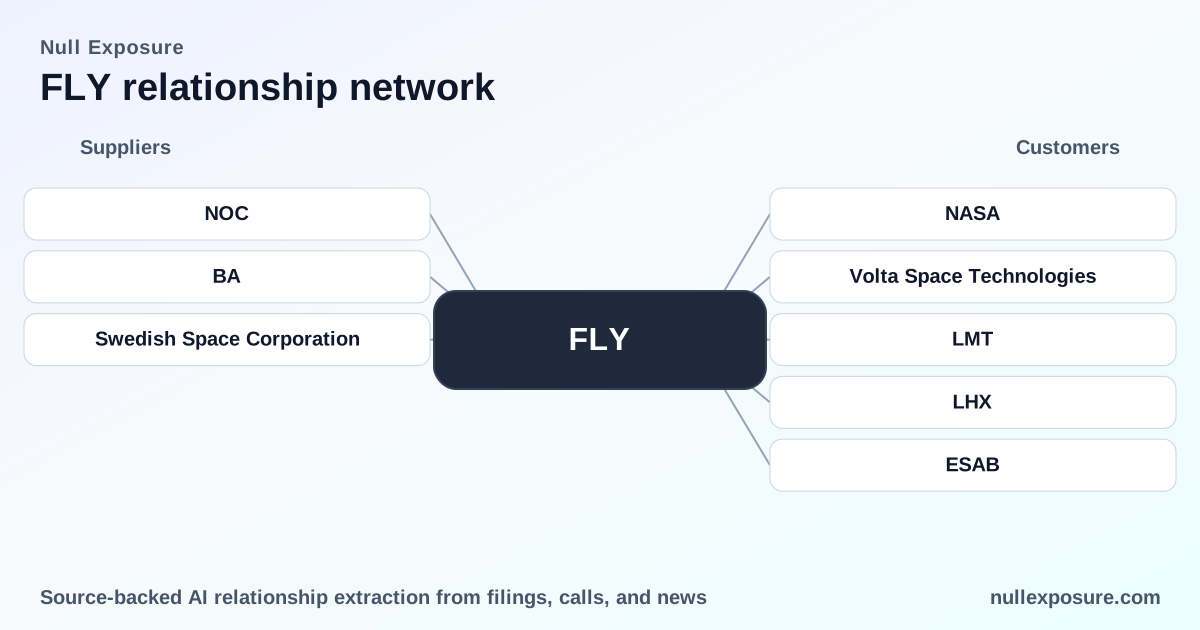
Northrop Grumman — prime-level co-development on Eclipse
Firefly is developing the medium-class Eclipse launch vehicle in partnership with Northrop Grumman, positioning the company to capture institutional and defense payloads that require a larger capability than Alpha. According to a FinancialContent deep dive on Firefly’s public era (January 28, 2026), the Eclipse program is explicitly developed with Northrop Grumman to serve the medium-launch market and institutional customers. (Source: FinancialContent / Finterra, Jan 28, 2026)
Boeing — strategic collaborator rather than pure competitor
Legacy primes like Boeing are increasingly partnering with Firefly instead of positioning as direct rivals for small/medium launch segments; these relationships expand Firefly’s access to integrated supply chains and institutional channels. A FinancialContent report noted that Boeing is among the legacy primes shifting toward collaboration in the ecosystem around Firefly (January 28, 2026). (Source: FinancialContent / Finterra, Jan 28, 2026)
Swedish Space Corporation — launch-site agreement at Esrange
Firefly has a commercial agreement with the Swedish Space Corporation to operate Alpha launches from Esrange Launch Complex 3C, and pad modifications are already underway to support operations there, expanding Firefly’s northern-hemisphere launch footprint. Firefly’s own press release describes the Esrange agreement and the pad‑modification work in March 2026, highlighting a tangible step to broaden access for European customers. (Source: Firefly press release, Mar 2026)
(If you want a consolidated view of partner flows and counterparties, see NullExposure: https://nullexposure.com/.)
What these relationships mean for Firefly’s contracting posture and commercial risk
The partner set signals a deliberate strategy: move from single-product commercial launches to integrated solutions with legacy primes and national launch sites. That strategy has several structural implications:
- Contracting posture — Firefly behaves as both a vendor (selling launch seats) and a systems partner (co-developing Eclipse), which increases contract complexity and creates blended revenue streams that include milestone payments and long-term institutional contracts.
- Concentration — partnerships with multiple legacy primes and national launch providers reduce single-counterparty concentration versus a pure commercial-only model, but execution dependence remains high on a small number of strategic relationships and on meeting technical milestones.
- Criticality to partners — for small-sat customers and regional launch access, Firefly’s Alpha is becoming a strategic capability, particularly in Europe after the Esrange agreement; for primes, Firefly is an enabler to fill medium/small-class gaps without in-house development.
- Maturity and scaling — Firefly is in an early commercialization phase with negative EBITDA and meaningful operating losses, so partner payments and contract structures materially influence near-term liquidity and de-risking.
These are company-level signals: constraints in contracts, concentration, or maturity should be monitored at the corporate level rather than tied to any single relationship unless explicit contract texts state otherwise.
Operational and financial risk checklist investors should monitor
- Execution risk on rocket development and pad activations directly drives revenue cadence and partner confidence.
- Cashflow sensitivity: negative EBITDA and operating losses mean milestone payments and contract timing affect solvency and capital needs.
- Counterparty and geopolitical exposure: launch-site agreements and defense relationships introduce regulatory and export-control vectors that change partner economics.
- Valuation gap: market cap versus current revenue and negative margins implies investors are paying for successful scaling; any slippage in partner programs compresses upside rapidly.
These items form the essential playbook for supplier evaluation: quantify milestone payments, demand performance bonds or schedule protections in supplier contracts, and stress-test scenarios where launch cadence slows by 20–40%.
For a concise supplier dashboard and counterparty monitoring tools, visit NullExposure: https://nullexposure.com/.
Investment conclusion and recommended next steps
Firefly’s supplier and partner map shows a deliberate pivot into strategic partnerships with legacy primes and national launch providers, which gives the company significantly improved market access but leaves it exposed to execution cadence and capital-intensity risk. The Northrop Grumman Eclipse collaboration and Boeing’s cooperative posture are material positives that accelerate institutional contracting; the Esrange agreement with SSC is a concrete expansion of geographic coverage. However, negative operating margins and a high revenue-to-market-capitalization gap make Firefly an execution-dependent growth investment.
Actions for investors and operator-partners:
- Demand transparent milestone schedules and contract payment profiles before committing as a supplier or investor.
- Monitor launch cadence and pad readiness at Esrange as a near-term operational indicator.
- Reweight exposure if quarter-over-quarter delivery outcomes deviate from partner timelines.
For continued counterparty intelligence, partner tracking, and supplier risk scoring, see NullExposure: https://nullexposure.com/.