Fly-E Group (FLYE): Supplier profile and implications for counterparties
Fly‑E Group designs, installs and sells smart electric motorcycles, bikes and scooters under the Fly E‑Bike brand in North America and monetizes through unit sales, accessories and related services. The business combines retail storefronts and direct sales with a parts and accessories supply chain concentrated in China, and carries a small market capitalization with negative earnings — a profile that amplifies counterparty concentration and working‑capital risk. For a concise supplier-risk dashboard and ongoing monitoring, visit https://nullexposure.com/.
The short thesis for investors and operators
Fly‑E is a hardware‑centric, retail‑facing auto manufacturer that generates revenue by selling e‑motorcycles, e‑bikes, scooters and accessories, supported by retail stores and online channels. The company’s upstream economics are driven by component sourcing (predominantly China), a narrow set of large vendors, and fixed retail/warehouse leases — all of which create a high‑impact supplier surface for partners and investors.
If you evaluate counterparties or underwrite exposure to Fly‑E, prioritize supplier concentration, payment pattern monitoring, and geopolitical sourcing risk. For direct access to an operational supplier map and monitoring tools, see https://nullexposure.com/.
What the supplier picture looks like today
- Supplier concentration is high and functionally critical. Fly‑E reported two principal vendors supplying roughly 42% and 32% of accessories and components for the year ended March 31, 2025, and the same two suppliers represented 63% and 25% of accounts payable balances as of that date, indicating both revenue and payables concentration in a tiny vendor set. According to the company’s FY2025 disclosures, those vendors are identified as Xiamen Innolabs Technology Co., Ltd. (“XFT”) and Depcl Corp. (previously Fly Wing E‑Bike Inc.) (company filing, year ended March 31, 2025).
- Geographic sourcing is concentrated in APAC (China). Over 50% of parts were sourced from China for the years ended March 31, 2025 and 2024, establishing China as the dominant origin point for core components (company filing, year ended March 31, 2025).
- Contracting posture mixes long‑term leasing with recent footprint contraction. The company uses non‑cancellable operating leases for offices, warehouses and retail stores (long‑term lease posture), but it also disclosed termination of 12 leases during the year ended March 31, 2025, indicating active right‑sizing of physical footprint (company filing, FY2025).
- Discrete software/partner spend is detectable. The GO FLY APP contract totaled $500,000, and Fly‑E prepaid $120,000 to PJMG as of March 31, 2025, signaling material, mid‑six‑figure vendor commitments outside hardware sourcing (company filing, FY2025).
Key takeaway: Fly‑E’s supplier profile is concentrated, China‑heavy, and materially important to production and payables — a setup that delivers execution leverage to suppliers and elevated operational risk to counterparties.
Relationship inventory: the names you should know
Below is every relationship entry surfaced in the supplier scope results.
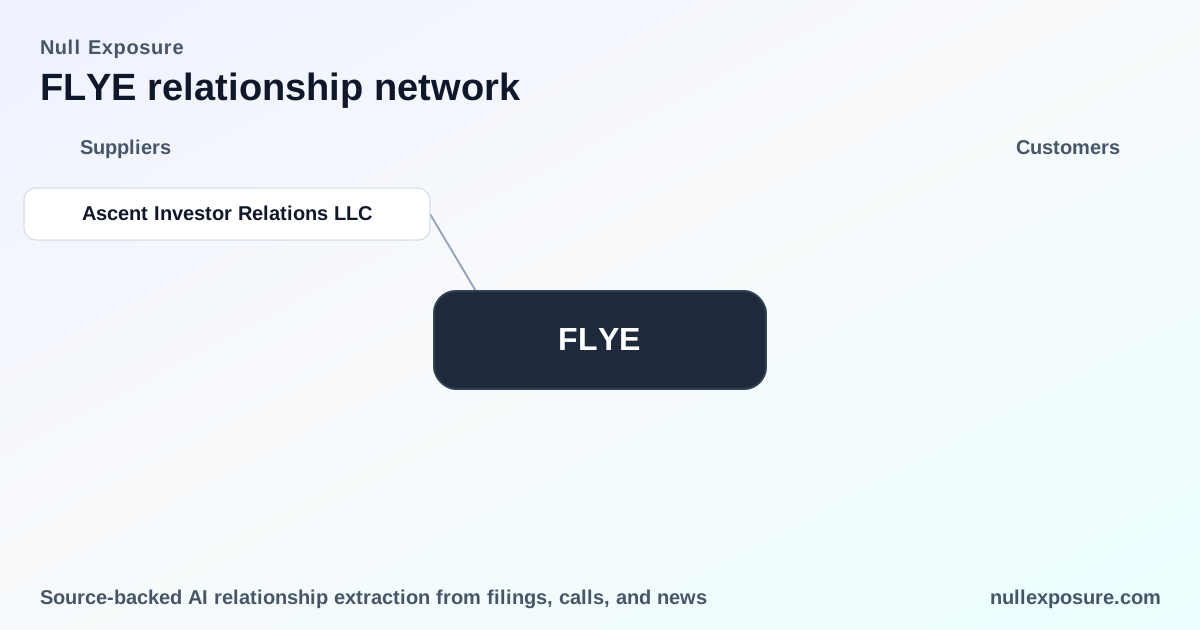
- Ascent Investor Relations LLC — Fly‑E lists Ascent Investor Relations and a contact (Tina Xiao) for investor and media inquiries; the contact information was published in a press release accessible via Yahoo Finance on March 9, 2026. This is an investor relations/communications relationship rather than a core production supplier, but it is the firm‑level point of contact for external communications (Yahoo Finance press release, March 9, 2026).
Named suppliers and the practical implications
- Xiamen Innolabs Technology Co., Ltd. (XFT) — Identified as one of two principal vendors supplying roughly 42% of accessories and components for the year ended March 31, 2025 (company filing, FY2025). This supplier is material to production volumes and payment flows.
- Depcl Corp. (formerly Fly Wing E‑Bike Inc.) — Reported as supplying roughly 32% of accessories and components for the year ended March 31, 2025 and accounting for a significant accounts‑payable balance (company filing, FY2025). Depcl is the second major node in Fly‑E’s supply network.
These two vendors together create a single‑point failure vector: they account for the majority of component supply and most of the accounts payable balance, underscoring supplier concentration risk and upside negotiating power for those vendors.
Operational constraints that change supplier economics
Fly‑E’s SEC‑style disclosures reveal several operating constraints that directly affect counterparties and supplier negotiations:
- Long‑term lease commitments for retail, office and warehouse space lock in fixed overhead and raise the importance of steady procurement funding to service those locations (company filing, FY2025).
- Footprint contraction through lease terminations (12 leases terminated in the year) signals a shift to lower physical capacity and potentially a consolidated logistics footprint — a factor that changes inventory build strategies and supplier delivery cadence (company filing, FY2025).
- APAC sourcing concentration (China >50% of parts) raises logistics, tariff, and geopolitical risk for suppliers and buyers alike; suppliers in China are critical nodes.
- Material mid‑six‑figure vendor commitments, such as a $500k app contract and a $120k prepayment to PJMG, demonstrate that Fly‑E commits non‑trivial sums to single vendors outside of hardware, which can be leverage points in vendor negotiations or financial prioritization (company filing, FY2025).
Investor implication: suppliers that are large, geographically concentrated, or integrated with Fly‑E’s logistics will extract more leverage and create greater operational exposure for any stakeholder underwriting Fly‑E’s obligations.
For a tailored supplier concentration report or ongoing monitoring for counterparties, check https://nullexposure.com/.
Risk, maturity and practical next steps for counterparties
- Counterparty credit and payment risk is elevated. Fly‑E is loss‑making (TTM EBITDA negative, diluted EPS –22.98) with a small market capitalization (~$3.2M) and limited institutional ownership; suppliers should require stronger payment terms or escrow arrangements where feasible (company financial summary, latest quarter 2025).
- Concentration reduces optionality. With two suppliers supplying the bulk of parts, a disruption to either XFT or Depcl will materially impact production and delivery schedules.
- Operational maturity is mixed. The supplier relationships are active and material, not experimental — Fly‑E is operating with committed vendors and long‑term leases while simultaneously shrinking store footprint, which signals transition from growth deployment toward consolidation.
Recommended actions for investors and operators:
- Stress‑test supplier continuity scenarios and model A/B supplier loss outcomes.
- Negotiate payment security: letters of credit, milestone escrow, or shortened payment cycles for critical suppliers.
- Monitor AP balances and vendor dispute indicators; two suppliers dominate payables and therefore any supplier liquidity issues will immediately affect Fly‑E’s operations.
Bottom line
Fly‑E’s supplier ecosystem is concentrated, China‑centric and materially critical to production and payables. That structure creates outsized supplier leverage and execution risk relative to the company’s modest market capitalization and negative earnings profile. Counterparties should price resiliency and payment security into relationship terms and monitor supplier health continuously. For a granular supplier risk briefing and automated alerts tailored to Fly‑E counterparties, start at https://nullexposure.com/.