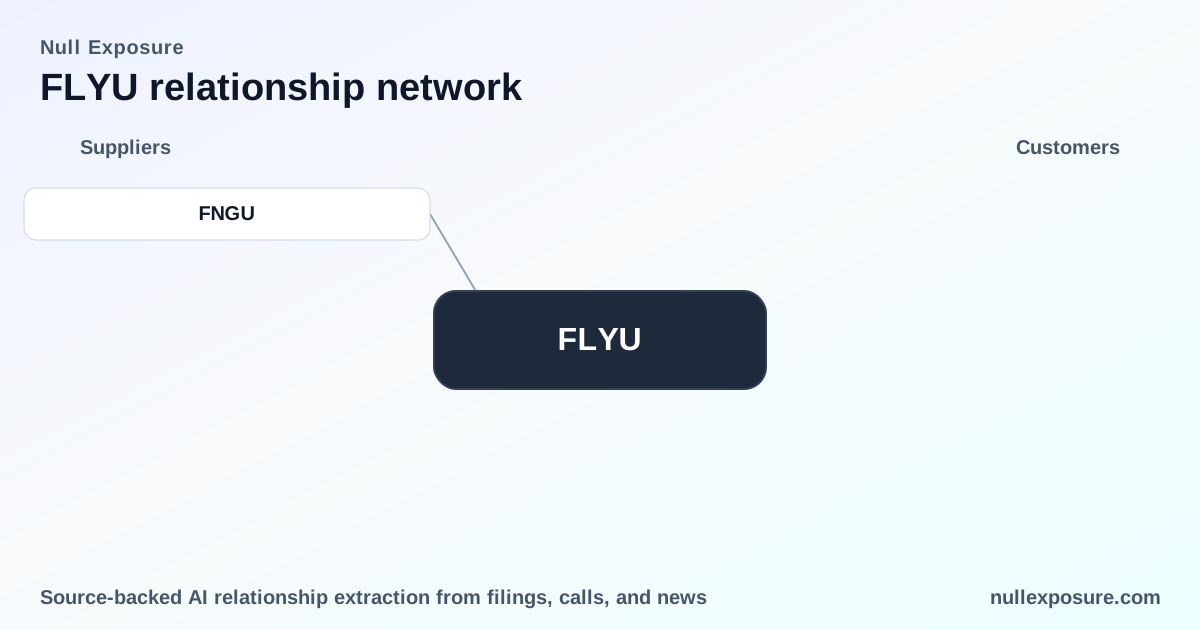
FLYU: How the MicroSectors Travel 3x ETN fits into counterparty and supplier analysis
FLYU is the ticker for the MicroSectors Travel 3x Leveraged ETN — a product that delivers three times the daily return of an index of U.S.-listed travel companies and generates revenue for its issuer through issuer fees, financing/spread capture and market-making flows. For investors and counterparties evaluating supplier relationships, FLYU behaves like a concentrated financial product: its economics are driven by leveraged exposure, short-term rebalancing dynamics, and the commercial arrangements between the ETN issuer, swap/financing counterparties, and liquidity providers.
If you need a single authoritative source for monitoring supplier exposures tied to niche tradable products like FLYU, start here: https://nullexposure.com/
Why FLYU matters to counterparties and operators
FLYU is not a traditional operating company; it is a packaged financial instrument whose value and revenue streams depend on the issuer’s trading and financing activities. That leads to four practical operating-model characteristics you should treat as company-level signals when assessing risk and supplier relationships:
- Contracting posture — centralized and issuer-led. The issuer controls the product terms and counterparty selection, so supplier relationships (market makers, prime brokers, swap counterparties) are contracted centrally through the issuer rather than distributed across many downstream holders.
- Concentration — product-level concentration is high. A leveraged ETN is a single product whose performance and commercial viability rely on a small set of counterparties and trading venues; counterparty failure or liquidity withdrawal has immediate impact on product tradability.
- Criticality — the product is critical to short-term traders and certain institutional strategies. Because FLYU targets daily 3x exposure, its primary users are intraday and short-term strategies that require continuous liquidity; disruptions translate quickly into investor losses and liquidity stress.
- Maturity — structurally modern but operationally fragile. Leveraged ETNs employ standard derivatives and financing constructs; these products are mature in terms of design, yet they remain operationally fragile because of leverage, daily rebalancing, and sensitivity to market dislocations.
All supplier relationships found in open-source signals
Below is every supplier relationship mention surfaced for FLYU in the provided results, summarized plainly and cited.
MicroSectors — issuer and brand
ETF research coverage identified FLYU as the MicroSectors Travel 3x Leveraged ETN, an exchange-traded note designed to track three times the daily price movements of a travel-related index. According to ETFdb’s March 23, 2025 roundup of leveraged products, FLYU is listed explicitly as MicroSectors’ 3x travel ETN, making MicroSectors the product sponsor and public-facing supplier for distribution and market infrastructure. (Source: ETFdb, March 23, 2025)
What the single-relationship footprint implies for investors
Because the only open-source mention ties FLYU directly to MicroSectors, treat this as a product-level supplier map where the issuer is the primary counterparty and gatekeeper for downstream economics and risk management. That creates a narrow surface for due diligence — you primarily evaluate:
- Issuer governance and disclosures: Verify who underwrites the ETN’s financing lines and what the prospectus discloses about swap counterparties and fees.
- Market-making and liquidity providers: Examine who routinely supplies intraday liquidity; an absence of multiple active market makers increases execution risk.
- Counterparty credit and settlement mechanics: Confirm the identity and creditworthiness of swap and financing counterparties named in primary documentation.
Operational and commercial risk profile investors need to track
FLYU’s structure creates a specific set of commercial and operational risks that impact supplier relationships and business continuity:
- Leverage and daily rebalancing risk. A 3x daily target amplifies volatility and creates predictable rebalancing flows that concentrate trading activity — liquidity providers and prime brokers bear time-of-day execution risk.
- Counterparty concentration risk. If the issuer uses a small number of banks for swaps or financing, a counterparty hit will quickly propagate to product pricing and redemption dynamics.
- Liquidity-event sensitivity. Travel-sector shocks (e.g., sudden travel restrictions or earnings surprises) cause sharp NAV swings; market makers could pull quotes, increasing spreads and trading costs for holders.
- Regulatory and disclosure dependency. The issuer’s prospectus and dealer agreements are the principal source of truth for supplier obligations; gaps or limited disclosure escalate second-order risk for counterparties.
Key takeaway: FLYU’s commercial viability and operational resilience are tied to a narrow set of supplier relationships driven by the issuer; this makes issuer due diligence and counterparties’ credit exposure analysis the highest-priority tasks.
If you want an end-to-end supplier risk view for tradable financial products, see https://nullexposure.com/ for tools and reporting.
Practical actions for investors and operators
Operators managing exposure to FLYU or similar leveraged ETNs should adopt these practical steps:
- Obtain the latest prospectus and counterparty schedule to map exactly which banks or firms perform swap, financing, and market-making roles.
- Monitor intraday liquidity and widening spreads as an early-warning system for market-maker withdrawal or funding stress.
- Reassess counterparty exposure limits in light of concentrated issuer counterparty lists and the high turnover profile of leveraged products.
- Consider operational contingency: ensure custody and prime brokerage arrangements can process rapid redemptions or transfers if liquidity providers step back.
For model portfolios that include leveraged ETNs, these checks should be operationalized as part of quarterly reviews. If you need a consolidated supplier exposure report that maps issuers to counterparties, visit https://nullexposure.com/ to learn how we assemble and present that information.
Final verdict: where FLYU sits in a supplier-risk framework
FLYU is a focused, issuer-controlled leveraged product whose supplier map is narrow by design. That narrowness concentrates commercial leverage and amplifies counterparty and liquidity risk, making issuer governance, counterparty credit, and active market-making the three critical lenses for evaluation. With only one verified public relationship in the reviewed signals — MicroSectors as issuer — the practical work for investors and operators becomes straightforward but essential: follow the prospectus, validate counterparties, and stress-test liquidity under travel-sector shocks.
For a consolidated supplier-risk assessment tailored to traded products like FLYU, explore subscription-grade reporting at https://nullexposure.com/.