Flywire (FLYW): Supplier map and procurement implications for investors
Flywire operates a global payments orchestration platform that monetizes by routing and settling cross-border payments for enterprises and institutions and charging transaction and platform fees. The company combines direct rails, local partners and ERP integrations to capture high-margin processing revenue and ancillary services; investors should treat supplier relationships as intrinsic to Flywire’s product economics and geographic reach. For a deeper supply-side risk picture, explore the Null Exposure supplier intelligence hub: https://nullexposure.com/
How Flywire’s supplier posture drives revenue and operational risk
Flywire is a software-enabled payments company that earns revenue from payments processing, platform subscriptions and value-added services tied to settlement and reconciliation. Its reported trailing revenue (TTM) of $623M and gross profit of $383M reflect a business where partner access to local payment rails directly influences conversion rates and margin capture. Flywire’s model is not vertically integrated bank-by-bank; instead it relies on a network of global, regional and local banks and technology partners to clear and settle transactions — that supplier network is the product.
Company disclosures provide useful, company-level signals about that network and the operating model:
- Global footprint: Filings state Flywire can accept and settle payments in over 240 countries and territories and in more than 140 currencies, which confirms the company’s reliance on a distributed supplier base to deliver cross-border settlement.
- Service-provider posture: Flywire characterizes many of its partners as third-party payment providers it uses to clear and settle transactions, and it documents security assessments and ongoing oversight for those engagements.
- Contracting and spend signals: Financial notes reference short-term lease expense and total undiscounted lease payments that place certain obligations in a modest spend band, consistent with a software company with limited long-term capital leases but meaningful operational vendor commitments.
These are company-level characteristics that define how supplier relationships affect execution, not relationship-specific claims.
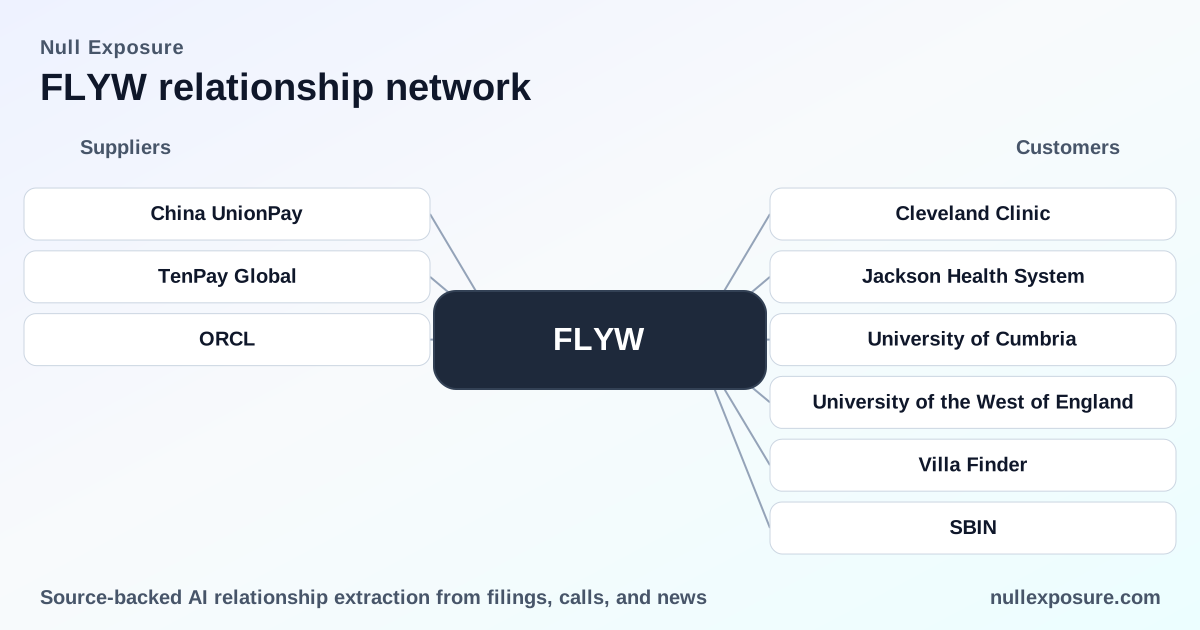
The commercial map: three supplier relationships investors should track
China UnionPay — local acquiring power for China flows
Flywire told investors in its Q4 2025 earnings call that it has direct access to China UnionPay, which underpins its ability to accept and settle Yuan-denominated flows and to offer localized payment options in China and adjacent corridors. This direct UnionPay access is a strategic enabler for institutional flows from Chinese payors. (InsiderMonkey, Q4 2025 earnings call transcript, FY2026)
TenPay Global (Weixin Pay) — expanding wallet options for Chinese students
Flywire expanded its partnership with TenPay Global to offer Weixin Pay as a payment option for Chinese students in South Korea and Malaysia, broadening local wallet acceptance in targeted education corridors and improving conversion for outbound tuition and fees. This extension strengthens Flywire’s product-market-fit in education corridors heavily used by Chinese payors. (Investing.com report on insider trading and company developments, March 2026)
NetSuite (Oracle) — ERP integration that embeds Flywire into receivables workflows
Flywire integrates with leading ERP systems, including NetSuite, enabling customers to streamline payments, reconciliation and operational workflows directly inside their enterprise systems; that integration reduces implementation friction and raises switching costs for customers that standardize on combined ERP–payments workflows. (SahmCapital investor event notices and press releases, Feb 2026)
What these relationships imply about concentration, criticality and maturity
These supplier linkages collectively reveal a hybrid go-to-market and operations strategy:
- Direct payment-rail relationships (China UnionPay, TenPay Global) are critical to regional monetization — when Flywire controls rails it captures more fees and reduces third-party spread leakage.
- ERP integrations (NetSuite) are commercially sticky, converting technical integrations into recurring revenue streams and increasing lifetime value per customer.
- The vendor posture documented in filings — formal security assessments, ongoing monitoring and a global supplier footprint — indicates a mature third-party governance program, appropriate for a payments infrastructure provider operating across regulated jurisdictions.
At the same time, company-level financial notes that reference short-term leases and modest undiscounted lease liabilities suggest Flywire runs a light capital footprint and negotiates shorter-term vendor commitments, which supports operational flexibility but requires steady supplier management to preserve service continuity.
Procurement and investor risk checklist
For procurement teams and investors evaluating Flywire relationships, focus on these practical items:
- Rail redundancy: Ensure Flywire’s dual-rail or fallback options are in place in regions where direct rails are critical (China, India, Brazil, Mexico, Vietnam).
- Regulatory exposure: Chinese wallet partnerships and UnionPay access accelerate revenue but increase regulatory and compliance sensitivity; examine contractual controls and responsibilities around AML/KYC and data localization.
- Integration lock-in: ERP integrations like NetSuite create commercial stickiness; quantify how much revenue is dependent on ERP-embedded flows versus standalone processing.
- Contract tenor and cost flexibility: Short-term leasing and vendor contracts give Flywire agility, but also require robust renewal and rate negotiation processes to avoid cost shocks.
These are actionable monitoring points that connect supplier relationships directly to Flywire’s ability to convert payment flows into durable revenue.
Trading and operational implications for investors
From a financial perspective, Flywire’s revenue mix and partner network correlate with both upside and concentration risks:
- Upside: Direct rails and wallet integrations expand addressable payment volume and improve margins on settled flows.
- Risk: Geographic concentration in corridors that rely on single wallets or rails (for example, specific Chinese wallets in targeted outbound markets) can create localized execution risk if partnerships shift or regulatory pressure increases.
Flywire’s market capitalization (~$1.51B) and forward valuation metrics reflect a growth story underpinned by these supplier-enabled channels; investors should reconcile stated growth objectives with the observable supplier map and governance excerpts in filings.
Explore tailored supplier risk reports and relationship-level exposure analysis at Null Exposure: https://nullexposure.com/
Practical next steps and closing view
Flywire’s supplier relationships — direct UnionPay access, expanded TenPay/Weixin Pay coverage, and ERP integration with NetSuite — are core to its monetization model and to how investors should underwrite growth and margin trajectories. Procurement should prioritize redundancy, contractual clarity around regulatory controls, and measurement of how ERP integrations convert to recurring revenue. Investors should monitor announcements on rail expansion and any material changes in wallet partnerships as binary catalysts for conversion and margin upside.
For a structured supplier-risk assessment and periodic monitoring of Flywire’s partner ecosystem, visit Null Exposure and request a supplier-focused briefing: https://nullexposure.com/
Bold takeaway: Flywire’s supplier network is not peripheral — it is the infrastructure of the product; understanding which rails and integrations the company controls is essential to valuing its revenue durability and regulatory exposure.