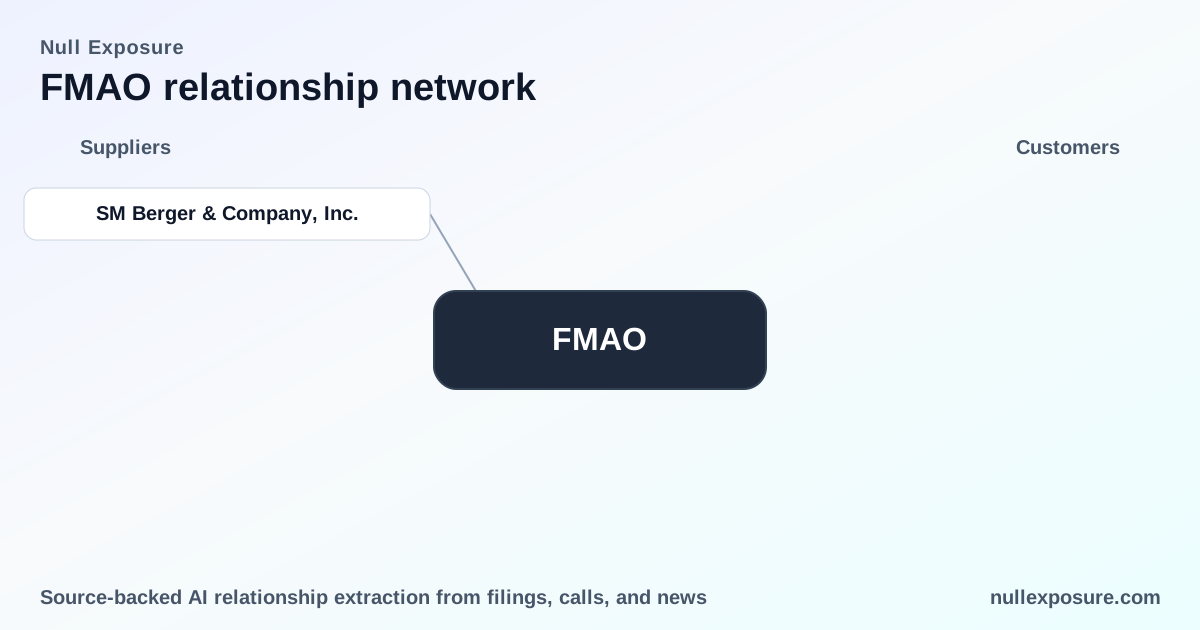
Farmers & Merchants Bancorp (FMAO): supplier map and implications for investors
Farmers & Merchants Bancorp is the holding company for The Farmers & Merchants State Bank, a small regional commercial bank that generates earnings from lending spreads, deposit funding and fee income across Northwest Ohio and Northeast Indiana. The company monetizes through net interest margin on loans and securities, supplemented by noninterest income and a modest dividend policy; at a market capitalization near $341 million and a price-to-book below 1.0, the stock trades like a capital-sensitive regional bank where operational relationships and funding counterparty choices materially influence risk and return. Investors evaluating FMAO should read supplier signals as proxies for funding posture, investor communications discipline, and branch network commitments.
Learn more about supplier exposure and relationship intelligence at https://nullexposure.com/.
Why third-party suppliers matter for a community bank investor
Supplier relationships are not discretionary overhead for a bank of this size — they are functional levers that shape liquidity, regulatory footprint and investor perception. For Farmers & Merchants that translates into four practical vectors:
- Funding and liquidity providers determine short-term resilience.
- Long-term real estate commitments set fixed-cost leverage for branch expansion.
- Investor relations and public relations firms shape market access and valuation multiple.
- Third-party service providers deliver operational capabilities the bank does not staff internally.
These are not peripheral considerations: they affect capital allocation, interest-rate sensitivity and the pace of geographic expansion.
Firm-level constraints and what they signal about operating posture
The disclosures include several recurring contract and counterparty signals that should be interpreted at the company level:
- Short-term funding relationships are active. The company discloses repurchase agreements and collateral schedules with remaining contractual maturities, signaling a posture that supplements deposit funding with short-term secured borrowing. This is a liquidity management lever that reduces funding cost volatility but concentrates counterparty and rollover risk.
- Material long-term occupancy commitments exist. Leases for retail branches, LPOs and ATMs carry terms from months up to almost 14 years, which embeds fixed costs into the model and raises operating leverage as branch density expands.
- Government-sponsored counterparties are part of the capital stack. Long-term borrowings include loans from the Federal Home Loan Banks (FHLB), indicating use of a predictable, rate-sensitive source of wholesale funding.
- Reliance on third-party service providers is explicit. Management discloses outsourced relationships to access specialized expertise and reduce costs, which implies operational dependency on vendors for compliance, IT and investor communications.
Together these signals describe a mixed funding profile (short-term repos + FHLB term debt), a moderate level of contractual fixed-cost commitment via branch leases, and an operational model that deliberately outsources specialized functions rather than internalizing every capability.
Learn more about how supplier structure influences bank valuations at https://nullexposure.com/.
What public filings and press releases record about SM Berger & Company, Inc.
SM Berger & Company, Inc. appears repeatedly as the external investor/IR contact across Farmers & Merchants news items and releases. The public record includes the following discrete mentions:
- A press notice published on Yahoo Finance (March 9, 2026) listed Andrew M. Berger, Managing Director of SM Berger & Company, Inc., as an investor and media contact for a personnel announcement, indicating an active IR contact role. Source: Yahoo Finance, March 2026 (https://finance.yahoo.com/news/f-m-bank-appoints-amy-143000331.html).
- A GlobeNewswire release dated December 17, 2024 announcing a board retirement listed Andrew M. Berger of SM Berger & Company, Inc. alongside the bank’s CEO as investor/media contacts, confirming the firm’s ongoing use as a public communications conduit. Source: GlobeNewswire, Dec 17, 2024 (https://www.globenewswire.com/news-release/2024/12/17/2998654/0/en/F-M-Bank-Announces-Retirement-of-Eugene-Burkholder-from-Board-of-Directors.html).
- The company’s August 7, 2025 GlobeNewswire release about opening a second full-service Michigan office again cites SM Berger & Company as an investor contact, underscoring that the IR/PR role extends to growth announcements. Source: GlobeNewswire, Aug 7, 2025 (https://www.globenewswire.com/news-release/2025/08/07/3129724/0/en/Farmers-Merchants-Bancorp-Inc-Announces-Opening-of-Second-Full-Service-Office-in-the-State-of-Michigan.html).
- A fourth-quarter dividend announcement distributed via The Globe and Mail (publication of a press release) in 2025 included Andrew M. Berger at SM Berger as the external media contact, demonstrating continuity of the engagement through dividend and capital return communications. Source: The Globe and Mail / GlobeNewswire distribution, 2025 (https://www.theglobeandmail.com/investing/markets/markets-news/GlobeNewswire/36365990/farmers-merchants-bancorp-inc-declares-2025-fourth-quarter-cash-dividend/).
- A 2023 GlobeNewswire branding release listing investor and media contacts named SM Berger & Company, Inc., showing the IR relationship predates the recent operational expansions. Source: GlobeNewswire, May 15, 2023 (https://www.globenewswire.com/news-release/2023/05/15/2668710/0/en/F-M-Bank-Unveils-New-Branding-Including-New-Forward-Looking-Logo-and-Shortened-Brand-Name.html).
Takeaway: Farmers & Merchants uses SM Berger as a persistent investor relations and media contact across strategic announcements, dividend communications and branding updates — a single external relationship consistently handling the company’s market-facing touchpoints.
Investment implications: concentration, criticality and optionality
- Concentration: The repeated use of SM Berger as the named IR contact signals low supplier fragmentation for investor communications; that reduces coordination cost but creates vendor concentration risk in a function that matters for market liquidity and perception.
- Criticality: IR and PR are mission-critical for a small-cap bank that trades on disclosure flow; any interruption would increase information asymmetry and could widen the stock’s liquidity premium.
- Maturity and contracting posture: The company-level disclosures show a mix of short-term funding contracts (repurchase agreements) and long-term occupancy leases, which together create a funding and fixed-cost profile investors must monitor through rate cycles. The presence of FHLB borrowings shows access to term wholesale funding that supports balance-sheet flexibility.
- Operational dependence: The explicit reliance on third-party service providers is an efficiency lever and a potential operational single point of failure; vendor management and continuity planning are relevant governance items for investors.
Key risk factors to track in quarterly filings and press releases: changes in the repo/collateral profile, new or renegotiated lease commitments, shifts in FHLB borrowing levels, and any change in IR/PR provider that could signal a strategic communications reset.
Learn how supplier intelligence affects portfolio decisions at https://nullexposure.com/.
Bottom line recommendation for investors and operators
For investors, the supplier footprint for Farmers & Merchants is not decorative: short-term repurchase agreements, long-term branch leases, FHLB term debt and a single visible IR firm together form a concise operational signature that frames liquidity, fixed-cost leverage and market transparency. Monitor funding disclosure lines and any changes to external communications vendors as early indicators of strategic shifts.
For operators and counterparties, maintain diligence on vendor continuity and contract expiration windows since the bank’s operating model intentionally outsources specialized capabilities. The combination of modest market cap, a dividend policy and concentrated IR services means public messaging cadence and funding choices will continue to move the valuation multiple.
If you want ongoing supplier intelligence and structured supplier risk signals for regional financial institutions, visit https://nullexposure.com/ for deeper coverage and alerts.