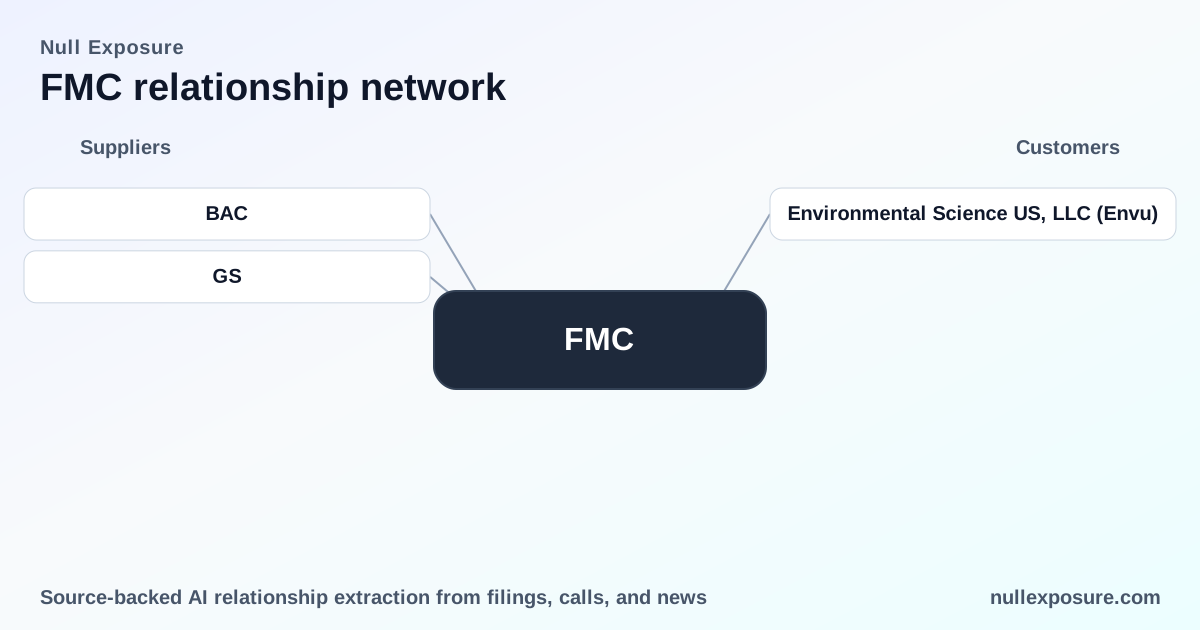
FMC Corporation: supplier posture, counterparty signals, and what investors should price in
FMC Corporation is a global agrochemical manufacturer that monetizes through the sale of crop protection active ingredients and formulated products, supported by owned manufacturing sites and contract manufacturing. The company runs a mix of short-term hedges and multi-year purchase/lease commitments to secure feedstocks and capacity, and it monetizes scale across geographies while managing currency and commodity exposure through major financial counterparties. Investors should treat FMC as a manufacturing-forward business with concentrated sourcing and material contractual fixed costs that compress near-term cash flow optionality.
Learn more about how supplier and counterparty signals affect risk exposure at https://nullexposure.com/.
How FMC runs its supplier and contracting posture — practical signals you can trade on
FMC combines owned facilities in the U.S., China, India, Denmark and Puerto Rico with contract manufacturers and significant off‑balance purchase obligations. The company discloses both short-term hedges and long-term take-or-pay purchase obligations, which creates a dual posture: tactical hedging for FX/commodity risk and structural locked-in spend for feedstock and energy. For example, FMC reports that current open contracts hedge forecasted transactions until December 31, 2025, while longer-term purchase obligations totaled $288.1 million as of December 31, 2024, with $90.1 million due within 12 months — a clear signal of high near-term fixed cash commitments. These are company filing disclosures as of December 31, 2024.
Operationally this produces four actionable constraints for investors and procurement managers:
- High fixed spend and leasing commitments: fixed lease payments of $152.7 million underline operating leverage in facilities and equipment. (Company filing as of December 31, 2024.)
- Concentration of upstream sourcing in APAC: critical intermediates and finished products are sourced largely from China and India, increasing geopolitical and supply-chain sensitivity. (Company filing.)
- Derivative counterparties are large financial institutions: FMC uses forwards and options to hedge FX and commodity exposure, and counterparties are primarily major financial institutions — a commercial risk that is mitigated by counterparty credit but creates exposure to global bank dynamics. (Company filing.)
- Spend scale is material: the firm-level spend profile and obligations place many supplier relationships in the $100m+ band, indicating supplier-critical status and limited near-term flexibility.
Who FMC is dealing with right now: advisory relationships identified in news
Bank of America
FMC’s CEO disclosed that the company is running a divestiture process and has engaged Bank of America as an advisor, a move that signals management is pursuing portfolio simplification or monetization to shore up cash or refocus operations. This was reported in a StockTwits news article on March 9, 2026 (https://stocktwits.com/news-articles/markets/equity/fmc-corp-stock-rises-what-did-the-ceo-say/cZRykUSRIGu).
Goldman Sachs
Goldman Sachs was named alongside Bank of America as a retained advisor for FMC’s divestiture process, which confirms that the company has engaged multiple major investment banks to run a competitive sale or strategic review. This was reported in the same StockTwits piece on March 9, 2026 (https://stocktwits.com/news-articles/markets/equity/fmc-corp-stock-rises-what-did-the-ceo-say/cZRykUSRIGu).
Both relationships are advisory in nature and were disclosed in market reporting on March 9, 2026; the engagement of full-service investment banks elevates the probability of a structured sale process with wide market reach.
What these supplier and advisory signals mean for investors and operators
The combination of advisory hires plus the company’s contractual profile forces a re-evaluation of optionality and timing:
- Near-term liquidity and capital allocation are constrained because of the $90.1 million of purchase obligations due within 12 months and $29.8 million of lease payments within 12 months (as of Dec 31, 2024). Those are not theoretical exposures; they materially affect cash available for buybacks, dividends, or large one-time restructuring costs.
- Divestiture process suggests a strategic pivot or liquidity need. The engagement of Bank of America and Goldman Sachs indicates FMC is pursuing a sale or carve‑out path that will materially change revenue composition and supplier footprint if executed; companies typically bring multiple banks to maximize buyer interest and valuation.
- Counterparty credit and market structure risk matter. Because FMC hedges with major financial institutions, shocks to bank liquidity or changes in derivative market functioning will transmit to FMC faster than to companies with only physical hedges.
These are company-level conclusions supported by FMC’s public filing language as of December 31, 2024 and the March 2026 market report noted above.
Learn how to integrate supplier signal risk into your investment process at https://nullexposure.com/.
Valuation context and market posture
FMC reports trailing revenue of $3.467 billion with gross profit of $1.172 billion and EBITDA of $413.8 million (latest periods through 2025-12-31). The company’s market capitalization is roughly $1.724 billion, and the EV/EBITDA multiple stands at 35.08 — a valuation that reflects either anticipated earnings improvement or priced execution risk. Profitability metrics are under stress: the company shows a negative diluted EPS of -17.59 and negative trailing profit margin, highlighting earnings volatility. Analysts are mixed: combined buy/hold ratings dominate with a median analyst target near $18.18, underscoring divergent views on execution and asset value.
From a supplier-risk standpoint, a high EV/EBITDA ratio and negative EPS increase the importance of execution on any divestiture: proceeds are likely earmarked to reduce leverage, reallocate capital, or invest in higher-margin product lines. That dynamic makes supplier contracts, especially take-or-pay and long-lead APAC sourcing, core determiners of deal value.
Practical investor and operator recommendations
- Prioritize diligence on APAC supplier resilience and contract transferability in any potential divestiture; sourcing concentration in China and India is an execution risk that buyers will price aggressively. (Company filing excerpts dated December 31, 2024.)
- Stress-test cash flow with the disclosed $152.7 million of lease obligations and $288.1 million of purchase obligations to understand how quickly liquidity would compress if a divestiture timeline slips.
- Track advisory process milestones from Bank of America and Goldman Sachs for signals on process cadence and likely outcomes; early auction vs strategic sale paths imply different counterparty and supplier negotiation windows (per the March 9, 2026 market report).
If you are evaluating counterparties or building a supplier-risk model for FMC, deeper supplier mapping and contract-level detail materially change valuation assumptions — start there at https://nullexposure.com/.
Bottom line
FMC operates a capital- and contract-intensive manufacturing business with notable APAC sourcing concentration and significant fixed obligations that restrict near-term flexibility. The company’s engagement of Bank of America and Goldman Sachs for a divestiture process is a clear strategic inflection point that investors and operators must treat as a catalyst for material balance-sheet and supplier-network changes. Risk is concentrated, visible in published purchase and lease obligations, and actionable through focused diligence on counterparty credit, contract assignment terms, and APAC supplier continuity.