How FMFC (Kandal M Venture) Converts Manufacturing into Market Value
Kandal M Venture Limited (trading as FMFC on NASDAQ) manufactures and sells handbags and related accessories across the United States, Europe, Canada, Japan and other international markets, and monetizes primarily through product sales from its manufacturing and wholesale channels. The company funds growth and liquidity through public equity markets — including underwritten offerings — and augments market visibility via retained investor-relations and legal advisers. For investors and operators, FMFC is a small-cap, export-oriented apparel supplier whose capital access, governance posture, and market liquidity are driven as much by its capital-market relationships as by retail demand.
If you evaluate supplier-counterparty risk or sponsor relationships, see how FMFC’s capital and communications stack is structured on the firm’s public disclosures: https://nullexposure.com/
How the business actually makes money and what that implies for partners
Kandal M Venture’s revenue stream is straightforward retail/manufacturing economics: design and manufacture handbags, distribute to international channels, and record sales as product revenue. The company reported roughly $17.19 million in trailing-twelve-month revenue with gross profit of about $3.36 million and a small positive net margin; operating margin is negative, indicating investment or margin pressure in operations. These figures imply a business that is operationally active but still scaling profitably at the operating level — a profile that increases reliance on external capital markets and service providers to bridge seasonal or growth-driven cash needs.
The company’s manufacturing base in Cambodia and its NASDAQ listing drive two structural realities for suppliers and counterparties: cost-competitive production capability paired with low market liquidity, given a market capitalization under $9 million and a low institutional ownership rate. That combination makes FMFC an attractive commercial partner for suppliers seeking volume, while increasing commercial counterparty exposure to concentration and governance dynamics.
Visit the company summary page for context and filings: https://nullexposure.com/
Capital-market and advisory relationships that matter, one by one
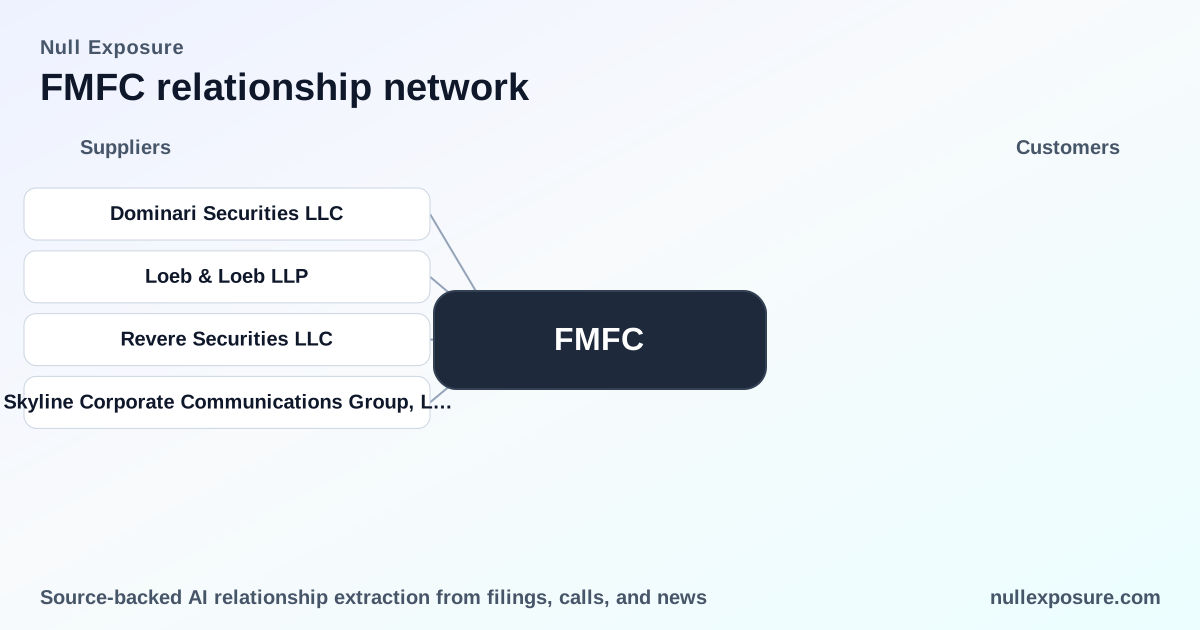
Dominari Securities LLC acted as the representative of the underwriters for FMFC’s equity offering, handling the primary placement and the full exercise of the underwriters’ over-allotment option in the July 2025 transaction. This establishes Dominari as the principal capital markets intermediary for that financing event (markets.financialcontent.com, July 16, 2025).
Revere Securities LLC served as co-underwriter alongside Dominari Securities in the same offering, providing syndicate support and allocation capacity for FMFC’s public issuance (markets.financialcontent.com, July 16, 2025).
Loeb & Loeb LLP served as U.S. legal counsel to Kandal M Venture Limited for the offering, indicating that the company retained established U.S. counsel to manage securities, regulatory, and transactional legal work connected with its capital raise (markets.financialcontent.com, July 16, 2025).
Skyline Corporate Communications Group, LLC is listed as the company’s investor relations contact in a December 30, 2025 communication regarding NASDAQ notifications, signaling an active externalized investor-relations approach to manage disclosures and market messaging (GlobeNewswire via ManilaTimes, December 30, 2025).
What these relationships tell investors and operators about FMFC’s operating posture
- Contracting posture: FMFC outsources critical capital-market functions to boutique underwriters and established U.S. law firms while using an external investor-relations firm to manage disclosures. That posture reflects a company that prefers specialist partners for regulatory and market access rather than in-house scale.
- Concentration and liquidity: With a market cap under $9 million, shares outstanding of 15.3 million and insiders controlling roughly 43% of the equity, share liquidity is constrained and insider influence is substantial — a governance signal counterparties need to price into contract terms.
- Criticality of relationships: Underwriting and legal counsel are mission-critical for additional equity raises, given the company’s negative operating margin and small cash cushion implied by size and trading history.
- Maturity of capital program: Engagement of underwriters and U.S. counsel in a public offering indicates a conventional capital-market maturity: FMFC uses standard issuance processes rather than private placements or alternative financing, which benefits transparency but also exposes the company to public-market price volatility.
Key risk signals to factor into supplier agreements and credit terms:
- Concentrated insider ownership (42.9%) and very low institutional ownership (0.99%) change bargaining dynamics and can compress secondary-market liquidity.
- Operating margin is negative despite positive net margin and EBITDA; that combination shows fragile operating leverage.
- Small market cap increases the probability that further financings will be required to support working capital or retail expansion.
Use these insights to structure commercial terms with protections (advance payments, shorter payment cycles, or performance-linked pricing) and to calibrate exposure limits.
If you need a concise counterparty scorecard or a tailored supplier-risk memo, start here: https://nullexposure.com/
Practical takeaways for investors, operators, and supplier managers
- Underwriting relationships matter for runway. Dominari and Revere’s role in the July 2025 offering demonstrates FMFC’s reliance on public equity to support operations and growth; future access to those markets will directly affect supplier payment risk.
- Legal and IR partners reduce disclosure friction. Retaining Loeb & Loeb as U.S. counsel and Skyline for investor relations signals a professionalized approach to compliance and market communications, which benefits counterparties requiring clear financial reporting or contractual certainty.
- Commercial dealings should reflect capital sensitivity. Given the company’s scale and insider concentration, structure supplier contracts with protective covenants and active monitoring of covenant triggers related to financing events or NASDAQ notifications.
For a deeper look at FMFC’s market counterparties and to monitor updates in real time, see the firm profile and relationship dashboard: https://nullexposure.com/
Bottom line
Kandal M Venture (FMFC) is a small-cap, export-oriented accessories manufacturer that monetizes through product sales and sustains growth with episodic public equity financing. The company’s servicing relationships — underwriters for capital, Loeb & Loeb for legal support, and Skyline for investor relations — are critical to its ability to convert manufacturing capacity into predictable cash flow. For suppliers and investors, the primary risks are liquidity constraints driven by low market capitalization and concentrated insider ownership; these should be priced into contracts and credit terms.
If you need a bespoke counterparty assessment tailored to your exposure to FMFC or comparable small-cap suppliers, start here: https://nullexposure.com/