Farmers National Banc Corp (FMNB): supplier-profile and what the Middlefield deal signals for operators and investors
Farmers National Banc Corp (FMNB) is a regional Ohio-based bank that earns the bulk of its revenues from traditional banking activities—net interest income on loan portfolios, fee income from deposit and treasury services, and incremental gains from strategic M&A that expands branch footprint and deposit base. The company monetizes through interest spread and fee capture, supplemented by disciplined cost control and periodic acquisition-led growth. For investors and vendor managers, FMNB’s model implies predictable recurring cash flow, concentrated vendor relationships for core infrastructure, and occasional transaction-driven strategic shifts that change supplier commitments.
Interested in a deeper supplier-level map for FMNB? Visit https://nullexposure.com/ for a full view of counterparties and contractual signals.
What FMNB does, in plain business terms
FMNB is a classic regional bank: it lends, takes deposits, and provides transaction services to local commercial and retail customers. The public data show conservative valuation multiples—trailing P/E around 8.7 and a price-to-book of ~1.52—combined with a dividend yield above 5% (0.0545), indicating a cash-return orientation to shareholders. Profitability metrics are solid for a regional lender: profit margin roughly 30% and return on equity in the low double-digits (around 12.2%), reflecting stable core margins and effective expense control.
Key operating characteristics:
- Mature, deposit-funded balance sheet that generates steady net interest income.
- Acquisition strategy used to scale deposit franchises and expand local market share.
- Dependence on third-party vendors for business infrastructure, which concentrates operational risk in a few strategic services.
Explore supplier risk signals and transaction history at https://nullexposure.com/ to align vendor diligence with investment view.
The Middlefield Banc Corp. relationship — what the market reported
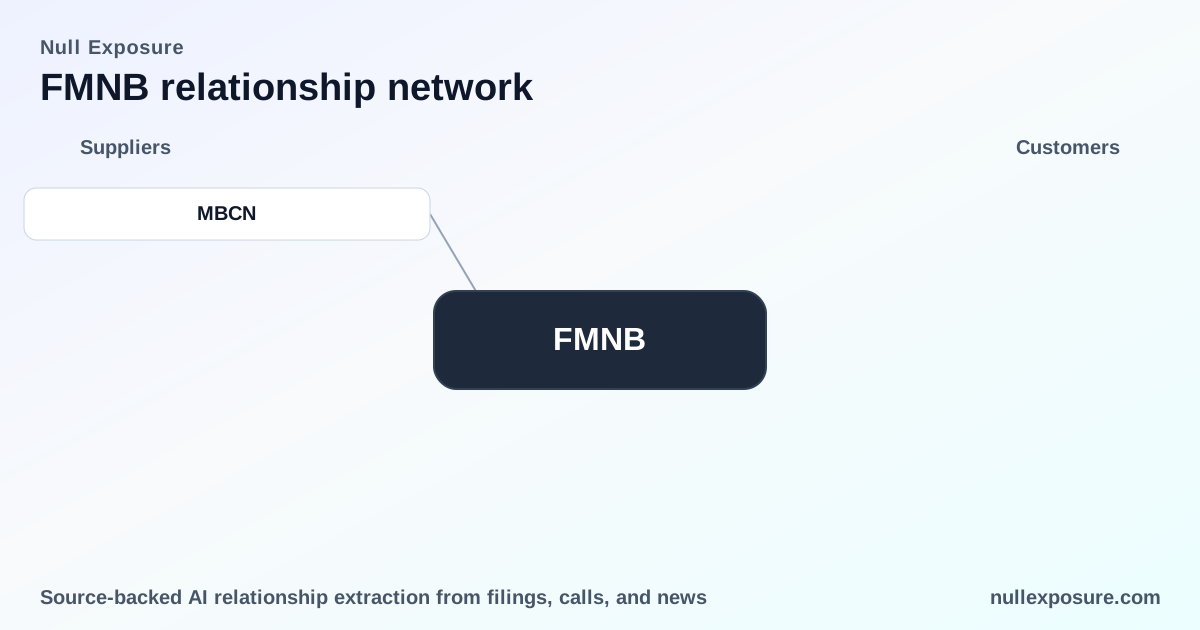
A proposed acquisition of Middlefield Banc Corp. (Nasdaq: MBCN) by Farmers National Banc Corp. was reported in market notices in early 2026. FMNB is pursuing a deal to acquire Middlefield, a transaction that extends FMNB’s branch and deposit footprint, consistent with its prior M&A behavior. The news was documented in a Morningstar/PR Newswire posting on March 9, 2026, outlining investor alerts and commentary related to the sale process. (Source: Morningstar/PR Newswire, March 9, 2026.)
Why the Middlefield deal matters to suppliers and operations
Acquisitions change supplier dynamics in three ways: immediate integration spend, potential vendor consolidation, and longer-term renegotiation of contracts. For FMNB:
- Transaction-driven vendor demand will be concentrated in IT integration, core banking migration, and facilities consolidation, increasing short-term spend in those categories.
- Acquired branches and assets carry embedded landlord and lease obligations, which can shift the company’s operational footprint and long-term lease profile.
Investors should expect a measurable but manageable spike in integration costs, offset by deposit synergies and expanded fee opportunities if the transaction closes under favorable terms.
Contracting posture and company-level constraints (what filings and excerpts show)
The public constraints extracted from FMNB disclosures paint a consistent operating posture:
- Long-term lease exposure is material to contract horizon: company filings show right-of-use assets and lease liabilities of approximately $9.7M and $9.9M as of December 31, 2024, reflecting leases with terms up to 16.6 years and extension options. This signals a stable, long-duration facilities footprint that favors landlords and makes rapid network contraction costly.
- Third-party vendors are essential service providers: FMNB explicitly depends on external vendors for key infrastructure, creating concentrated operational risk that requires active vendor management and continuity planning.
- Spending on certain contracts sits in the $1M–$10M band: the lease liability scale offers a proxy for contract spend magnitude, implying mid-sized vendor commitments rather than hyper-scale outsourcing deals.
- Non-core captive insurance activities are immaterial: pooled captive arrangements exist but do not represent material revenue or risk concentration for the firm.
These constraints describe a bank with stable, long-dated operational commitments and mid-sized vendor relationships, rather than a firm built on highly elastic, short-term supplier contracts.
Operational and financial implications for investors and counterparty managers
- Integration risk is tactical, not strategic. The Middlefield acquisition increases near-term integration work and vendor engagement, but FMNB’s balance sheet and low beta (0.81) support measured execution.
- Vendor concentration is a core governance item. Because FMNB depends on third-party providers for critical functions, counterparties should expect rigorous contractual standards, SLAs, and business-continuity requirements.
- Lease structure reduces flexibility. Long-duration leases with extension options mean the bank cannot quickly exit locations without bearing economic cost, which elevates the importance of lease-renegotiation capability for any supplier of facilities or branch services.
- Spend scale calibrates risk appetite. With vendor spend generally in the $1M–$10M band, suppliers should tailor solutions to mid-market contract sizes rather than enterprise-scale pricing structures.
Major risks to watch (concise)
- Execution risk on M&A integration—integration overruns or failed IT migrations would pressure margins.
- Vendor concentration and operational resilience—outsourced infrastructure failures could cause outsized operational impacts.
- Lease liabilities limit network flexibility, raising the cost of branch rationalization if market dynamics change.
For a complete supplier risk profile and to monitor third-party signals in real time, see https://nullexposure.com/.
Bottom line: what operators and investors should take away
FMNB is a steady, acquisition-capable regional bank with a predictable revenue model and deliberate vendor posture. The proposed Middlefield acquisition reinforces a growth-through-transaction strategy that will require targeted vendor engagement and incremental integration spend but does not fundamentally alter FMNB’s capital or operating model. Vendor managers should prioritize contractual robustness and continuity planning; investors should credit the company’s history of margin stability and cautious M&A execution while monitoring integration KPIs.
If you manage vendor exposure or underwrite M&A-related services, review FMNB’s supplier map and transaction history at https://nullexposure.com/ to align engagement strategy with balance-sheet reality.