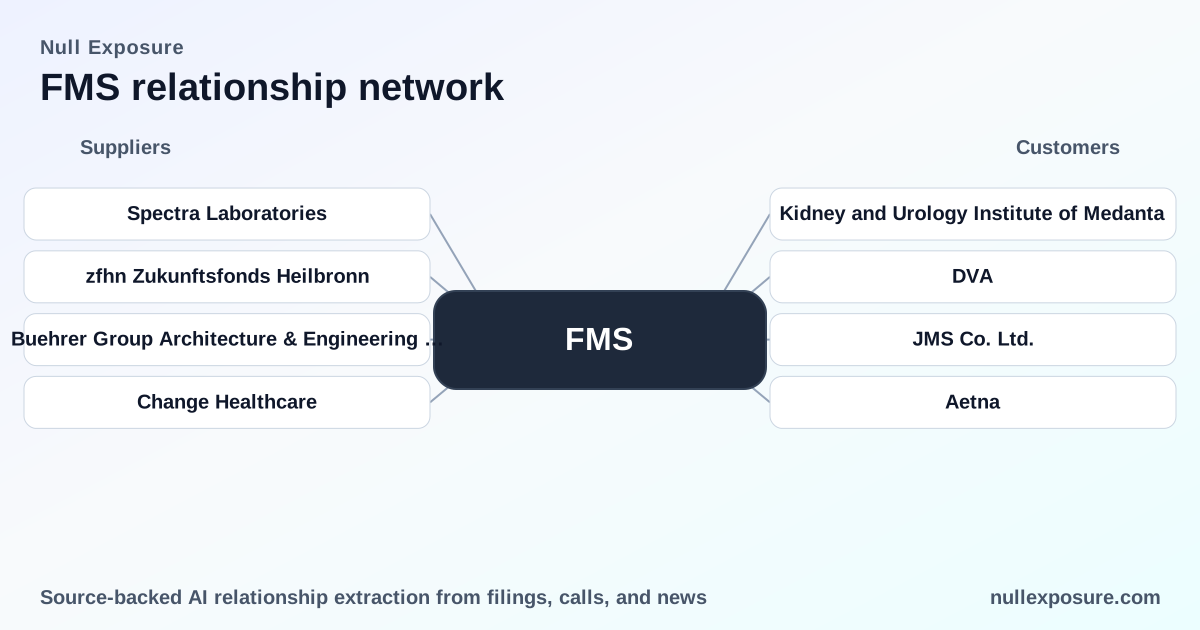
Fresenius Medical Care (FMS): supplier footprint and what it means for enterprise risk and value
Fresenius Medical Care operates the world’s largest dialysis services and products platform, monetizing through a dual model: recurring revenue from clinic operations and consumables plus equipment sales and services tied to treatment volumes. That mix produces steady cash flow but leaves the company exposed to supplier continuity for lab testing, IT services, and capital projects—areas that compound operational and reputational risk for operators and investors alike. For a concise supplier-risk dashboard and ongoing monitoring, visit https://nullexposure.com/.
Why suppliers matter to Fresenius investors
Fresenius’s financial profile—roughly $19.6bn revenue and $2.62bn EBITDA, with market capitalization near $13.3bn—reflects a mature healthcare operator with meaningful operating leverage to volume and pricing. The business is highly operational: clinical throughput, regulatory compliance, and patient outcomes depend on third-party vendors for diagnostics, IT, construction and M&A-sourced assets. That creates four practical characteristics for supplier analysis:
- Contracting posture: Fresenius negotiates at scale and integrates M&A targets into its supply chain, giving it bargaining power but also creating integration complexity when it acquires vendor-dependent assets.
- Concentration: Core services are geographically diversified, which reduces single-market exposure, but specialized suppliers (lab services, IT platforms) can be single points of failure for material cash flows and operations.
- Criticality: Suppliers tied directly to clinical delivery (labs, IT, equipment maintenance) are mission-critical and have outsized operational impact.
- Maturity: FMS is an established firm with stable margins and low beta, indicating supplier relationships are generally entrenched and contractual; however, the company’s scale does not eliminate operational risk from discrete supplier failures.
For ongoing supplier intelligence and portfolio monitoring, go to https://nullexposure.com/.
Supplier relationships: company-by-company read
Below are the supplier and partner mentions surfaced in public reporting and commentary. Each item is summarized in plain English with source context.
Spectra Laboratories
Fresenius’s FY2025 communications list selected asset divestitures from Spectra Laboratories, indicating the company executed targeted disposals of lab-test related assets as part of portfolio optimization and regional restructurings. According to a Fresenius press release addressing FY2025 results, selected assets of Spectra Laboratories in the U.S. were relinquished alongside other regional disposals. Source: company news release on Fresenius Medical Care website (FY2025) — https://freseniusmedicalcare.com/de/medien/newsroom/fresenius-medical-care-erzielt-im-jahr-2024-ein-ergebniswachstum-von-18prozent-und-wird-die-wachstumsdynamik-auch-im-jahr-2025-fortsetzen/.
zfhn Zukunftsfonds Heilbronn
Fresenius purchased the Med‑Tech company Xenios AG from the German venture investor zfhn Zukunftsfonds Heilbronn, reflecting the company’s acquisition-driven approach to expand clinical capability and proprietary technology. Healthcare-in-Europe covered the FY2016 transaction documenting the sale of Xenios to Fresenius Medical Care. Source: Healthcare‑in‑Europe coverage of the Xenios sale (FY2016) — https://healthcare-in-europe.com/de/news/xenios-ag-wird-an-fresenius-medical-care-verkauft.html.
Buehrer Group Architecture & Engineering Inc.
Local reporting on a U.S. clinic build identifies Buehrer Group Architecture & Engineering as the architect for a Fresenius Kidney Care facility in Wilmington, demonstrating Fresenius’s use of regional A/E firms for clinic expansion projects and property-level delivery. WNewsJ reported the construction project in FY2018 naming Buehrer Group as architect. Source: local project reporting (2018) — https://www.wnewsj.com/2018/10/23/fresenius-kidney-care-constructing-a-dialysis-clinic-in-wilmington/.
Change Healthcare
Fresenius referenced cash-flow disruptions stemming from the Change Healthcare cyber incident in 2024 as a material operational headwind; management adjusted cash-flow assessment windows accordingly in Q3 2025 commentary. The Q3 2025 earnings call transcript available through investor commentary platforms cited the Change Healthcare incident as a meaningful short-term cash-flow disruption. Source: Q3 2025 earnings call transcript coverage (InsiderMonkey) — https://www.insidermonkey.com/blog/fresenius-medical-care-ag-co-kgaa-nysefms-q3-2025-earnings-call-transcript-1640434/.
What these relationships imply for investors and operators
- Operational concentration on third-party clinical services and IT is a persistent risk. The Change Healthcare incident is a concrete example of how an external vendor event translates directly into cash-flow volatility and management commentary adjustments.
- Fresenius uses M&A and selective divestitures to re-shape supplier exposure. The Spectra Laboratories asset sales and the Xenios acquisition demonstrate an active portfolio approach: the company acquires technology where it needs control and divests non-core lab assets to streamline operations.
- Capital projects rely on local contractors. Architecture and construction partners like Buehrer Group reveal that facility-level execution is decentralized, which introduces execution risk across different jurisdictions.
Key investment takeaway: Fresenius combines predictable, scale-driven revenue with discrete supplier-driven operational risk. Investors should underwrite earnings stability but stress-test cash flows around vendor incidents and integration cycles.
For active monitoring and a supplier risk scorecard tailored to healthcare operators, visit https://nullexposure.com/.
Practical due diligence checklist for FMS supplier risk
- Verify continuity plans and SLAs for mission-critical vendors (labs, data/IT, equipment maintenance).
- Confirm integration timelines and cost synergies for any recent or announced acquisitions.
- Check region-level vendor concentration where Fresenius operates facilities prone to regulatory or reimbursement variability.
Conclusion — how to act on this read
Fresenius Medical Care is a mature operator whose valuation and margin profile depend on stable clinic throughput and reliable supplier networks. The company’s supplier-related exposures are tangible and actionable: cyber incidents and asset rationalizations directly affect cash flow and strategy. Investors and operators should combine financial monitoring with targeted supplier due diligence to protect operational continuity and valuation. For deeper supplier mapping and alerts, return to https://nullexposure.com/.