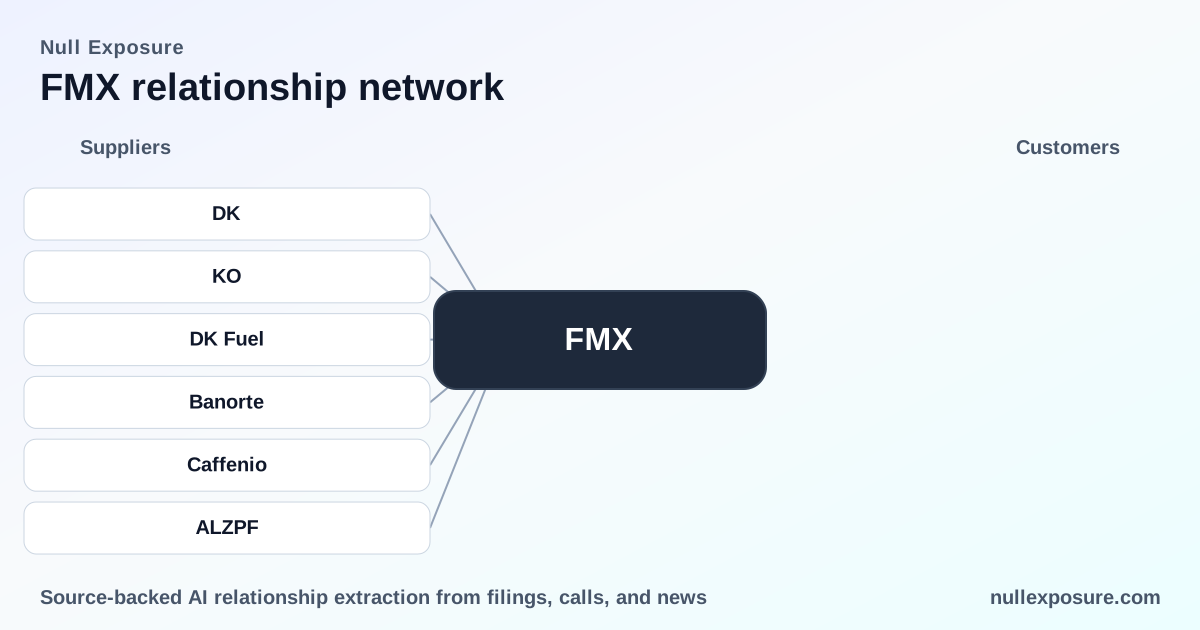
FEMSA (FMX): Bottler, Retailer, and a Supplier Footprint That Drives Cash Flow
FEMSA operates two tightly integrated monetization engines: franchise Coca‑Cola bottling and a large convenience‑store retail network (Oxxo), with ancillary businesses in fuel and health services that monetize through branded partnerships, retail margins, and distribution agreements. The company converts scale in beverage distribution into recurring cash flow while using Oxxo as a high‑frequency retail channel to cross‑sell logistics and payment services; recent U.S. expansion via acquisitions materially shifts the supplier counterparty map for investors evaluating FMX exposure. For a deeper supplier and counterparty lens, visit https://nullexposure.com/ for primary research and relationship mapping.
How FEMSA actually makes money — plain and strategic
FEMSA’s core economics are simple and durable: bottling margins on Coca‑Cola brands plus retail profit on millions of Oxxo transactions. Revenue sits at scale (Revenue TTM ~ 840.95 billion MXN per the company overview) and the operating model is vertically integrated across distribution, merchandising, and retail operations, which creates recurring supplier relationships for packaging, fuel, logistics, and banking/payment services. This verticality also makes some supplier relationships operationally critical and long‑dated in practice.
- Contracting posture: FEMSA operates with a mix of long‑term franchise agreements (bottling), multi‑year retail supply contracts, and localized fuel/merchant partnerships—a posture that favors continuity over spot sourcing.
- Concentration and criticality: Coca‑Cola bottling rights are strategically critical and heavily concentrated; losing or renegotiating those contracts would materially affect revenue. Oxxo’s roll‑out and fuel partnerships create additional but less concentrated dependencies.
- Maturity: The firm’s supplier relationships are mature in core markets (Mexico, Latin America) and in flux where it is expanding (U.S. convenience retail), so expect a hybrid profile: established anchors and dynamic new counterparty commitments.
If you’re mapping counterparties across FMX for underwriting or portfolio due diligence, our relationship summaries below consolidate all cited ties in the public record. Get a visual map and raw source links at https://nullexposure.com/ — the quickest route to actionable counterparty intelligence.
Key counterparties and what they mean for investors
Delek US Holdings (DK)
FEMSA completed a late‑2024 acquisition of 249 convenience stores from Delek US Holdings, providing an immediate U.S. retail footprint that is being rebranded as Oxxo and represents FEMSA’s operational entry into the U.S. convenience channel. Source: CSP Daily News and related coverage discussing the October 2024 purchase (reported March 2026).
Delek (DK) — related mentions
Multiple reports treat Delek and Delek US Holdings as the seller of the 249 stores that became Oxxo locations; the transaction value cited in media was roughly $385 million and is central to FEMSA’s U.S. growth narrative. Source: InsiderMonkey and CSP Daily News coverage from FY2025–FY2026 reporting periods.
DK Fuel (owned by Delek)
FEMSA’s acquired U.S. locations will retain an existing fuel‑branding relationship with DK Fuel, indicating FEMSA’s retail expansion does not immediately displace existing fuel supply/branding contracts and that fuel partners remain operational stakeholders at converted sites. Source: CSP Daily News articles covering Oxxo U.S. operations and fuel partnerships (FY2025–FY2026).
The Coca‑Cola Company (KO)
FEMSA is one of the world’s largest Coca‑Cola franchise bottlers, operating bottling, distribution, and merchandising for Coca‑Cola brands—this relationship supplies the core product flow and underpins a large portion of FEMSA’s gross profits. Source: MarketBeat, FinViz, and multiple FY2026 news summaries describing FEMSA’s franchise bottler role.
Banorte
FEMSA referenced Banorte in investor calls as part of its payment or banking network rollout, indicating banking or financial services partnerships that support retail payment infrastructure and growth in value‑added services. Source: InsiderMonkey transcription of FEMSA’s FY2026 Q4 earnings call.
Caffenio
FEMSA cited a long‑standing partnership with Caffenio as an operational simplifier for in‑store coffee offerings, illustrating how FEMSA sources specialty foodservice concessions to standardize store operations and drive incremental margins. Source: InsiderMonkey earnings call reporting (FY2026).
Alon (ALZPF)
Media reports indicate that converted U.S. sites will retain a branded fuel partnership with Alon at some locations, reflecting multi‑partner fuel arrangements that coexist with FEMSA’s retail rebranding and limiting short‑term operational disruption. Source: CSP Daily News coverage of Oxxo U.S. expansion (FY2025–FY2026).
What these relationships imply for suppliers, operators, and investors
FEMSA’s supplier map is a mix of high‑criticality, long‑dated beverage partnerships (Coca‑Cola) and more modular retail partnerships (fuel brands, local suppliers, payment processors). The Coca‑Cola bottling franchise is the structural backbone; retail acquisitions (Delek/Delek US) shift exposure to new U.S. suppliers and preserve incumbent fuel-brand relationships (DK Fuel, Alon), reducing immediate integration risk but increasing counterparty coordination complexity.
- Risk factors: High dependence on Coca‑Cola for product flow; operational integration risk from cross‑border retail acquisitions; fuel supply and branding fragmentation at newly acquired sites.
- Opportunity: Rapid U.S. footprint expansion gives FEMSA scale to negotiate better procurement terms, monetize cross‑sell (payments, logistics), and export Oxxo operating standards to acquired stores.
Visit https://nullexposure.com/ to see how these counterparty dynamics influence supplier concentration analysis and exposure modelling.
Practical takeaways for investment and operations teams
- Balance of stability and change: The Coca‑Cola relationship provides durable revenue but the recent Delek purchase creates a period of supplier onboarding and dual‑brand operations that require monitoring.
- Operational risk is manageable if integration preserves fuel and banking partnerships; the public record shows FEMSA is keeping several incumbent arrangements in place to smooth conversions.
- Monitor three vectors: bottler franchising terms, Oxxo conversion cadence in the U.S., and fuel/merchant contract renewals—these will determine margin trajectory and counterparty concentration over the next 12–24 months.
For a full mapping of FEMSA’s supplier exposures and a downloadable counterparty data pack, return to https://nullexposure.com/ — our homepage hosts the primary research and direct source links used above.
Conclusion — a measured, actionable view
FEMSA combines highly strategic bottling rights with an aggressive retail expansion play that imports new supplier relationships into its operating model. Investors should treat Coca‑Cola as the operational anchor and the Delek acquisition (with ongoing DK Fuel/Alon fuel ties) as a catalytic event that increases near‑term integration risk but also expands revenue channels. For investors and operators underwriting FMX exposure, the immediate priority is tracking conversion progress on those 249 U.S. stores and the status of fuel and payment partnerships that determine short‑run cash conversion and long‑term margin uplift.
Explore the underlying source links and get a relationship map that aligns with investment workflows at https://nullexposure.com/.