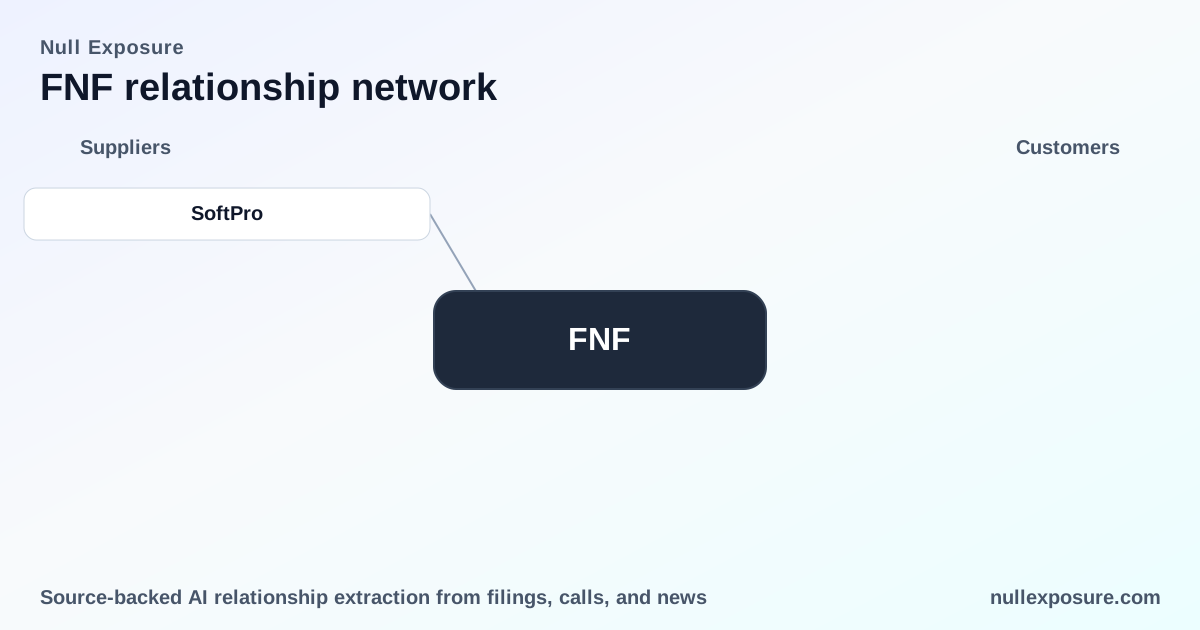
Fidelity National Financial (FNF): supplier posture, platform moves, and what investors should price
Fidelity National Financial monetizes primarily through title insurance premiums and related transaction services, supplemented by specialty insurance and fee-based investment and annuity businesses (notably the F&G segment). The company drives margins through scale in title processing, ancillary settlement services and by leveraging third‑party asset managers for investment income; operational efficiency and vendor relationships that support platform consolidation are therefore direct drivers of profitability. Investors should treat supplier changes — especially platform migrations and outsourced service contracts — as material levers on margin trajectory and execution risk.
Explore more supplier signals and supplier risk profiles at https://nullexposure.com/.
Platform consolidation is a strategic lever — and a near-term execution cost
FNF is actively migrating operations onto a common processing stack as part of its digital strategy. That migration reduces long-term unit costs and creates a single operating footprint for title and settlement operations, but the transition generates short-term variability in results and operational risk.
- Short-term pain, long-term scale: management described continued migration activity through FY2026, which creates transitional operational disruption but also underpins future margin expansion.
- Outsourcing is baked into the model: FNF’s filings show the company regularly uses third‑party service providers across administration, IT and hosting — a deliberate contracting posture that trades direct control for flexibility and lower fixed cost.
According to FNF’s FY2026 earnings call transcripts and market reporting, the company continued migrating operations to the SoftPro platform throughout the year (comments recorded in March 2026). See the earnings call coverage in The Globe and Mail and an earnings transcript published on InsiderMonkey in March 2026, and a FinancialContent market piece from February 2026 that links the migration to the inHere platform strategy.
SoftPro — the active supplier relationship you must track
FNF is migrating operational workflows onto the SoftPro operating system as part of its inHere platform integration; that migration was still underway through FY2026 and carried into the fourth quarter. According to the FY2026 earnings call transcript reported by The Globe and Mail (March 2026) and an InsiderMonkey transcript of the Q4 2025 earnings call (March 2026), management confirmed ongoing migration activity to SoftPro. FinancialContent coverage from February 2026 also linked inHere platform expansion to deeper SoftPro integration.
- The practical takeaway: SoftPro is a live, material supplier relationship tied to FNF’s core title processing operations; performance and timing of the migration will influence near‑term title margins and processing throughput.
Sources: The Globe and Mail earnings call transcript (March 2026); InsiderMonkey Q4 2025 earnings transcript (March 2026); FinancialContent market coverage (Feb 2026).
What the filings say about contracting posture and third‑party roles
Company disclosures provide clear signals about FNF’s supplier strategy and risk profile:
- Contracting posture — flexible, often short‑term: the company discloses agency agreements that are typically terminable without cause on 30 days’ notice or immediately for cause, reflecting a low‑duration contracting approach that prioritizes operational flexibility over long-term lock‑ins.
- Outsourcing breadth — substantial and deliberate: FNF’s F&G segment explicitly outsources new business administration, policy servicing, call centers, IT development and co‑located data center hosting, among other functions. This is a structural design choice that shifts fixed cost and staffing risk to third parties while keeping capital light.
- Named asset management relationships: filings include Investment Management Agreements with Blackstone ISG‑I Advisors (documented in the company’s Form 10‑Q exhibits for the quarter ended Sept 30, 2022), indicating material use of external asset managers for investment operations in certain segments.
- Active financing posture: the company’s Sixth Amended and Restated Credit Agreement dated Feb 16, 2024 is incorporated in its filings, which signals an active credit facility consistent with liquidity and working‑capital management for an insurer with transaction‑driven cash flows.
These points come from the company’s public filings (Form 10‑Q exhibits and a Form 8‑K filed Feb 16, 2024) and are company‑level signals about how suppliers and counterparties fit into FNF’s operating model. Treat these as structural attributes: short notice termination rights, broad outsourcing, external asset managers, and an active syndicated credit facility.
Operational and risk implications for investors and operators
The supplier posture generates a distinct set of risks and optionality that bears on valuation and procurement strategy:
- Execution risk during migration: platform moves (SoftPro) create phased disruption risk to throughput and margin recognition; monitor quarter‑to‑quarter processing metrics and title margin reconciliation.
- Vendor concentration and single‑stack risk: consolidating on one operating system reduces unit costs but increases dependency on that supplier’s uptime, release cadence and integration quality.
- Contract flexibility vs. lock‑in: short‑term agency agreements give FNF flexibility to change vendors quickly, which is beneficial for cost control but raises transition risk and vendor churn exposure.
- Control of investment outcomes: using third‑party asset managers (e.g., Blackstone ISG‑I) externalizes investment-management execution — this improves professional management but introduces counterparty and fee structures that affect net investment spread.
If you are underwriting FNF credit or evaluating equity risk, focus on three operational KPIs: title processing throughput, conversion and settlement cycle times, and third‑party incident / downtime disclosures. For procurement teams, prioritize SLAs, rollback and contingency plans around any critical system migration.
Learn more about how supplier signals affect portfolio decisions at https://nullexposure.com/.
Practical next steps for due diligence
- Demand migration run‑rate and defect metrics tied to the SoftPro program; require historical incident logs and change management evidence.
- Verify contractual termination provisions and transition assistance clauses in agency agreements to measure true vendor portability.
- Review the scope and fees of Investment Management Agreements with external managers to understand net yield sensitivity.
- Stress test title margin models under multi‑quarter migration scenarios and measure balance‑sheet liquidity under the active credit agreement.
Bottom line and where to go from here
FNF’s supplier posture is strategic: platform consolidation (SoftPro) is the near‑term execution story that drives margin upside, while broad outsourcing and short‑term agency contracts create both flexibility and operational dependency. Investment managers should price a balance of transitional execution risk and structural margin leverage into forward earnings assumptions.
For a consolidated view of supplier exposures and to monitor new relationship signals as they surface, visit https://nullexposure.com/.